Prologue
There are people who simply work, simply fly. And there are those who turn cinematography into art, aviation into revolution, and the sky into their home. Clay Lacy is exactly such a person. His story begins in the small town of Wichita in 1932 and spans decades of progress, records, and discoveries that forever changed the world of private aviation.
There are people who simply work, simply fly. And there are those who turn cinematography into art, aviation into revolution, and the sky into their home. Clay Lacy is exactly such a person. His story begins in the small town of Wichita in 1932 and spans decades of progress, records, and discoveries that forever changed the world of private aviation.

Chapter 1: The Birth of a Dream in Aviation's Cradle
On August 14, 1932, in Wichita, Kansas, a boy was born who was destined to rewrite established rules. Wichita is not accidentally called the cradle of American aviation – it is here where the air is saturated with the smell of aviation fuel and the hum of propellers. Twelve-year-old Clay was already working at the local airfield, daily absorbing the magic of flight. The metal birds taking off and landing around him were not just machines – they were the embodiment of freedom.
By nineteen, this lean young man from Kansas had logged nearly 2,000 hours. Imagine: most of his peers were still learning to drive cars, while he was already an experienced pilot and instructor. January 1952 became a pivotal moment – Lacy donned the uniform of a United Airlines co-pilot and first sat at the controls of a Douglas DC-3 at Los Angeles International Airport.
The next four decades were a symphony of impeccable mastery. Convair 340, Douglas DC-4, DC-6, DC-7, DC-8, DC-10, Boeing 727, and – the crown of his career – the Boeing 747-400. Not a single accident, not one serious incident. Only sky, only flight, only perfection. When Clay left the United Airlines cockpit in 1992, aviation lost one of its greatest masters.
Chapter 2: Revolution Begins in Van Nuys
But Clay Lacy was not created to simply follow airline schedules. In his soul burned the fire of an entrepreneur dreaming to create something fundamentally new. 1968. Van Nuys Airport in California. A few aircraft, boundless enthusiasm, and a revolutionary idea: what if private aviation could be not just luxury, but a new standard of travel?
Clay Lacy Aviation was born not in a corporate boardroom, but in the dreams of a man who understood the sky better than the road home. Hollywood stars and businessmen quickly realized: this guy from Kansas was offering them not just flight, but an experience. And when the company owner himself sits at the controls and pilots your flight, it's not just business – it's art.
Over the decades, Lacy logged more than 55,000 hours on 300 types of aircraft, including 32 jets. Each flight was not merely movement from point A to point B – it was a journey with a master for whom the sky had become home.
Chapter 3: The Purple Demon with Snoopy
Parallel to business development, another passion lived in Lacy's soul – speed. From 1964 to 1972, the sky over America was regularly cut by a purple P-51 Mustang with the funny character Snoopy on its tail. This aircraft became a legend of unlimited class air racing, and its pilot became an idol to thousands of spectators.
Picture this: the roaring engine of a World War II fighter, a pilot in goggles and helmet racing over the ground at breathtaking speed. 1970 brought Lacy a national championship, and 1971 became a year of triumph: victories in the Milwaukee-St. Louis race, the Fighter Pilot Tournament, and the Great London-to-Victoria race in a Learjet.
But the real madness was the 1970 Mojave race when Lacy and Allen Paulson decided to compete in a four-engine Douglas DC-7 nicknamed Super Snoopy. A heavy transport airliner in a fighter race? This was genius bordering on insanity. Finishing sixth with an average speed of 325 mph proved: for a true pilot, nothing is impossible.
Chapter 4: The Birth of Learjet and Friendship with Genius
Early 1960s. William Powell Lear – inventor, visionary, madman – was working on a project that would change the world of business aviation. A compact, fast, elegant jet aircraft for corporate clients. But how to make it not just flying, but perfect?
Lear knew the answer: he needed a pilot with golden hands and an instinct for perfection. Clay Lacy became the man who helped turn idea into legend. Countless trips to Wichita, endless consultations, testing every detail – this is how the Learjet was born.
October 1964 forever entered aviation history: Lacy ferried a new Learjet 23 from Wichita to Los Angeles, making it the first corporate jet at Van Nuys Airport. Hollywood fell in love with this silver bird instantly. Frank Sinatra became one of the first buyers – and this was just the beginning.
1965 brought a feat that seemed impossible: Lacy and National Guard pilot Jack Conroy completed a transcontinental flight from Los Angeles to New York and back on a Learjet in one day. For the first time in history, a business jet crossed the United States both ways between sunrise and sunset. Speed ceased to be just a characteristic – it became a philosophy.
Chapter 5: Fleet Evolution – From Dream to Empire
The history of Clay Lacy Aviation is not just a chronicle of a company, it's a chronicle of private aviation evolution. In 1968, everything began with a few Learjets – compact silver birds capable of carrying up to 8 passengers and racing 2,600 kilometers at 860 km/h.
By the 1970s, the fleet had grown to 30 aircraft. Gulfstream and Bombardier joined, bringing the comfort of long-distance flights. The 1980s and 1990s became a period of expansion: Dassault Falcon with their French elegance, British "aristocrats" Hawker, and versatile Cessna Citation.
Today Clay Lacy Aviation manages a sky empire: more than 100 business jets with a combined value exceeding 1.5 billion dollars. Boeing BBJ – flying palaces for corporate leaders. Airbus ACJ – European luxury in the heavens. Gulfstream G650 and G550 – the embodiment of speed and comfort. Bombardier Global – for those conquering continents. Each aircraft in this fleet is not just a machine, but an instrument for realizing dreams.
Chapter 6: When Sky Becomes Cinematography
The mid-1970s brought Clay another revelation. What if films could be shot not from the ground looking up at the sky, but the opposite – from the sky, capturing flight dynamics as seen by a pilot? Thus was born the Astrovision system – a revolutionary air-to-air filming camera mounted on a Learjet.
Imagine: a jet aircraft races parallel to fighters, capturing every movement, every maneuver. Lacy personally piloted during filming, turning each frame into a masterpiece. More than 2,000 projects, each adding realism and adrenaline to cinematography.
Top Gun (1986) – iconic F-14 Tomcat flight footage that took your breath away. Firefox (1982) with Clint Eastwood – the tension of high-altitude flight. The Concorde... Airport '79 – the elegance of a supersonic liner. Armageddon (1998) – the cosmic scale of disaster. Each of these films became more intense thanks to a man who understood both cinema and aviation flying in the sky.
Learjet N564CL – Screen Star
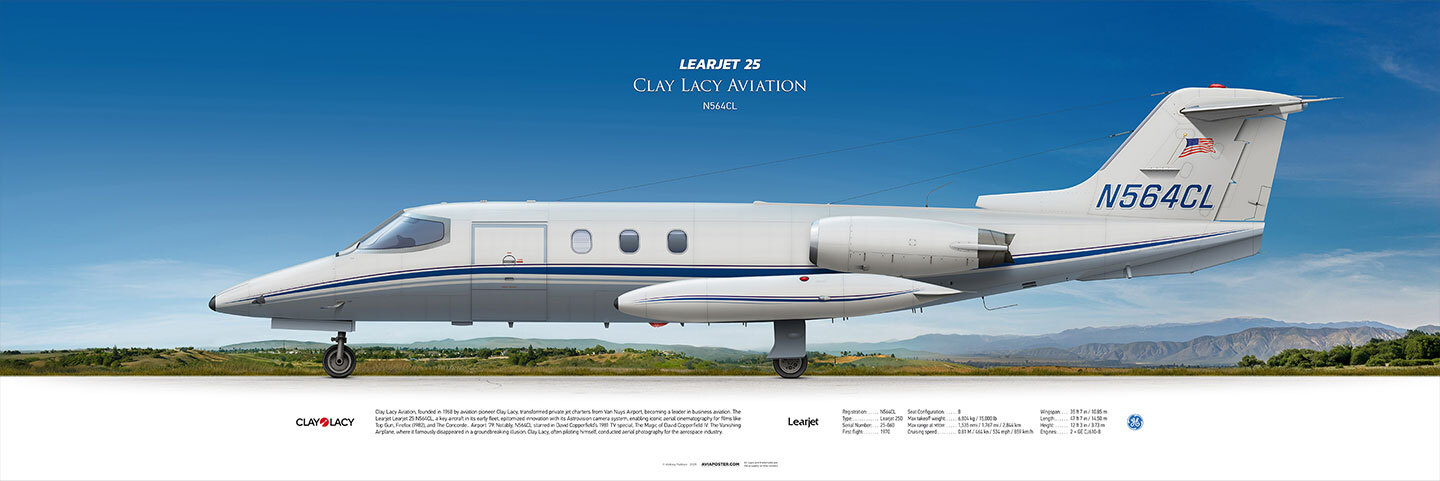
Among all aircraft in the Clay Lacy Aviation fleet, Learjet 25 N564CL holds a special place. This compact beauty became a true Hollywood star. Equipped with the Astrovision system, it participated in filming iconic movies, but the most unusual episode in its career was participation in David Copperfield's television show.
1981. The Magic of David Copperfield IV: The Vanishing Airplane. Before an astonished audience, the famous illusionist made an entire airplane disappear. N564CL with its elegant design proved the perfect partner for such a large-scale trick. In that moment, aviation and magic merged, creating a spectacle remembered by millions of viewers.
Chapter 7: Partnership with NASA – From Hollywood to Space
Lacy's talent in aerial photography did not go unnoticed beyond Hollywood. NASA and the aerospace industry needed someone who could capture history from a bird's eye view. And since 1965, Clay's lens has recorded thousands of moments that entered the chronicle of astronautics.
Space Shuttle launches, experimental aircraft test flights, prototype testing – all this required not just a photographer, but a pilot-artist capable of flying at extreme altitudes and speeds. Each frame was not just a photograph – these were data for engineers, stories for posterity, testimony to human genius in striving for the stars.
Projects for Boeing, Lockheed, and other aerospace giants strengthened Clay Lacy Aviation's reputation as a company capable of solving any task in the sky. The FAA and NBAA awarded Lacy for innovations, recognizing his contribution to industry development.
Chapter 8: Records and Recognition
29 world speed records – each one the story of a separate feat. But 1988 and the Boeing 747SP Friendship One hold a special place. A 37-hour round-the-world flight that became not just a record, but a charitable mission that raised $530,000 for children's organizations.
Imagine: a giant airliner racing across the planet, with a man in its cockpit for whom the impossible is just another task. Every mile of that flight was proof that with sufficient passion and skill, any height can be reached.
2010 brought induction into the National Aviation Hall of Fame – recognition reserved only for true legends. The "Pathfinder" award from the Seattle Museum of Flight, the FAA Wright Brothers "Master Pilot" Award, induction into the Kansas Aviation Hall of Fame – each award was deserved recognition of a life dedicated to the sky.
From 2016 to 2020, the Los Angeles Business Journal included Lacy in the list of the city's 500 most influential people. At 92, this man remains an inspiration to thousands of pilots, entrepreneurs, and dreamers worldwide.
Epilogue: Legacy Soaring in the Clouds
Today Clay Lacy Aviation is not just a company, it's a philosophy. A philosophy that the sky has no boundaries for those ready to dream and work. From humble beginnings at Van Nuys Airport to a global network with hubs in major cities worldwide – the path the company has traveled reflects the life of Clay Lacy himself.
His autobiography "Lucky Me" (2010) bears a modest title, but behind this modesty lies a life full of achievements. Lucky? Perhaps. But this is the luck of a man who created his own fortune with his own hands, who turned passion into profession, and dreams into reality.
Clay Lacy Aviation aircraft still fly over California's skies. Each takeoff is a continuation of a story that began nearly a century ago with a boy from Wichita who dreamed of flight. Each landing is a new chapter in a book written by a man who made the sky his home.
Clay Lacy didn't just conquer the sky – he gave this opportunity to thousands of other people. And in this, perhaps, lies his greatest record – a record of inspiration that cannot be measured by speed, altitude, or distance. This record is measured only by the number of lives he helped change.