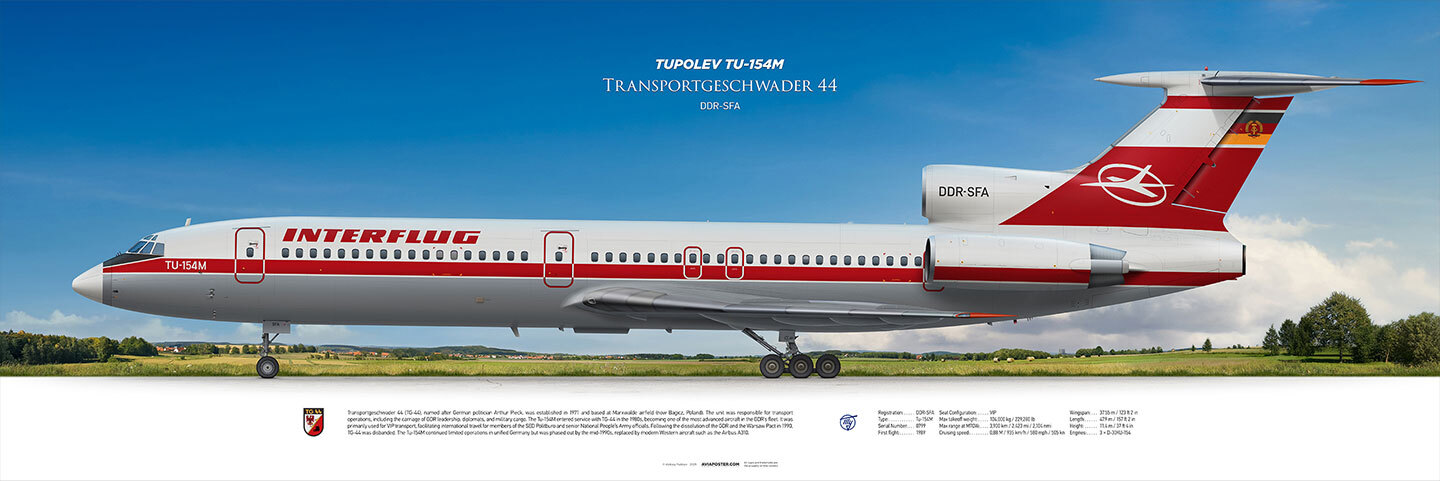
In the final year of the German Democratic Republic's existence, two special aircraft appeared in the sky, becoming witnesses to one of the most dramatic periods in European history. We're talking about a pair of Tu-154Ms that entered service with Transportgeschwader 44 – an elite unit responsible for transporting the leadership of socialist Germany.
Transportgeschwader 44
The story began in 1971 when a special transport unit of the GDR Air Force was formed at Marxwalde airfield in Brandenburg. Named after Arthur Pieck – a prominent German politician, TG-44 became the true "wings" of East German leaders.
The unit's fleet was impressive for a small country: Soviet Il-18, Il-62, Tu-134 aircraft and Mi-8 helicopters provided all the state's aviation transport needs – from diplomatic missions to military cargo transport. But the real jewels of the fleet were to be two brand-new Tu-154Ms.
Unexpected Guests from the East
The paradox was that the GDR's national airline Interflug never operated the Tu-154, despite the country's membership in the Warsaw Pact and close ties with the Soviet Union. Its fleet consisted of smaller Tu-134s and larger Il-62s, bypassing this aircraft that was popular throughout the socialist world.
Everything changed in late 1989 when TG-44 received two brand-new Tu-154Ms – a modernized version of the Soviet medium-range airliner. The aircraft with serial numbers 89A-815 (DDR-SFA) and 89A-816 (DDR-SFB) were true flying palaces: three Kuznetsov D-30KU-154 engines provided a range of approximately 6,500 kilometers, and the cabins were refitted for high-ranking officials – with conference rooms and sleeping quarters.
An interesting feature of these government aircraft was their disguise. Instead of military livery, they wore the colors of the civilian airline Interflug and carried ordinary civilian registration numbers. Such a trick was necessary to obtain unimpeded flight clearances to foreign countries.
The philosophy was simple: government aircraft should look like ordinary passenger airliners, even if they were equipped completely differently inside. This was characteristic of an era when socialist leaders preferred modesty to ostentatious luxury.
Short Service in a Changing World
The Tu-154Ms entered TG-44 service at the most inappropriate historical moment. 1989 became the year of the socialist bloc's collapse, and soon the GDR itself ceased to exist. The two practically new aircraft served East German leadership for only a very short time.
After German reunification in 1990, TG-44 was disbanded, and both Tu-154Ms were transferred to the Luftwaffe – the air force of unified Germany. They received new registration numbers: 11+01 and 11+02, and continued to perform VIP transport duties, as well as participating in observation flights under the Open Skies Treaty from 1992.
The further paths of the two aircraft diverged dramatically.
The first aircraft – 11+01 (formerly DDR-SFA), was withdrawn from service and replaced by the more modern Airbus A310, receiving a second life in Iran. In 1991, it was transferred to Iran Air Tours with the new registration EP-ITD. Later, from 2005 to 2008, the aircraft operated with Eram Air under the number EP-EAK. In 2011, the veteran was finally withdrawn from service and sent to storage in Iran, where it probably remains to this day.
The second aircraft – 11+02 (formerly DDR-SFB) – met a tragic end. On September 13, 1997, it collided in mid-air with an American C-141B at a distance of 65 miles off the coast of Namibia. The accident, caused by an error in airspace coordination, claimed the lives of 24 people aboard the Tu-154M and 9 crew members of the American aircraft. Both machines were completely destroyed.
Legacy of the Iron Curtain
The story of the Tu-154M in TG-44 service is a brief but symbolic chapter in Germany's aviation chronicle. These aircraft witnessed the fall of the Berlin Wall, German reunification, and the integration of the former GDR into the Western world.
Today, the memory of TG-44 is preserved in archival documents and museum exhibitions at Marxwalde airfield. This story reminds us of how aviation reflected the political changes of the era, and that even the most modern aircraft can become hostages to historical circumstances.
The two Tu-154Ms are not just the story of aircraft, but the tale of an entire country's transformation from socialism to capitalism, from the Warsaw Pact to NATO, from a divided Germany to a unified nation. And although the machines themselves did not survive to our days, their story remains a vivid example of how aviation serves as a reflection of its era.
Transportgeschwader 44
The story began in 1971 when a special transport unit of the GDR Air Force was formed at Marxwalde airfield in Brandenburg. Named after Arthur Pieck – a prominent German politician, TG-44 became the true "wings" of East German leaders.
The unit's fleet was impressive for a small country: Soviet Il-18, Il-62, Tu-134 aircraft and Mi-8 helicopters provided all the state's aviation transport needs – from diplomatic missions to military cargo transport. But the real jewels of the fleet were to be two brand-new Tu-154Ms.
Unexpected Guests from the East
The paradox was that the GDR's national airline Interflug never operated the Tu-154, despite the country's membership in the Warsaw Pact and close ties with the Soviet Union. Its fleet consisted of smaller Tu-134s and larger Il-62s, bypassing this aircraft that was popular throughout the socialist world.
Everything changed in late 1989 when TG-44 received two brand-new Tu-154Ms – a modernized version of the Soviet medium-range airliner. The aircraft with serial numbers 89A-815 (DDR-SFA) and 89A-816 (DDR-SFB) were true flying palaces: three Kuznetsov D-30KU-154 engines provided a range of approximately 6,500 kilometers, and the cabins were refitted for high-ranking officials – with conference rooms and sleeping quarters.
An interesting feature of these government aircraft was their disguise. Instead of military livery, they wore the colors of the civilian airline Interflug and carried ordinary civilian registration numbers. Such a trick was necessary to obtain unimpeded flight clearances to foreign countries.
The philosophy was simple: government aircraft should look like ordinary passenger airliners, even if they were equipped completely differently inside. This was characteristic of an era when socialist leaders preferred modesty to ostentatious luxury.
Short Service in a Changing World
The Tu-154Ms entered TG-44 service at the most inappropriate historical moment. 1989 became the year of the socialist bloc's collapse, and soon the GDR itself ceased to exist. The two practically new aircraft served East German leadership for only a very short time.
After German reunification in 1990, TG-44 was disbanded, and both Tu-154Ms were transferred to the Luftwaffe – the air force of unified Germany. They received new registration numbers: 11+01 and 11+02, and continued to perform VIP transport duties, as well as participating in observation flights under the Open Skies Treaty from 1992.
The further paths of the two aircraft diverged dramatically.
The first aircraft – 11+01 (formerly DDR-SFA), was withdrawn from service and replaced by the more modern Airbus A310, receiving a second life in Iran. In 1991, it was transferred to Iran Air Tours with the new registration EP-ITD. Later, from 2005 to 2008, the aircraft operated with Eram Air under the number EP-EAK. In 2011, the veteran was finally withdrawn from service and sent to storage in Iran, where it probably remains to this day.
The second aircraft – 11+02 (formerly DDR-SFB) – met a tragic end. On September 13, 1997, it collided in mid-air with an American C-141B at a distance of 65 miles off the coast of Namibia. The accident, caused by an error in airspace coordination, claimed the lives of 24 people aboard the Tu-154M and 9 crew members of the American aircraft. Both machines were completely destroyed.
Legacy of the Iron Curtain
The story of the Tu-154M in TG-44 service is a brief but symbolic chapter in Germany's aviation chronicle. These aircraft witnessed the fall of the Berlin Wall, German reunification, and the integration of the former GDR into the Western world.
Today, the memory of TG-44 is preserved in archival documents and museum exhibitions at Marxwalde airfield. This story reminds us of how aviation reflected the political changes of the era, and that even the most modern aircraft can become hostages to historical circumstances.
The two Tu-154Ms are not just the story of aircraft, but the tale of an entire country's transformation from socialism to capitalism, from the Warsaw Pact to NATO, from a divided Germany to a unified nation. And although the machines themselves did not survive to our days, their story remains a vivid example of how aviation serves as a reflection of its era.