Aircraft in Addition
The story of how All Nippon Airways became an A380 operator is a convoluted one: the Japanese airline had no enthusiasm for the type, yet ultimately found itself forced to take it on.
It all began in January 2015, when Japanese low-cost carrier Skymark Airlines declared bankruptcy. Skymark had struggled to introduce its A330 fleet and had also placed an order for five A380s it could no longer afford. ANA was eager to acquire Skymark's slots at Tokyo's Haneda Airport, but to win the restructuring bid it needed to outmanoeuvre a consortium led by Delta Air Lines. Airbus ultimately threw its support behind ANA's proposal — and in December 2015, the Japanese carrier took on three of the five A380s originally destined for Skymark.
In doing so, ANA became the owner of a fleet it had never wanted. With few viable route options for just three of the world's largest jets, the airline created a dedicated service for them.
A Competition, a Turtle, and 930 Stencils
The story of the Flying Honu livery began long before the first flight — in autumn 2016, when ANA launched an open international competition to design the paint scheme for its future A380s. Between October and November 2016, the airline received 2,197 submissions from around the world. The winner was chosen by an in-house selection committee.
The grand prize went to Tokyo-based Chihiro Masuoka for his concept "Sea Turtle Family," depicting Hawaiian green sea turtles — symbols of good luck and prosperity. As his prize, Masuoka received two round-trip business class tickets on the Tokyo–Honolulu route, as well as a model of the A380 wearing his own livery. Four runners-up also received commemorative gifts from the airline. Among the finalists were the creators of the design "Stephen+Cayden" — a father and his six-year-old son from Hawaii, who had drawn a beach scene with marine flora and fauna, and himself swimming in the water. The child's drawing was enough to melt the hearts of the judging panel.
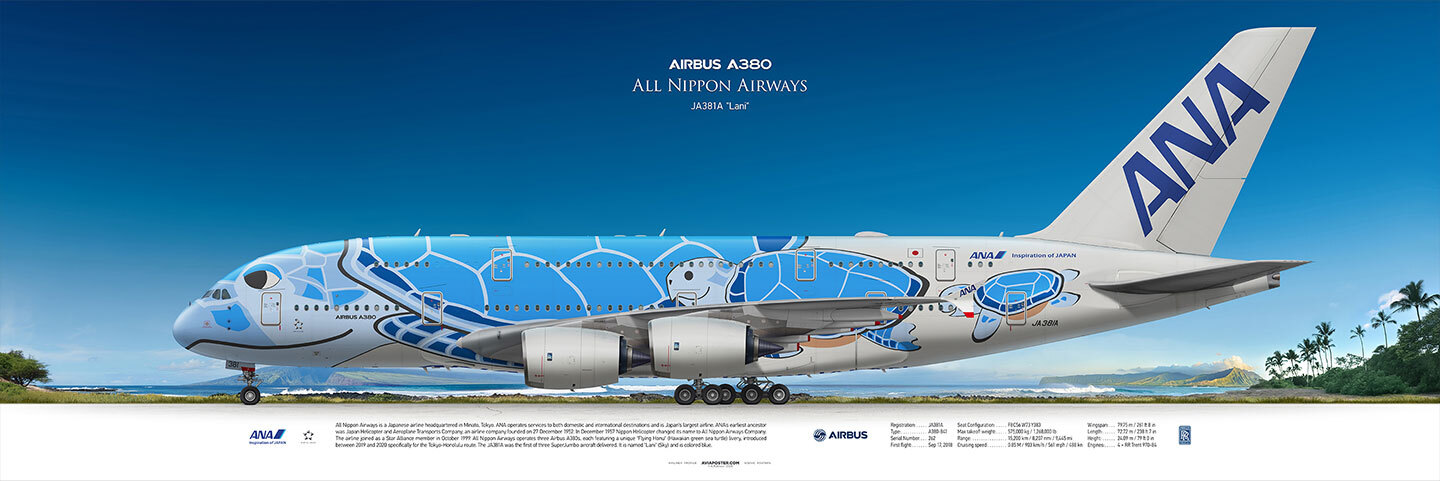
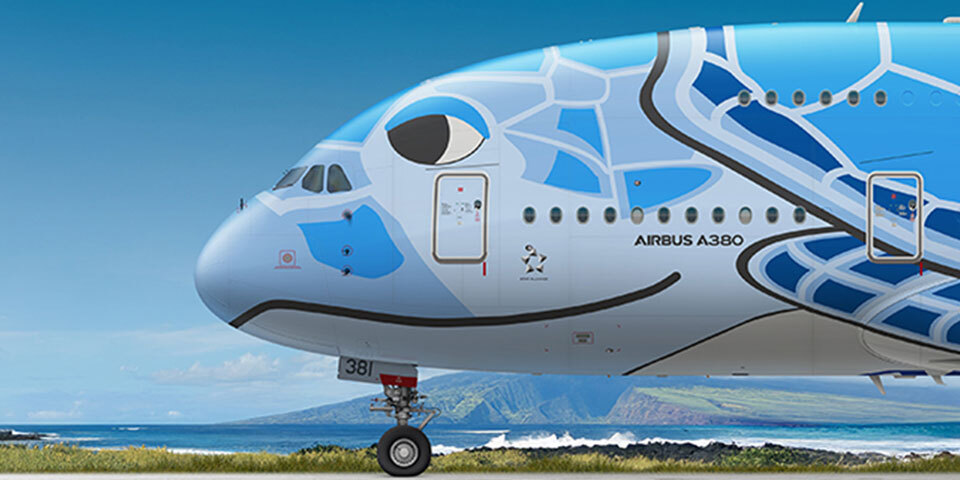
Masuoka's idea was both simple and sweeping in scale: the fuselage of each aircraft features three turtles — one enormous, one large, and one small — forming a family. The core design is identical across all three aircraft, with differences only in colour and the expression on the face of the largest turtle. As a result, these Hawaiian green sea turtles hold the distinction of being the largest animal paintings ever applied to the side of an aircraft.
The three liveries form a poetic triptych of Hawaiian nature. The first aircraft, named "Lani" — sky in Hawaiian — is painted blue. The second, "Kai," meaning ocean, wears emerald green. The third, "Ka La," sunset, is dressed in orange. All three names come from the Hawaiian language and together conjure an image of the islands seen from above: sky, sea, and a sun sinking below the horizon.
The Hamburg Paint Shop: A Stencil Record
Once the design was approved, the first aircraft spent 21 days in Airbus's paint facility in Hamburg. For Airbus, it was a genuine ordeal.
"This was the most difficult livery we have ever applied to an A380," admitted Ralph Maurer, head of the Hamburg paint centre. "We needed 16 different colours and 930 stencils, whereas we would normally use around 150."
The reason for such an extraordinary number of stencils was Airbus's deliberate decision to forgo decals entirely: every element of the design was built up layer by layer using spray guns alone. The total fuselage surface area measures approximately 1,500 square metres, and painting it required 8,000 man-hours — considerably more than the 13 days a standard livery would take. The paint itself added around 600 kilograms to the aircraft's weight — within acceptable limits, but the labour involved was in a different league entirely.
The result is something the aviation world now refers to simply as a work of art — and that is said of an object 73 metres long.
The story of how All Nippon Airways became an A380 operator is a convoluted one: the Japanese airline had no enthusiasm for the type, yet ultimately found itself forced to take it on.
It all began in January 2015, when Japanese low-cost carrier Skymark Airlines declared bankruptcy. Skymark had struggled to introduce its A330 fleet and had also placed an order for five A380s it could no longer afford. ANA was eager to acquire Skymark's slots at Tokyo's Haneda Airport, but to win the restructuring bid it needed to outmanoeuvre a consortium led by Delta Air Lines. Airbus ultimately threw its support behind ANA's proposal — and in December 2015, the Japanese carrier took on three of the five A380s originally destined for Skymark.
In doing so, ANA became the owner of a fleet it had never wanted. With few viable route options for just three of the world's largest jets, the airline created a dedicated service for them.
A Competition, a Turtle, and 930 Stencils
The story of the Flying Honu livery began long before the first flight — in autumn 2016, when ANA launched an open international competition to design the paint scheme for its future A380s. Between October and November 2016, the airline received 2,197 submissions from around the world. The winner was chosen by an in-house selection committee.
The grand prize went to Tokyo-based Chihiro Masuoka for his concept "Sea Turtle Family," depicting Hawaiian green sea turtles — symbols of good luck and prosperity. As his prize, Masuoka received two round-trip business class tickets on the Tokyo–Honolulu route, as well as a model of the A380 wearing his own livery. Four runners-up also received commemorative gifts from the airline. Among the finalists were the creators of the design "Stephen+Cayden" — a father and his six-year-old son from Hawaii, who had drawn a beach scene with marine flora and fauna, and himself swimming in the water. The child's drawing was enough to melt the hearts of the judging panel.
Masuoka's idea was both simple and sweeping in scale: the fuselage of each aircraft features three turtles — one enormous, one large, and one small — forming a family. The core design is identical across all three aircraft, with differences only in colour and the expression on the face of the largest turtle. As a result, these Hawaiian green sea turtles hold the distinction of being the largest animal paintings ever applied to the side of an aircraft.
The three liveries form a poetic triptych of Hawaiian nature. The first aircraft, named "Lani" — sky in Hawaiian — is painted blue. The second, "Kai," meaning ocean, wears emerald green. The third, "Ka La," sunset, is dressed in orange. All three names come from the Hawaiian language and together conjure an image of the islands seen from above: sky, sea, and a sun sinking below the horizon.
The Hamburg Paint Shop: A Stencil Record
Once the design was approved, the first aircraft spent 21 days in Airbus's paint facility in Hamburg. For Airbus, it was a genuine ordeal.
"This was the most difficult livery we have ever applied to an A380," admitted Ralph Maurer, head of the Hamburg paint centre. "We needed 16 different colours and 930 stencils, whereas we would normally use around 150."
The reason for such an extraordinary number of stencils was Airbus's deliberate decision to forgo decals entirely: every element of the design was built up layer by layer using spray guns alone. The total fuselage surface area measures approximately 1,500 square metres, and painting it required 8,000 man-hours — considerably more than the 13 days a standard livery would take. The paint itself added around 600 kilograms to the aircraft's weight — within acceptable limits, but the labour involved was in a different league entirely.
The result is something the aviation world now refers to simply as a work of art — and that is said of an object 73 metres long.
What's Inside?
ANA's aircraft are configured for 520 passengers across four cabin classes. The upper deck houses 8 first class seats in a 1-2-1 layout, 56 business class seats in a 1-2-1 layout, and 73 premium economy seats in a 2-3-2 layout. The lower deck is home to 383 economy seats in a 3-4-3 configuration.
The Tokyo–Honolulu route marked the first time ANA introduced a first class product on this service. Previously, the route had been treated as a predominantly leisure destination and was not considered to warrant that level of service.
Particular attention deserves the economy cabin: 60 seats follow the ANA COUCHii concept — a first among Japanese carriers. Much like Air New Zealand's Sky Couch, these seats allow passengers to fold up the leg rests and transform a row of three or four seats into a makeshift sleeping surface, complete with a mattress and duvet.
A Paradox: Loss-Making but Beloved
The Flying Honu flights got off to a surprisingly strong start: by early 2020, ANA was recording year-on-year passenger growth of 49% on the route and was planning to expand the schedule to 14 weekly frequencies. Then the pandemic intervened.
The picture today is more complicated. In 2023, the average two-way load factor stood at around 69%, but figures deteriorated in 2024 — partly due to the weak yen, which has made Hawaii an expensive destination for Japanese travellers.
Industry analysts believe that the nonstop Hawaii service is operating at a loss. Yet ANA has invested so heavily in this fleet that retiring the aircraft is simply not a realistic option.
In searching for ways to cut costs, the company found an inventive solution. In late 2021, ANA introduced a mixed fleet flying programme, allowing pilots to hold type ratings on both the A320 and the A380 simultaneously. This is a first among A380 operators worldwide — and it meaningfully reduces the cost of maintaining such a small sub-fleet.
In Summary
The ANA Flying Honu is one of the most striking examples of corporate necessity becoming cultural phenomenon. Aircraft that nobody asked for have become a symbol of Japan's enduring love affair with Hawaii, and a benchmark for leisure flying across the Pacific — commercial ambiguity and all.
ANA's aircraft are configured for 520 passengers across four cabin classes. The upper deck houses 8 first class seats in a 1-2-1 layout, 56 business class seats in a 1-2-1 layout, and 73 premium economy seats in a 2-3-2 layout. The lower deck is home to 383 economy seats in a 3-4-3 configuration.
The Tokyo–Honolulu route marked the first time ANA introduced a first class product on this service. Previously, the route had been treated as a predominantly leisure destination and was not considered to warrant that level of service.
Particular attention deserves the economy cabin: 60 seats follow the ANA COUCHii concept — a first among Japanese carriers. Much like Air New Zealand's Sky Couch, these seats allow passengers to fold up the leg rests and transform a row of three or four seats into a makeshift sleeping surface, complete with a mattress and duvet.
A Paradox: Loss-Making but Beloved
The Flying Honu flights got off to a surprisingly strong start: by early 2020, ANA was recording year-on-year passenger growth of 49% on the route and was planning to expand the schedule to 14 weekly frequencies. Then the pandemic intervened.
The picture today is more complicated. In 2023, the average two-way load factor stood at around 69%, but figures deteriorated in 2024 — partly due to the weak yen, which has made Hawaii an expensive destination for Japanese travellers.
Industry analysts believe that the nonstop Hawaii service is operating at a loss. Yet ANA has invested so heavily in this fleet that retiring the aircraft is simply not a realistic option.
In searching for ways to cut costs, the company found an inventive solution. In late 2021, ANA introduced a mixed fleet flying programme, allowing pilots to hold type ratings on both the A320 and the A380 simultaneously. This is a first among A380 operators worldwide — and it meaningfully reduces the cost of maintaining such a small sub-fleet.
In Summary
The ANA Flying Honu is one of the most striking examples of corporate necessity becoming cultural phenomenon. Aircraft that nobody asked for have become a symbol of Japan's enduring love affair with Hawaii, and a benchmark for leisure flying across the Pacific — commercial ambiguity and all.