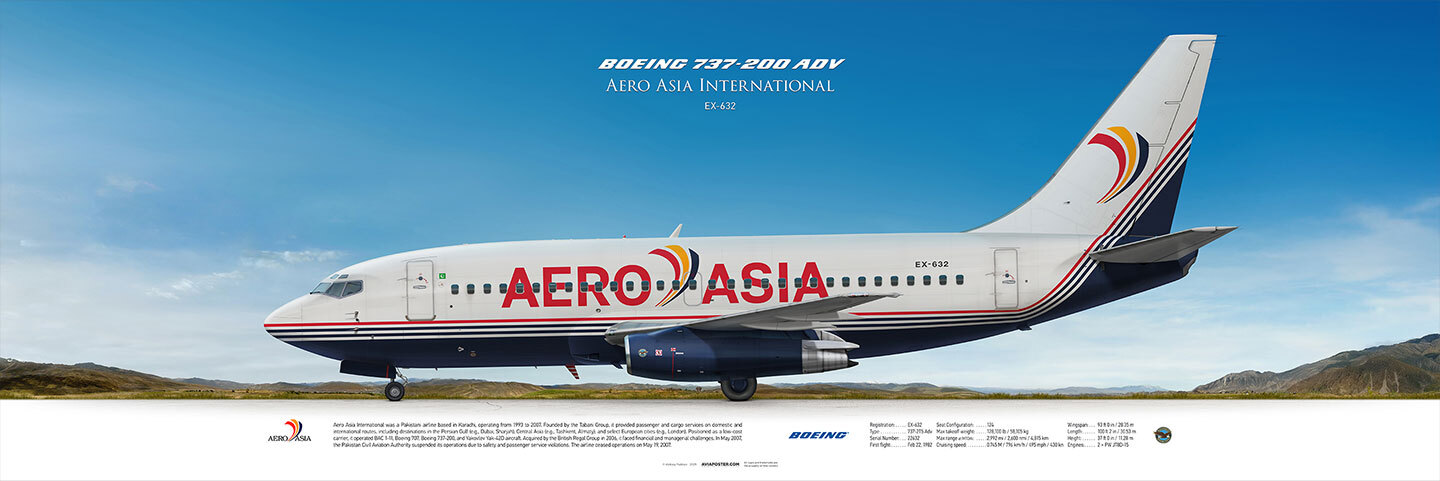
In the early 1990s, Pakistan’s aviation industry stood on the cusp of transformation. The deregulation of the airline market opened opportunities for private enterprises to challenge the dominance of the state-owned Pakistan International Airlines (PIA). Among the new entrants was Aero Asia International, a Karachi-based airline founded with ambitions to redefine affordable air travel in the region. Established in 1993 by the Tabani Group, a prominent Pakistani conglomerate with interests in trade and commerce, Aero Asia aimed to capture a niche as a low-cost carrier, offering passenger and cargo services on domestic and international routes. This is the story of its rise, struggles, and eventual closure—a narrative that mirrors the volatile nature of Pakistan’s aviation industry.
Genesis and Objectives
Aero Asia International was created to make air travel accessible to Pakistanis and meet the growing demand for regional connectivity. Leveraging its business expertise, the Tabani Group identified an opportunity to serve the expanding middle class and the Pakistani diaspora in the Persian Gulf. The airline positioned itself as a budget carrier, promising affordable fares without compromising service quality. Its operational hub in Karachi, Pakistan’s economic center, provided strategic access to both domestic and international markets.
The airline’s fleet was modest but diverse, comprising older yet reliable aircraft such as the BAC 1-11, Boeing 707, McDonnell Douglas DC-9 and MD-80, Boeing 737-200, and the Soviet-designed Yakovlev Yak-42D, leased from the Russian company Tulpar in Kazan. Though not state-of-the-art, these aircraft were cost-effective for a startup aiming to minimize expenses. Aero Asia’s early operations focused on domestic routes, linking major Pakistani cities like Karachi, Lahore, and Islamabad. However, its ambitions extended beyond Pakistan, encompassing popular destinations in the Persian Gulf, such as Dubai and Sharjah, and Central Asian cities like Tashkent and Almaty. The airline also ventured into select European markets, with London serving as a key destination for the Pakistani community in the United Kingdom.
Expansion and Operations
By the late 1990s, Aero Asia had solidified its presence in the regional aviation market. Its low-cost model resonated with price-sensitive travelers, particularly those flying between Pakistan and the Persian Gulf, where a sizable Pakistani diaspora resided. Cargo services also generated a steady client base, transporting goods to trade hubs in the Middle East and Central Asia. Aero Asia’s ability to serve both passenger and cargo segments provided a competitive edge, enabling it to diversify revenue streams in a challenging industry.
The selection of aircraft reflected Aero Asia’s pragmatic approach. The BAC 1-11 and Boeing 737-200, despite their age, were suitable for short- and medium-haul routes, while the Boeing 707 handled cargo and long-haul flights. The inclusion of the Yak-42D, a rare aircraft in South Asia, underscored the airline’s willingness to experiment with cost-effective solutions, even if it meant navigating the complexities of maintaining Soviet-era equipment. This eclectic fleet allowed Aero Asia to adapt flexibly to the demands of its varied routes.
Challenges and Acquisition
Despite early successes, Aero Asia faced significant obstacles. The aviation industry, notorious for high operational costs and low profitability, posed constant challenges. Fluctuating fuel prices, maintenance expenses for an aging fleet, and competition from major carriers like PIA and Gulf-based airlines strained Aero Asia’s finances. Additionally, Pakistan’s aviation sector was subject to stringent oversight, and the airline struggled to consistently meet the safety and service standards of the Pakistan Civil Aviation Authority (PCAA).
In 2006, a turning point came when the British Regal Group acquired Aero Asia, aiming to inject fresh capital. The acquisition was seen as an opportunity to revive the airline’s operations, modernize its fleet, and expand its route network. However, the transition proved difficult. Regal Group’s management faced challenges integrating their strategies with Aero Asia’s existing operations, and cultural differences between British and Pakistani business practices exacerbated the situation. Financial difficulties persisted, and the airline’s reputation suffered due to inconsistent service quality and operational disruptions.
Decline and Closure
The final chapter of Aero Asia’s story unfolded in 2007. The PCAA, citing repeated violations of safety standards and passenger service quality, suspended the airline’s Air Operator Certificate in May 2007. This decision dealt a severe blow, grounding the fleet and halting all operations. Management attempted to address the issues, but the financial and operational challenges proved insurmountable. On May 19, 2007, Aero Asia International ceased operations, concluding its 14-year journey.
The closure left a gap in Pakistan’s aviation market, particularly for budget-conscious travelers who relied on Aero Asia’s affordable fares. Employees faced job losses, and the Tabani Group, once optimistic about its aviation venture, shifted focus to other business endeavors. Regal Group’s brief stewardship failed to reverse the airline’s fortunes, highlighting the difficulties of rescuing a struggling carrier in a competitive and tightly regulated industry.
Legacy and Lessons
Aero Asia International’s history illustrates the challenges faced by private airlines in emerging markets. Its aspiration to provide affordable air travel and connect Pakistan with key regional and international destinations was commendable, but its collapse under financial pressures, regulatory hurdles, and operational inefficiencies was inevitable. The eclectic fleet and diverse route network showcased innovation but also exposed the airline to risks of overextension and reliance on outdated technology.
In the broader context of Pakistan’s aviation history, Aero Asia serves as a case study in the risks of undercapitalization and the critical role of effective management in the airline industry. Its brief foray into the European market and focus on underserved Central Asian routes highlight the potential for regional carriers to fill niche gaps, yet also underscore the need for sustainable business models. Today, Aero Asia remains a footnote in Pakistan’s aviation narrative, a reminder of the high stakes and missed opportunities in the skies.
Genesis and Objectives
Aero Asia International was created to make air travel accessible to Pakistanis and meet the growing demand for regional connectivity. Leveraging its business expertise, the Tabani Group identified an opportunity to serve the expanding middle class and the Pakistani diaspora in the Persian Gulf. The airline positioned itself as a budget carrier, promising affordable fares without compromising service quality. Its operational hub in Karachi, Pakistan’s economic center, provided strategic access to both domestic and international markets.
The airline’s fleet was modest but diverse, comprising older yet reliable aircraft such as the BAC 1-11, Boeing 707, McDonnell Douglas DC-9 and MD-80, Boeing 737-200, and the Soviet-designed Yakovlev Yak-42D, leased from the Russian company Tulpar in Kazan. Though not state-of-the-art, these aircraft were cost-effective for a startup aiming to minimize expenses. Aero Asia’s early operations focused on domestic routes, linking major Pakistani cities like Karachi, Lahore, and Islamabad. However, its ambitions extended beyond Pakistan, encompassing popular destinations in the Persian Gulf, such as Dubai and Sharjah, and Central Asian cities like Tashkent and Almaty. The airline also ventured into select European markets, with London serving as a key destination for the Pakistani community in the United Kingdom.
Expansion and Operations
By the late 1990s, Aero Asia had solidified its presence in the regional aviation market. Its low-cost model resonated with price-sensitive travelers, particularly those flying between Pakistan and the Persian Gulf, where a sizable Pakistani diaspora resided. Cargo services also generated a steady client base, transporting goods to trade hubs in the Middle East and Central Asia. Aero Asia’s ability to serve both passenger and cargo segments provided a competitive edge, enabling it to diversify revenue streams in a challenging industry.
The selection of aircraft reflected Aero Asia’s pragmatic approach. The BAC 1-11 and Boeing 737-200, despite their age, were suitable for short- and medium-haul routes, while the Boeing 707 handled cargo and long-haul flights. The inclusion of the Yak-42D, a rare aircraft in South Asia, underscored the airline’s willingness to experiment with cost-effective solutions, even if it meant navigating the complexities of maintaining Soviet-era equipment. This eclectic fleet allowed Aero Asia to adapt flexibly to the demands of its varied routes.
Challenges and Acquisition
Despite early successes, Aero Asia faced significant obstacles. The aviation industry, notorious for high operational costs and low profitability, posed constant challenges. Fluctuating fuel prices, maintenance expenses for an aging fleet, and competition from major carriers like PIA and Gulf-based airlines strained Aero Asia’s finances. Additionally, Pakistan’s aviation sector was subject to stringent oversight, and the airline struggled to consistently meet the safety and service standards of the Pakistan Civil Aviation Authority (PCAA).
In 2006, a turning point came when the British Regal Group acquired Aero Asia, aiming to inject fresh capital. The acquisition was seen as an opportunity to revive the airline’s operations, modernize its fleet, and expand its route network. However, the transition proved difficult. Regal Group’s management faced challenges integrating their strategies with Aero Asia’s existing operations, and cultural differences between British and Pakistani business practices exacerbated the situation. Financial difficulties persisted, and the airline’s reputation suffered due to inconsistent service quality and operational disruptions.
Decline and Closure
The final chapter of Aero Asia’s story unfolded in 2007. The PCAA, citing repeated violations of safety standards and passenger service quality, suspended the airline’s Air Operator Certificate in May 2007. This decision dealt a severe blow, grounding the fleet and halting all operations. Management attempted to address the issues, but the financial and operational challenges proved insurmountable. On May 19, 2007, Aero Asia International ceased operations, concluding its 14-year journey.
The closure left a gap in Pakistan’s aviation market, particularly for budget-conscious travelers who relied on Aero Asia’s affordable fares. Employees faced job losses, and the Tabani Group, once optimistic about its aviation venture, shifted focus to other business endeavors. Regal Group’s brief stewardship failed to reverse the airline’s fortunes, highlighting the difficulties of rescuing a struggling carrier in a competitive and tightly regulated industry.
Legacy and Lessons
Aero Asia International’s history illustrates the challenges faced by private airlines in emerging markets. Its aspiration to provide affordable air travel and connect Pakistan with key regional and international destinations was commendable, but its collapse under financial pressures, regulatory hurdles, and operational inefficiencies was inevitable. The eclectic fleet and diverse route network showcased innovation but also exposed the airline to risks of overextension and reliance on outdated technology.
In the broader context of Pakistan’s aviation history, Aero Asia serves as a case study in the risks of undercapitalization and the critical role of effective management in the airline industry. Its brief foray into the European market and focus on underserved Central Asian routes highlight the potential for regional carriers to fill niche gaps, yet also underscore the need for sustainable business models. Today, Aero Asia remains a footnote in Pakistan’s aviation narrative, a reminder of the high stakes and missed opportunities in the skies.