Prologue: A Bridge Between Eras
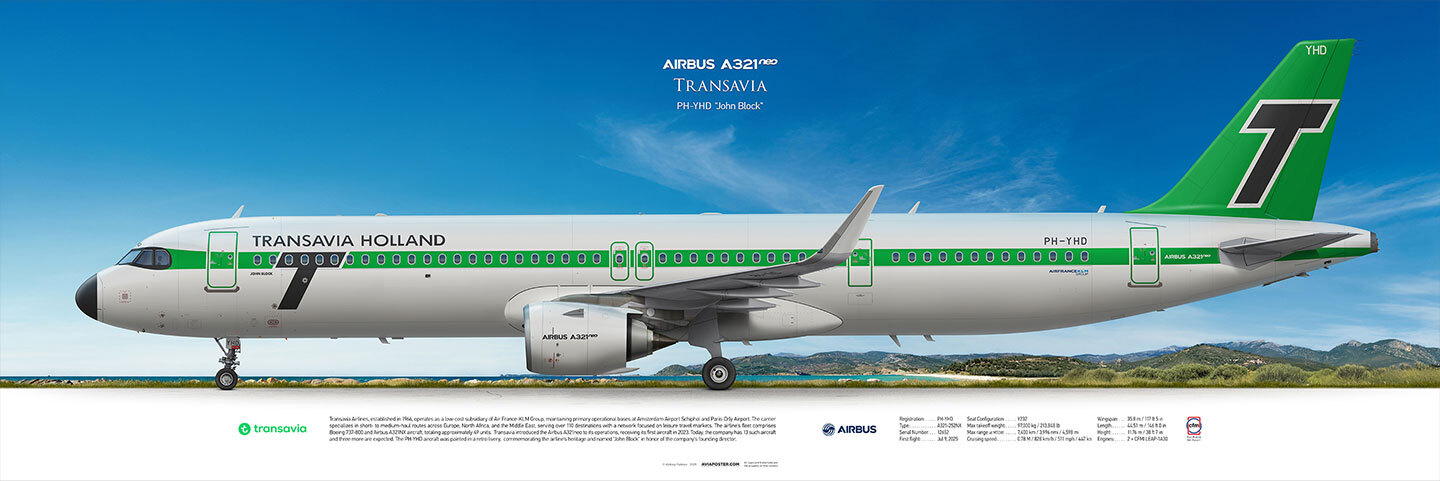
On a July morning in 2025, an Airbus A321neo gleaming with fresh paint taxied onto the apron at Amsterdam Schiphol Airport. The aircraft's retro livery sharply contrasted with the modern liveries of neighboring airliners. The large black letter "T" on the green tail caught the eyes of aviation enthusiasts—this was not merely a retro design, but a message from the past captured in the form of the most modern aircraft. By October, the name "John Block" would appear on the fuselage—a tribute to the man who nearly sixty years ago transformed a tiny company into one of the pioneers of accessible aviation.
The Golden Era of Dutch Tourism
To understand the significance of what John Block created, one must immerse oneself in the atmosphere of the Netherlands in the mid-1960s. Post-war economic recovery was gaining momentum, middle-class disposable incomes were growing, and for the first time in the country's history, ordinary citizens—teachers, office workers, laborers—began to contemplate what had previously been a privilege exclusively for the wealthy: traveling by plane to Mediterranean resorts.
Dutch aviation already had glorious traditions. KLM, founded in 1919, remained the world's oldest airline still operating under its original name. In 1960, KLM received its first jet-powered Douglas DC-8, radically reducing flight time to New York. Fokker, the Dutch aircraft manufacturer, had gained fame in the pre-war years for its reliable aircraft that connected continents. But these achievements belonged to the world of scheduled aviation and transcontinental routes. The charter market, oriented toward mass tourism, was only just beginning to emerge.
In 1958, Martinair appeared, founded by Martin Schröder (Johan Martin Schröder) and a young pilot named Johan Nicolaas Block. It was Martinair that introduced the Dutch to the concept of tourist air travel—the opportunity to fly on vacation as a group without spending a fortune. The success was evident: demand for affordable charter flights to the sunny shores of Spain, Greece, and Italy grew exponentially. The market was already waiting for new players.
On a July morning in 2025, an Airbus A321neo gleaming with fresh paint taxied onto the apron at Amsterdam Schiphol Airport. The aircraft's retro livery sharply contrasted with the modern liveries of neighboring airliners. The large black letter "T" on the green tail caught the eyes of aviation enthusiasts—this was not merely a retro design, but a message from the past captured in the form of the most modern aircraft. By October, the name "John Block" would appear on the fuselage—a tribute to the man who nearly sixty years ago transformed a tiny company into one of the pioneers of accessible aviation.
The Golden Era of Dutch Tourism
To understand the significance of what John Block created, one must immerse oneself in the atmosphere of the Netherlands in the mid-1960s. Post-war economic recovery was gaining momentum, middle-class disposable incomes were growing, and for the first time in the country's history, ordinary citizens—teachers, office workers, laborers—began to contemplate what had previously been a privilege exclusively for the wealthy: traveling by plane to Mediterranean resorts.
Dutch aviation already had glorious traditions. KLM, founded in 1919, remained the world's oldest airline still operating under its original name. In 1960, KLM received its first jet-powered Douglas DC-8, radically reducing flight time to New York. Fokker, the Dutch aircraft manufacturer, had gained fame in the pre-war years for its reliable aircraft that connected continents. But these achievements belonged to the world of scheduled aviation and transcontinental routes. The charter market, oriented toward mass tourism, was only just beginning to emerge.
In 1958, Martinair appeared, founded by Martin Schröder (Johan Martin Schröder) and a young pilot named Johan Nicolaas Block. It was Martinair that introduced the Dutch to the concept of tourist air travel—the opportunity to fly on vacation as a group without spending a fortune. The success was evident: demand for affordable charter flights to the sunny shores of Spain, Greece, and Italy grew exponentially. The market was already waiting for new players.
A Man with an Indomitable Spirit
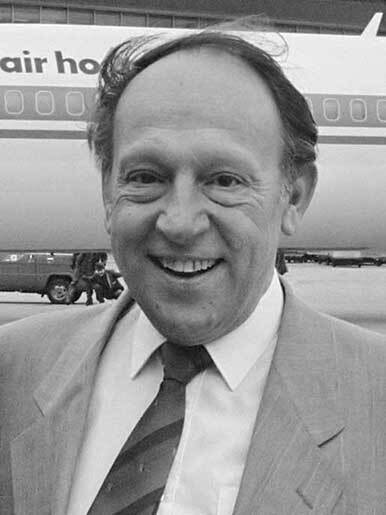
Johan Nicolaas Block, or simply John, as friends and colleagues called him, was born in 1929 in Amsterdam to a schoolteacher's family. After the war, inspired by the romance of aviation, he applied to KLM but was rejected. For many, this would have been the end of the dream. But not for Block. The rejection only strengthened his determination. He joined the Royal Netherlands Air Force, became a pilot, and then, having gained experience and understanding of the aviation business, founded Martinair together with Martin Schröder in 1958.
John was not merely a pilot—he was a visionary with entrepreneurial instincts. At Martinair, he assumed the position of chief pilot and member of management, helping the company gain altitude on the wave of the tourism boom. But by 1965, Block felt ready for new horizons. He had his own philosophy: air travel should be accessible to every citizen, not just the elite. And he decided to independently embody this idea.
The Birth of Transavia: 15 Minutes to an Icon
In the spring of 1966, American entrepreneur Chalmers Hubert "Slick" Goodlin was seeking a partner to launch a second charter airline in the Netherlands. He acquired the rights to Transavia Limburg, based in Maastricht, along with three Douglas DC-6 aircraft. This was a small company in a dormant state. Captain Piet Holmes introduced Goodlin to Block, and this meeting proved fateful. Block agreed to lead the project and became Transavia's first managing director.
Events unfolded rapidly. On June 12, 1966, Block officially assumed his position and that same month commissioned Dutch designer Thijs Postma to create a livery for the three DC-6s. Postma, a renowned aviation artist, listened to the requirements and literally sketched the design in 15 minutes: a large black letter "T" on a green background with white accents—simple, memorable, dynamic. By Friday the design was refined, by Sunday the paint was already drying on the fuselage. This lightning-fast execution of ideas became symbolic of Transavia's early phase—no bureaucracy, only action.
On November 14, 1966, the Ministry of Transport and Water Management issued Transavia an operator's license. Just two days later, on November 16, the inaugural flight took place. Captain Piet Holmes piloted the DC-6 registered as PH-TRC, named "Valkenburg," which carried the Dutch Ballet Orchestra and Dance Theatre from Amsterdam to Naples. Transavia Holland had begun its journey.
A Decade of Triumph
Success came quickly. Already in 1967, just one year after launch, Transavia transported 41,000 passengers and captured 8% of the Dutch tourist transport market. This was a phenomenal result for a startup. Block understood that speed and accessibility were key success factors. In 1968, Transavia received its first jet aircraft, a Boeing 707, becoming the first and only Dutch airline operating this type. Jet engines drastically reduced flight time, making Mediterranean resorts even more accessible.
By the mid-1970s, Block's company had grown into a major player. In 1974, Transavia became the first Dutch airline to receive the Boeing 737—an aircraft that would form the fleet's foundation for decades to come. The company signed contracts with major tour operators, organized hajj flights for pilgrims, and even transported the Dutch national football team to the 1974 World Cup. Within ten years, Transavia had captured 45% of the tourist transport market—an incredible achievement that proved the validity of Block's philosophy.
But the entrepreneurial path is rarely smooth. In 1975, following disagreements with investors, Block decided to leave the company he had created. For many founders, this would have been a bitter finale. However, Transavia continued to grow, guided by the principles Block had established: accessibility, efficiency, customer orientation.
Evolution and Continuity
After Block's departure, Transavia went through several stages of transformation. In 1991, KLM acquired 80% of Transavia's shares, and in 2003, the remaining 20%, becoming its sole owner. The subsequent merger of KLM and Air France made Transavia wholly owned by the Air France-KLM Group. From a charter airline, Transavia evolved into a low-cost carrier of European scale.
By 2025, Transavia had transformed into the second-largest airline in the Netherlands and the country's largest tourist carrier. Its fleet numbers 137 aircraft serving more than 110 destinations in nearly 30 countries. The company opened the French subsidiary Transavia France, a base in Brussels, survived the COVID-19 pandemic, and launched a major fleet renewal program, transitioning to fuel-efficient Airbus A321neos.
Symbol of Memory: PH-YHD "John Block"
In December 2021, Transavia announced an order for 20 Airbus A321neo aircraft, the first of which was delivered on December 19, 2023. But special significance was given to the twelfth A321-252NX registered as PH-YHD.
For the company's 60th anniversary, Transavia's management decided to create a special aircraft—a tribute to the founder. In July 2025, the aircraft was painted in that very same Thijs Postma livery that was born in 15 minutes in June 1966. The large black letter "T" on a green background once again adorned the fuselage of a Dutch airliner, but now on the most modern aircraft. And in October, as part of the upcoming anniversary celebrations, the name "John Block" appeared on the fuselage.
Transavia has only three aircraft bearing individual names, and PH-YHD is one of them. This aircraft became not merely an airplane, but a flying symbol embodying the paradox of continuity: it represents cutting-edge technology—fuel efficiency, reduced noise levels, increased range—cloaked in the visual image of the past.
Winged Legacy
When PH-YHD "John Block" takes to the sky, it carries something more than just passenger transport. It embodies the idea for which John Block fought: air travel is not a luxury, but an accessible way to open up the world. In 1966, a teacher or office worker from Amsterdam could for the first time afford to fly to Mediterranean shores. Today, nearly sixty years later, millions of Europeans continue to enjoy this opportunity thanks to low-cost carriers like Transavia.
The history of Transavia is a story of how one man's perseverance, rejected by KLM, can transform an entire industry. It is a story of how 15 minutes of work by a talented designer creates a visual symbol that endures for decades. It is a story of how ideas laid down in the 1960s continue to shape the reality of the 21st century.
In 2026, Transavia will celebrate its 60th anniversary. The aircraft PH-YHD "John Block" will fly throughout Europe and the Mediterranean, reminding everyone who sees its recognizable livery: accessibility is not a contradiction, but an alliance. This is exactly how John Block envisioned the future of aviation—a man who did not accept rejection, changing the skies over the Netherlands.
Johan Nicolaas Block, or simply John, as friends and colleagues called him, was born in 1929 in Amsterdam to a schoolteacher's family. After the war, inspired by the romance of aviation, he applied to KLM but was rejected. For many, this would have been the end of the dream. But not for Block. The rejection only strengthened his determination. He joined the Royal Netherlands Air Force, became a pilot, and then, having gained experience and understanding of the aviation business, founded Martinair together with Martin Schröder in 1958.
John was not merely a pilot—he was a visionary with entrepreneurial instincts. At Martinair, he assumed the position of chief pilot and member of management, helping the company gain altitude on the wave of the tourism boom. But by 1965, Block felt ready for new horizons. He had his own philosophy: air travel should be accessible to every citizen, not just the elite. And he decided to independently embody this idea.
The Birth of Transavia: 15 Minutes to an Icon
In the spring of 1966, American entrepreneur Chalmers Hubert "Slick" Goodlin was seeking a partner to launch a second charter airline in the Netherlands. He acquired the rights to Transavia Limburg, based in Maastricht, along with three Douglas DC-6 aircraft. This was a small company in a dormant state. Captain Piet Holmes introduced Goodlin to Block, and this meeting proved fateful. Block agreed to lead the project and became Transavia's first managing director.
Events unfolded rapidly. On June 12, 1966, Block officially assumed his position and that same month commissioned Dutch designer Thijs Postma to create a livery for the three DC-6s. Postma, a renowned aviation artist, listened to the requirements and literally sketched the design in 15 minutes: a large black letter "T" on a green background with white accents—simple, memorable, dynamic. By Friday the design was refined, by Sunday the paint was already drying on the fuselage. This lightning-fast execution of ideas became symbolic of Transavia's early phase—no bureaucracy, only action.
On November 14, 1966, the Ministry of Transport and Water Management issued Transavia an operator's license. Just two days later, on November 16, the inaugural flight took place. Captain Piet Holmes piloted the DC-6 registered as PH-TRC, named "Valkenburg," which carried the Dutch Ballet Orchestra and Dance Theatre from Amsterdam to Naples. Transavia Holland had begun its journey.
A Decade of Triumph
Success came quickly. Already in 1967, just one year after launch, Transavia transported 41,000 passengers and captured 8% of the Dutch tourist transport market. This was a phenomenal result for a startup. Block understood that speed and accessibility were key success factors. In 1968, Transavia received its first jet aircraft, a Boeing 707, becoming the first and only Dutch airline operating this type. Jet engines drastically reduced flight time, making Mediterranean resorts even more accessible.
By the mid-1970s, Block's company had grown into a major player. In 1974, Transavia became the first Dutch airline to receive the Boeing 737—an aircraft that would form the fleet's foundation for decades to come. The company signed contracts with major tour operators, organized hajj flights for pilgrims, and even transported the Dutch national football team to the 1974 World Cup. Within ten years, Transavia had captured 45% of the tourist transport market—an incredible achievement that proved the validity of Block's philosophy.
But the entrepreneurial path is rarely smooth. In 1975, following disagreements with investors, Block decided to leave the company he had created. For many founders, this would have been a bitter finale. However, Transavia continued to grow, guided by the principles Block had established: accessibility, efficiency, customer orientation.
Evolution and Continuity
After Block's departure, Transavia went through several stages of transformation. In 1991, KLM acquired 80% of Transavia's shares, and in 2003, the remaining 20%, becoming its sole owner. The subsequent merger of KLM and Air France made Transavia wholly owned by the Air France-KLM Group. From a charter airline, Transavia evolved into a low-cost carrier of European scale.
By 2025, Transavia had transformed into the second-largest airline in the Netherlands and the country's largest tourist carrier. Its fleet numbers 137 aircraft serving more than 110 destinations in nearly 30 countries. The company opened the French subsidiary Transavia France, a base in Brussels, survived the COVID-19 pandemic, and launched a major fleet renewal program, transitioning to fuel-efficient Airbus A321neos.
Symbol of Memory: PH-YHD "John Block"
In December 2021, Transavia announced an order for 20 Airbus A321neo aircraft, the first of which was delivered on December 19, 2023. But special significance was given to the twelfth A321-252NX registered as PH-YHD.
For the company's 60th anniversary, Transavia's management decided to create a special aircraft—a tribute to the founder. In July 2025, the aircraft was painted in that very same Thijs Postma livery that was born in 15 minutes in June 1966. The large black letter "T" on a green background once again adorned the fuselage of a Dutch airliner, but now on the most modern aircraft. And in October, as part of the upcoming anniversary celebrations, the name "John Block" appeared on the fuselage.
Transavia has only three aircraft bearing individual names, and PH-YHD is one of them. This aircraft became not merely an airplane, but a flying symbol embodying the paradox of continuity: it represents cutting-edge technology—fuel efficiency, reduced noise levels, increased range—cloaked in the visual image of the past.
Winged Legacy
When PH-YHD "John Block" takes to the sky, it carries something more than just passenger transport. It embodies the idea for which John Block fought: air travel is not a luxury, but an accessible way to open up the world. In 1966, a teacher or office worker from Amsterdam could for the first time afford to fly to Mediterranean shores. Today, nearly sixty years later, millions of Europeans continue to enjoy this opportunity thanks to low-cost carriers like Transavia.
The history of Transavia is a story of how one man's perseverance, rejected by KLM, can transform an entire industry. It is a story of how 15 minutes of work by a talented designer creates a visual symbol that endures for decades. It is a story of how ideas laid down in the 1960s continue to shape the reality of the 21st century.
In 2026, Transavia will celebrate its 60th anniversary. The aircraft PH-YHD "John Block" will fly throughout Europe and the Mediterranean, reminding everyone who sees its recognizable livery: accessibility is not a contradiction, but an alliance. This is exactly how John Block envisioned the future of aviation—a man who did not accept rejection, changing the skies over the Netherlands.
Appendix: The People Around John Block
When this article was already published, I realized it would be unfair not to briefly tell the stories of the people mentioned in passing. Each of them deserves a separate account, and someday I will do that, but for now let's take a closer look at those who surrounded John Block.
Martin Schröder (Johan Martin Schröder, 1931–2024)
Comrade and partner of John Block in creating Martinair—Martin Schröder was born on May 13, 1931, in Amsterdam. In 1958, at the age of 27, the young pilot founded Martin's Air Charter together with Block—a modest enterprise that started with one De Havilland Dove aircraft and five employees. Schröder was the driving force of the company. Air travel should be accessible to everyone—such was his philosophy, which he shared with Block.
After Block's departure from Martinair in 1965, Schröder continued to develop the company, transforming it into a significant player in both passenger and cargo transport markets. Under his leadership, Martinair became a legend of Dutch aviation. Schröder remained president and managing director of the company for an impressive 40 years, retiring only in 1998. His colleagues and friends remember him as an open person with an infectious sense of humor. His famous phrase is known: "You need to be lucky and able to recognize luck when it comes."
Interestingly, Martin Schröder was a close friend of aviation artist Thijs Postma, who created the original livery for Martinair aircraft. Their friendship, based on a shared passion for aviation, lasted for decades. Schröder passed away on October 2, 2024, in Noordwijk at the age of 93, leaving behind a legacy that continues to inspire new generations of aviation entrepreneurs.
Thijs Postma (born 1933)
Dutch artist, illustrator, and aviation historian Thijs Postma was born on September 22, 1933, in Sint Annaparochie—the very same year that the Douglas DC-1 made its first flight, opening a new era in commercial aviation. This coincidence, in my view, is quite symbolic: taking flight into the world alongside the aircraft, the artist devoted his life to capturing aviation history in art.
After military service as an aircraft recognition instructor, Postma began his career as an advertising artist and graphic designer. In 1957, he founded his own studio, working with clients such as Philips and Kreidler. In 1960, Postma created the corporate identity and livery for Martin's Air Charter (Martinair's original name), launching his career as an aviation designer. In 1966, John Block approached him with a commission: to create a livery for his new company Transavia.
The story goes that Postma sketched the iconic design—a large black letter "T" on a green background—in just 15 minutes. By Friday the sketch was refined, and by Sunday the aircraft were painted. This rapidity perfectly reflected the spirit of the era and the character of the people creating Transavia. Postma became a lifelong close friend of Martin Schröder.
The artist gained international recognition thanks to his gouache paintings for the popular science magazine KIJK in the 1970s. His works, distinguished by their drama, precision, and attention to detail, adorn the walls of many outstanding figures in world aviation. In the 1980s, he created about 50 illustrations for collectible model manufacturers Revell, Matchbox, and Monogram. From 1993 to 2000, Postma served as editor-in-chief of aviation magazines, and since 2001 has been writing and illustrating monthly articles on aviation history.
In 2021, the book "Luchtvaartkunst / Aviation Art" (from Dutch "Aviation") was published, spanning 400 pages and containing more than 580 of his paintings and a description of his career. In July 2025, as part of Transavia's 60th anniversary celebration, the company received a new Airbus A321neo painted in that very same livery Postma created in 1966.
Today, at the age of 93, Postma continues to paint daily, remaining a living legend of aviation art.
Chalmers "Slick" Goodlin (Chalmers Hubert "Slick" Goodlin, 1923–2005)
American entrepreneur and legendary test pilot, Chalmers Goodlin was born on January 2, 1923, in Greensburg, Pennsylvania. He began learning to fly at age 15, and at 18, inspired by air battles over the English Channel, joined the Royal Canadian Air Force, becoming the youngest RCAF officer. Later he transferred to the U.S. Navy as a test pilot, and in 1943 became a test pilot for Bell Aircraft.
Goodlin entered aviation history as the second pilot of the rocket-powered Bell X-1 and the first to fly it with engines running. He completed 26 flights on the X-1, pushing the boundaries of speed toward the sound barrier. However, due to a contractual dispute with the military, the right to the first supersonic flight passed to Chuck Yeager. This circumstance was often presented unfairly—Goodlin was no less a professional; history simply decided otherwise.
In 1966, Goodlin, already an experienced aviation entrepreneur, acquired the rights to Transavia Limburg and was seeking a partner to launch a charter airline in the Netherlands. Captain Piet Holmes introduced him to John Block—and this meeting changed Transavia's fate. Goodlin possessed business acumen and vision, while Block had market knowledge and management talent. After participating in Transavia's founding, Goodlin continued his aviation career, owning several companies involved in supplying parts and aircraft. He passed away on October 20, 2005, at the age of 82, leaving his mark on aviation history as a man who stood at the origins of the first supersonic flights and helped create one of Europe's successful airlines.
Epilogue
Looking at these four people—John Block, Martin Schröder, Slick Goodlin, and Thijs Postma—one cannot help but think about how people sometimes influence each other. Each of them was a self-sufficient personality, but it was precisely this intersection of fates that became decisive. These people influenced and complemented each other, and that is why their joint projects outlived their creators and continue to influence the world of aviation decades later.
John Block's story cannot be complete without these people. Just as their stories are incomplete without him. They created not just airlines—they created an era when courage, speed, and the ability to forecast could change the sky over an entire continent.
When this article was already published, I realized it would be unfair not to briefly tell the stories of the people mentioned in passing. Each of them deserves a separate account, and someday I will do that, but for now let's take a closer look at those who surrounded John Block.
Martin Schröder (Johan Martin Schröder, 1931–2024)
Comrade and partner of John Block in creating Martinair—Martin Schröder was born on May 13, 1931, in Amsterdam. In 1958, at the age of 27, the young pilot founded Martin's Air Charter together with Block—a modest enterprise that started with one De Havilland Dove aircraft and five employees. Schröder was the driving force of the company. Air travel should be accessible to everyone—such was his philosophy, which he shared with Block.
After Block's departure from Martinair in 1965, Schröder continued to develop the company, transforming it into a significant player in both passenger and cargo transport markets. Under his leadership, Martinair became a legend of Dutch aviation. Schröder remained president and managing director of the company for an impressive 40 years, retiring only in 1998. His colleagues and friends remember him as an open person with an infectious sense of humor. His famous phrase is known: "You need to be lucky and able to recognize luck when it comes."
Interestingly, Martin Schröder was a close friend of aviation artist Thijs Postma, who created the original livery for Martinair aircraft. Their friendship, based on a shared passion for aviation, lasted for decades. Schröder passed away on October 2, 2024, in Noordwijk at the age of 93, leaving behind a legacy that continues to inspire new generations of aviation entrepreneurs.
Thijs Postma (born 1933)
Dutch artist, illustrator, and aviation historian Thijs Postma was born on September 22, 1933, in Sint Annaparochie—the very same year that the Douglas DC-1 made its first flight, opening a new era in commercial aviation. This coincidence, in my view, is quite symbolic: taking flight into the world alongside the aircraft, the artist devoted his life to capturing aviation history in art.
After military service as an aircraft recognition instructor, Postma began his career as an advertising artist and graphic designer. In 1957, he founded his own studio, working with clients such as Philips and Kreidler. In 1960, Postma created the corporate identity and livery for Martin's Air Charter (Martinair's original name), launching his career as an aviation designer. In 1966, John Block approached him with a commission: to create a livery for his new company Transavia.
The story goes that Postma sketched the iconic design—a large black letter "T" on a green background—in just 15 minutes. By Friday the sketch was refined, and by Sunday the aircraft were painted. This rapidity perfectly reflected the spirit of the era and the character of the people creating Transavia. Postma became a lifelong close friend of Martin Schröder.
The artist gained international recognition thanks to his gouache paintings for the popular science magazine KIJK in the 1970s. His works, distinguished by their drama, precision, and attention to detail, adorn the walls of many outstanding figures in world aviation. In the 1980s, he created about 50 illustrations for collectible model manufacturers Revell, Matchbox, and Monogram. From 1993 to 2000, Postma served as editor-in-chief of aviation magazines, and since 2001 has been writing and illustrating monthly articles on aviation history.
In 2021, the book "Luchtvaartkunst / Aviation Art" (from Dutch "Aviation") was published, spanning 400 pages and containing more than 580 of his paintings and a description of his career. In July 2025, as part of Transavia's 60th anniversary celebration, the company received a new Airbus A321neo painted in that very same livery Postma created in 1966.
Today, at the age of 93, Postma continues to paint daily, remaining a living legend of aviation art.
Chalmers "Slick" Goodlin (Chalmers Hubert "Slick" Goodlin, 1923–2005)
American entrepreneur and legendary test pilot, Chalmers Goodlin was born on January 2, 1923, in Greensburg, Pennsylvania. He began learning to fly at age 15, and at 18, inspired by air battles over the English Channel, joined the Royal Canadian Air Force, becoming the youngest RCAF officer. Later he transferred to the U.S. Navy as a test pilot, and in 1943 became a test pilot for Bell Aircraft.
Goodlin entered aviation history as the second pilot of the rocket-powered Bell X-1 and the first to fly it with engines running. He completed 26 flights on the X-1, pushing the boundaries of speed toward the sound barrier. However, due to a contractual dispute with the military, the right to the first supersonic flight passed to Chuck Yeager. This circumstance was often presented unfairly—Goodlin was no less a professional; history simply decided otherwise.
In 1966, Goodlin, already an experienced aviation entrepreneur, acquired the rights to Transavia Limburg and was seeking a partner to launch a charter airline in the Netherlands. Captain Piet Holmes introduced him to John Block—and this meeting changed Transavia's fate. Goodlin possessed business acumen and vision, while Block had market knowledge and management talent. After participating in Transavia's founding, Goodlin continued his aviation career, owning several companies involved in supplying parts and aircraft. He passed away on October 20, 2005, at the age of 82, leaving his mark on aviation history as a man who stood at the origins of the first supersonic flights and helped create one of Europe's successful airlines.
Epilogue
Looking at these four people—John Block, Martin Schröder, Slick Goodlin, and Thijs Postma—one cannot help but think about how people sometimes influence each other. Each of them was a self-sufficient personality, but it was precisely this intersection of fates that became decisive. These people influenced and complemented each other, and that is why their joint projects outlived their creators and continue to influence the world of aviation decades later.
John Block's story cannot be complete without these people. Just as their stories are incomplete without him. They created not just airlines—they created an era when courage, speed, and the ability to forecast could change the sky over an entire continent.