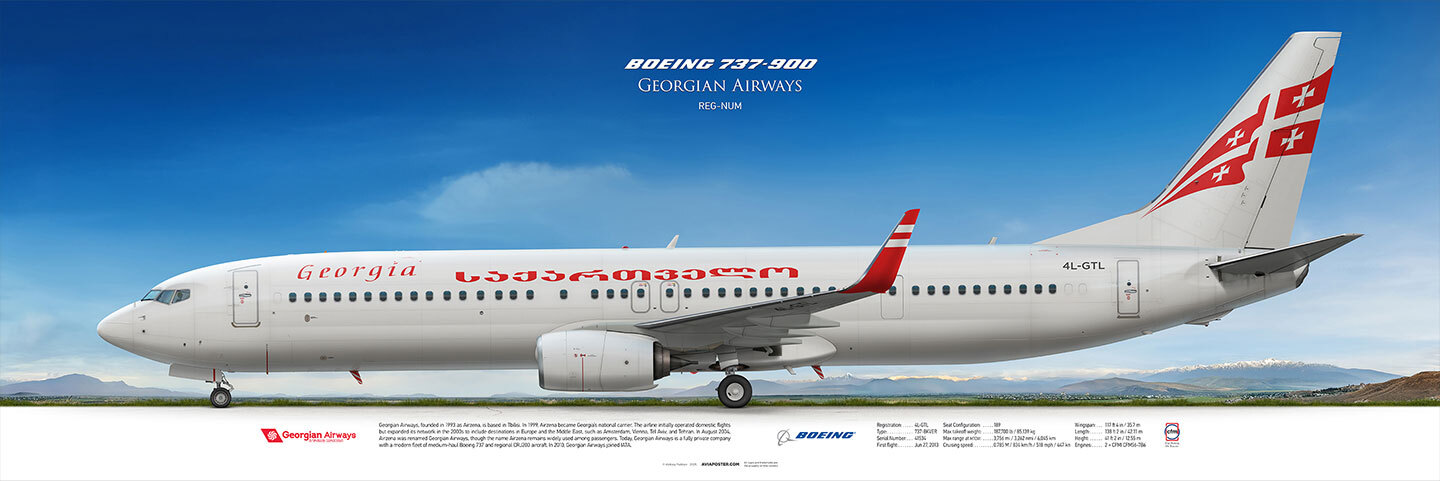
Founded in 1993 as Airzena, Georgian Airways evolved from a charter carrier into a major player in the South Caucasus aviation market. From its inception, the airline connected Georgia with the wider world—its charters flew to the UAE, Italy, China, Egypt, India, and Syria, while a regular route to Vienna opened a window to Europe for the country.
The turning point came in 1999 when Airzena received national carrier status. This coincided with the start of large-scale modernization: instead of outdated Soviet aircraft, two Boeing 737-500s leased from Germany's Hapag-Lloyd took to the skies. The rebranding to Georgian Airways occurred in 2004, though the old name still lives on in passengers' memories. The signature red livery remained unchanged—a nod to its earlier history.
Since 2004, the company has been fully private, giving it advantages among competitors. Joining IATA in 2010 confirmed compliance with global standards, while interline agreements with Air France, KLM, and Delta expanded its geographic reach beyond its own network.
Over its existence, Georgian Airways' routes evolved from charter programs to a dense network of scheduled flights covering Europe and the Middle East. The Tbilisi hub became an intersection point for business and tourist flows. The ban on flights to Russia in 2019 complicated the airline's operations. But the resumption of service in 2023 brought back an important destination to its route map and strengthened the company's position in a region where geopolitics is highly volatile.
The airline's fleet today consists of ten aircraft, including seven Boeing 737s of various variants for medium-haul flights, one Boeing 767-300 for long-haul routes, and a pair of CRJ200s for regional services—a practical configuration for the tasks at hand.
And while this company's journey has not been without turbulence, and the bankruptcy filing in 2021 could have ended its story, smart restructuring allowed it not just to survive but to return to the game with its reputation as a reliable carrier intact. For those who follow the region's aviation industry, Georgian Airways is an example of how to adapt to changing conditions without losing identity.
From Soviet legacy to a private company with a modern fleet and IATA membership — Georgian Airways remains the link between Georgia and the rest of the world, proving that resilience matters far more than size.
The turning point came in 1999 when Airzena received national carrier status. This coincided with the start of large-scale modernization: instead of outdated Soviet aircraft, two Boeing 737-500s leased from Germany's Hapag-Lloyd took to the skies. The rebranding to Georgian Airways occurred in 2004, though the old name still lives on in passengers' memories. The signature red livery remained unchanged—a nod to its earlier history.
Since 2004, the company has been fully private, giving it advantages among competitors. Joining IATA in 2010 confirmed compliance with global standards, while interline agreements with Air France, KLM, and Delta expanded its geographic reach beyond its own network.
Over its existence, Georgian Airways' routes evolved from charter programs to a dense network of scheduled flights covering Europe and the Middle East. The Tbilisi hub became an intersection point for business and tourist flows. The ban on flights to Russia in 2019 complicated the airline's operations. But the resumption of service in 2023 brought back an important destination to its route map and strengthened the company's position in a region where geopolitics is highly volatile.
The airline's fleet today consists of ten aircraft, including seven Boeing 737s of various variants for medium-haul flights, one Boeing 767-300 for long-haul routes, and a pair of CRJ200s for regional services—a practical configuration for the tasks at hand.
And while this company's journey has not been without turbulence, and the bankruptcy filing in 2021 could have ended its story, smart restructuring allowed it not just to survive but to return to the game with its reputation as a reliable carrier intact. For those who follow the region's aviation industry, Georgian Airways is an example of how to adapt to changing conditions without losing identity.
From Soviet legacy to a private company with a modern fleet and IATA membership — Georgian Airways remains the link between Georgia and the rest of the world, proving that resilience matters far more than size.