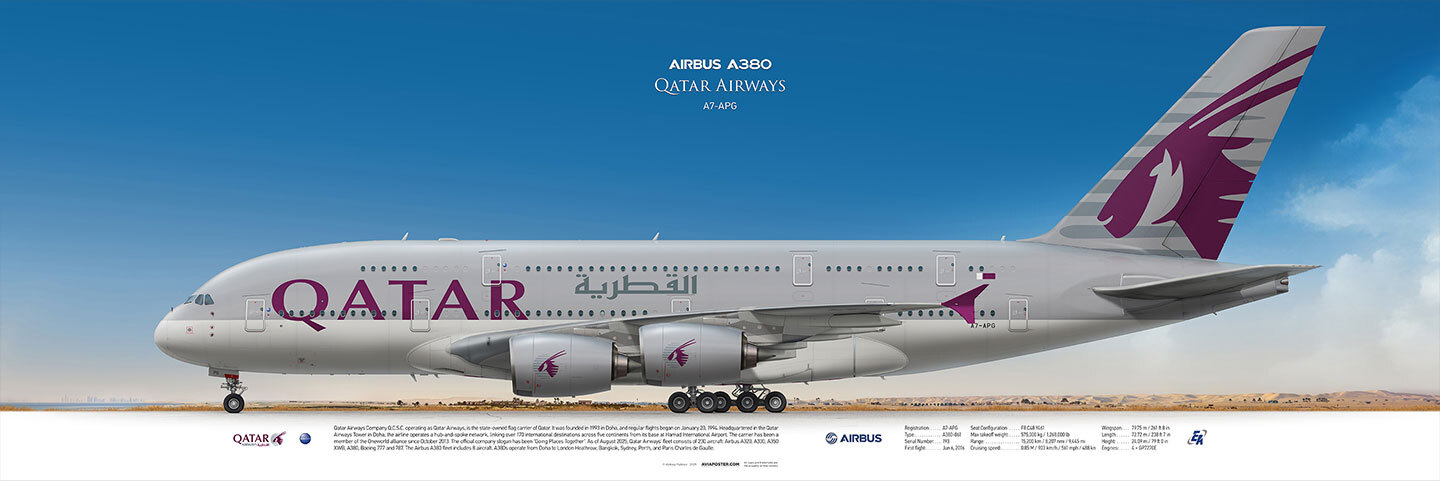
The history of Airbus A380 operations at Qatar Airways represents a striking example of how a flagship wide-body liner can become the calling card of a premium-class air carrier. The Qatari airline, which rapidly gained a reputation as one of the world's leading carriers, saw in the double-decker giant not merely a means of transportation, but an instrument for implementing its ambitious strategy – to offer passengers an unparalleled level of comfort on key routes of its global network.
Order and Deliveries
Qatar Airways' decision to acquire the Airbus A380 was made in the context of a large-scale fleet modernization program that unfolded in the first decade of the 21st century. An order for ten aircraft was placed at the Le Bourget Air Show in 2007, when the entire aviation world enthusiastically welcomed the emergence of a new generation of super-large wide-body aircraft. This order demonstrated to the world Qatar Airways' ambition to take its rightful place among the elite airlines operating the most spacious passenger liner in civil aviation history.
The first A380 was delivered to the airline in September 2014 – an event that became landmark for the Qatari carrier. The aircraft acceptance ceremony in Toulouse, at the Airbus manufacturing facility, was conducted with appropriate solemnity. The aircraft, which received registration number A7-APA, was painted in Qatar Airways' signature livery with its characteristic burgundy-gray design – a recognizable symbol of the company at airports around the world.
By 2018, all ten Airbus A380s had taken their place in the Qatar Airways fleet. Each aircraft represented a significant investment – not only financial but also reputational – since A380 operations required appropriate infrastructure, highly qualified personnel, and impeccable service.
Cabin Configuration and Philosophy of Comfort
Qatar Airways approached the layout of its A380 cabins with the company's characteristic meticulousness, striving to create an interior that would reflect the brand's ideology – a combination of Eastern hospitality with modern technology and design solutions.
The double-decker liner was configured for 517 passenger seats, distributed among four classes of service – a decision emphasizing the carrier's premium orientation. The upper deck was entirely dedicated to first and business class passengers, creating an atmosphere of exclusivity and seclusion unattainable on conventional wide-body aircraft.
First class, located in the forward section of the upper deck, included eight luxurious enclosed suites, each representing a miniature room with a sliding door ensuring complete privacy. A seat-bed with a handcrafted mattress, premium material finishes, an individual wardrobe, and a bar cabinet – all this transformed the flight into a journey worthy of the most discerning individuals. The entertainment system with a 26-inch touchscreen and Oryx One technology – Qatar Airways' proprietary multimedia platform – offered a library of thousands of entertainment programs.
Business class, occupying the aft section of the upper deck, was designed for 48 passengers. Seats, installed in a 1-2-1 configuration, transformed into fully flat sleeping surfaces up to 2 meters in length, providing direct aisle access for each passenger – a nuance highly valued by business travelers. Exquisite finishing materials, subdued lighting, and thoughtful ergonomics created an atmosphere of tranquility and productivity.
A special pride of Qatar Airways was the "onboard lounge" system on the upper deck – a space between the first and business class cabins where passengers could socialize, have a drink, or simply stretch during a long flight. This element of social interaction, rare in commercial aviation, gave the flight an additional dimension of comfort.
The lower deck was divided between economy and premium economy class. The 461-seat economy class was designed with modern comfort standards in mind: seat pitch of 32-34 inches, ergonomic seats with adjustable headrests, and personal entertainment systems with 11-inch HD screens for each passenger. Despite the high seating density, attention to detail – from pillow quality to lighting design – distinguished Qatar Airways' product from its competitors.
Route Network and Usage Strategy
The operation of Airbus A380s at Qatar Airways was deployed on strategically important long-haul routes with high passenger traffic intensity, where its enormous capacity and economic efficiency per passenger-seat could be optimally utilized. Based at Hamad International Airport in Doha – one of the world's most modern aviation hubs, opened in 2014 – the A380 liners connected the Qatari capital with key global destinations.
Among the priority routes were flights to London (Heathrow) – one of the busiest aviation corridors for Qatar Airways. The British capital, traditionally serving as the most important gateway to Europe for Middle Eastern carriers, was ideally suited for A380 operations thanks to consistently high demand in both business and economy class. Flights operated with enviable regularity, sometimes several times a day using various aircraft types.
Paris (Charles de Gaulle) became another European destination where Qatar Airways actively utilized its A380s. The French capital, with its numerous business community, tourist flow, and significant diaspora from the Middle East and North Africa, provided sustainable demand for premium seats and economy class.
In the Asia-Pacific region, A380s operated on routes to Bangkok, Guangzhou and, most notably, to Sydney and Melbourne – Australian metropolises that traditionally see high demand from travelers around the world. The Australian direction was of particular interest. Ultra-long-haul flights lasting over 14 hours required maximum comfort, which the spacious A380 cabins could provide.
Qatar Airways' strategy was not simply about transporting the maximum number of passengers, but about creating flagship flights where the flight experience became an integral part of the premium brand. The A380s were used as a showcase of the airline's capabilities, demonstrating to customers the remarkable abilities of a carrier from a small but highly ambitious Gulf state.
Operational Features and Challenges
Operating the Airbus A380 involves a number of specific technical and logistical aspects that the air carrier had to consider and overcome. The aircraft's gigantic dimensions – wingspan of 79.75 meters, fuselage length of nearly 73 meters – required appropriate infrastructure. Not all airports in the world are capable of receiving the A380: reinforced taxiways, special jet bridges capable of servicing both decks simultaneously, and enlarged parking positions are necessary.
Hamad International Airport was designed with A380 operations in mind from the very beginning, which gave Qatar Airways a strategic advantage over competitors whose hubs required costly modernization. However, the situation varied at destination airports: while Heathrow or Charles de Gaulle were ready to receive the super jumbo, some other destinations required coordination and special procedures.
A380 technical maintenance also presented certain complexities. Four Engine Alliance GP7200 engines – specifically these engines are installed on all Qatari "Super Jumbos" – required regular monitoring and maintenance by highly qualified personnel. Qatar Airways invested significant resources in training its engineers and technicians, creating world-class competencies in servicing this most complex aircraft.
The economic aspects of A380 operations have always been a subject of discussion in the aviation industry. The aircraft, developed in an era of relatively cheap aviation fuel and optimism about passenger traffic growth, showed its efficiency only at high load factors. Qatar Airways, thanks to its hub model and effective revenue management, generally coped with this task, although route profitability required constant monitoring.
The COVID-19 Pandemic as a Test of Resilience
The year 2020 became a turning point not only for Qatar Airways but for the entire global aviation industry. The COVID-19 pandemic devastated passenger traffic, closed borders, and called into question the very model of super-large wide-body aircraft. The Airbus A380, requiring high load factors for profitability, proved particularly vulnerable under the new conditions.
Qatar Airways, like most A380 operators, was forced to temporarily ground its entire fleet of these liners. The aircraft were placed in long-term storage – a process requiring careful preservation of systems, engine protection, and regular condition monitoring. In conditions of uncertainty regarding the timeline for international travel recovery, the future of the A380 in the airline's fleet was seriously in question.
Qatar Airways management, led by CEO Akbar Al Baker, repeatedly expressed skepticism about the prospects of four-engine giants during the height of the pandemic. Statements were made about the possible complete retirement of the A380 fleet, which seemed logical in the context of the new reality with volatile demand and an emphasis on flight frequency rather than aircraft size. Unlike more modern and economical twin-engine wide-body aircraft such as the Boeing 777 or Airbus A350, the A380 indeed appeared to be a less flexible tool for the post-pandemic world.
The Giant's Return: Resumption of Operations
But the story of the Qatari "Super Jumbos" was not quick to end – a new chapter awaited. As international air travel recovered in 2022-2023, Qatar Airways faced an unexpected situation: demand on certain key routes not only recovered but exceeded pre-pandemic levels. A global tourism boom, pent-up demand for business travel, and the hosting of the FIFA 2022 World Cup in Qatar created conditions under which the large capacity of the A380 once again made economic sense.
The airline made a pragmatic decision: to abandon plans for complete fleet retirement and return the A380s to routes with the highest demand. This required depreservation of the aircraft, technical maintenance, and crew retraining, but company management considered these investments justified.
Of the original fleet of ten aircraft, two did indeed leave the airline – possibly due to lease expiration or technical condition that made their return to service unprofitable. However, the remaining eight A380s were returned to active operations, proving Qatar Airways' ability to adapt to changing market conditions.
As of late 2025, seven A380 superliners of Qatar Airways are actively performing commercial flights, while the eighth aircraft is undergoing scheduled maintenance and is expected to return to service in the coming weeks. These majestic giants once again traverse the skies on routes such as London, Paris, and a number of destinations in the Asia-Pacific region, where their capacity and premium product find their audience.
The decision to resume A380 operations was met with enthusiasm among aviation enthusiasts and passengers who value the unique experience of flying on a double-decker giant. For Qatar Airways, this also became an important signal of recovery and confidence in the future of international air travel.
Legacy and Prospects
The history of Airbus A380 operations at Qatar Airways continues, and this makes it particularly interesting. While many carriers hastened to retire their "Super Jumbos," Qatar Airways demonstrated flexibility and willingness to reconsider initial decisions in light of changing market conditions.
These majestic double-decker liners have been and remain a symbol of the airline's ambitions, an instrument for strengthening its premium image, and a technological platform for demonstrating the capabilities of the Qatari carrier. The A380 allowed Qatar Airways to compete on equal terms with such giants as Emirates and Singapore Airlines in the luxury long-haul segment.
Thousands of passengers who have experienced the comfort of first-class cabins with enclosed suites or spacious business-class seats on the upper deck have undoubtedly remembered this experience. For many travelers, a flight on Qatar Airways' A380 has become the standard against which all subsequent flights are compared. And unlike memories, this experience is still available on select airline routes.
For aviation enthusiasts and travelers who value the special atmosphere of flying on a double-decker giant, the return of Qatar Airways' A380 is a true gift. In a world where most carriers have abandoned this type, the opportunity to experience the unique combination of size, comfort, and smoothness of flight is becoming increasingly rare. Qatar Airways, having preserved its A380 fleet, offers this experience to those who value it.
The eight A380s continuing to serve under the flag of Qatar represent an intriguing balance between past and future. Qatar Airways continues to invest in its modern A350 fleet and awaits delivery of the latest Boeing 777X, but is in no hurry to part with assets that still bring value. This is a pragmatic approach that distinguishes sound management from blindly following trends.
From the aviation industry's perspective, Qatar Airways' experience with the A380 demonstrates an important truth: in aviation, there are no final decisions. An aircraft that seemed doomed during the height of the pandemic returned to life when market conditions changed. This speaks not only to the merits of the A380 itself as a technological platform but also to Qatar Airways' ability to make difficult yet justified decisions.
The future of the A380 at Qatar Airways is certainly limited. Airbus ceased production of this type in 2021, and eventually the eight remaining liners will also be retired – perhaps within the next decade, as resources are exhausted and maintenance costs for aging systems grow. However, each year that the A380 continues to fly adds new pages to its history.
The history of Airbus A380 operations at Qatar Airways is a story about the pursuit of excellence, about technological optimism, about pandemic challenges, and about the ability to adapt to unpredictable circumstances. It is a reminder that in aviation, as in life, success is determined not only by the correctness of initial decisions but also by the willingness to reconsider them when reality teaches new lessons.
Today, watching as Qatar Airways' A380 majestically climbs into the sky above Doha, heading toward distant horizons, we see not a relic of the past but an active symbol that great engineering achievements can find their place in this rapidly changing world, if there is the will and wisdom to use them correctly.
Order and Deliveries
Qatar Airways' decision to acquire the Airbus A380 was made in the context of a large-scale fleet modernization program that unfolded in the first decade of the 21st century. An order for ten aircraft was placed at the Le Bourget Air Show in 2007, when the entire aviation world enthusiastically welcomed the emergence of a new generation of super-large wide-body aircraft. This order demonstrated to the world Qatar Airways' ambition to take its rightful place among the elite airlines operating the most spacious passenger liner in civil aviation history.
The first A380 was delivered to the airline in September 2014 – an event that became landmark for the Qatari carrier. The aircraft acceptance ceremony in Toulouse, at the Airbus manufacturing facility, was conducted with appropriate solemnity. The aircraft, which received registration number A7-APA, was painted in Qatar Airways' signature livery with its characteristic burgundy-gray design – a recognizable symbol of the company at airports around the world.
By 2018, all ten Airbus A380s had taken their place in the Qatar Airways fleet. Each aircraft represented a significant investment – not only financial but also reputational – since A380 operations required appropriate infrastructure, highly qualified personnel, and impeccable service.
Cabin Configuration and Philosophy of Comfort
Qatar Airways approached the layout of its A380 cabins with the company's characteristic meticulousness, striving to create an interior that would reflect the brand's ideology – a combination of Eastern hospitality with modern technology and design solutions.
The double-decker liner was configured for 517 passenger seats, distributed among four classes of service – a decision emphasizing the carrier's premium orientation. The upper deck was entirely dedicated to first and business class passengers, creating an atmosphere of exclusivity and seclusion unattainable on conventional wide-body aircraft.
First class, located in the forward section of the upper deck, included eight luxurious enclosed suites, each representing a miniature room with a sliding door ensuring complete privacy. A seat-bed with a handcrafted mattress, premium material finishes, an individual wardrobe, and a bar cabinet – all this transformed the flight into a journey worthy of the most discerning individuals. The entertainment system with a 26-inch touchscreen and Oryx One technology – Qatar Airways' proprietary multimedia platform – offered a library of thousands of entertainment programs.
Business class, occupying the aft section of the upper deck, was designed for 48 passengers. Seats, installed in a 1-2-1 configuration, transformed into fully flat sleeping surfaces up to 2 meters in length, providing direct aisle access for each passenger – a nuance highly valued by business travelers. Exquisite finishing materials, subdued lighting, and thoughtful ergonomics created an atmosphere of tranquility and productivity.
A special pride of Qatar Airways was the "onboard lounge" system on the upper deck – a space between the first and business class cabins where passengers could socialize, have a drink, or simply stretch during a long flight. This element of social interaction, rare in commercial aviation, gave the flight an additional dimension of comfort.
The lower deck was divided between economy and premium economy class. The 461-seat economy class was designed with modern comfort standards in mind: seat pitch of 32-34 inches, ergonomic seats with adjustable headrests, and personal entertainment systems with 11-inch HD screens for each passenger. Despite the high seating density, attention to detail – from pillow quality to lighting design – distinguished Qatar Airways' product from its competitors.
Route Network and Usage Strategy
The operation of Airbus A380s at Qatar Airways was deployed on strategically important long-haul routes with high passenger traffic intensity, where its enormous capacity and economic efficiency per passenger-seat could be optimally utilized. Based at Hamad International Airport in Doha – one of the world's most modern aviation hubs, opened in 2014 – the A380 liners connected the Qatari capital with key global destinations.
Among the priority routes were flights to London (Heathrow) – one of the busiest aviation corridors for Qatar Airways. The British capital, traditionally serving as the most important gateway to Europe for Middle Eastern carriers, was ideally suited for A380 operations thanks to consistently high demand in both business and economy class. Flights operated with enviable regularity, sometimes several times a day using various aircraft types.
Paris (Charles de Gaulle) became another European destination where Qatar Airways actively utilized its A380s. The French capital, with its numerous business community, tourist flow, and significant diaspora from the Middle East and North Africa, provided sustainable demand for premium seats and economy class.
In the Asia-Pacific region, A380s operated on routes to Bangkok, Guangzhou and, most notably, to Sydney and Melbourne – Australian metropolises that traditionally see high demand from travelers around the world. The Australian direction was of particular interest. Ultra-long-haul flights lasting over 14 hours required maximum comfort, which the spacious A380 cabins could provide.
Qatar Airways' strategy was not simply about transporting the maximum number of passengers, but about creating flagship flights where the flight experience became an integral part of the premium brand. The A380s were used as a showcase of the airline's capabilities, demonstrating to customers the remarkable abilities of a carrier from a small but highly ambitious Gulf state.
Operational Features and Challenges
Operating the Airbus A380 involves a number of specific technical and logistical aspects that the air carrier had to consider and overcome. The aircraft's gigantic dimensions – wingspan of 79.75 meters, fuselage length of nearly 73 meters – required appropriate infrastructure. Not all airports in the world are capable of receiving the A380: reinforced taxiways, special jet bridges capable of servicing both decks simultaneously, and enlarged parking positions are necessary.
Hamad International Airport was designed with A380 operations in mind from the very beginning, which gave Qatar Airways a strategic advantage over competitors whose hubs required costly modernization. However, the situation varied at destination airports: while Heathrow or Charles de Gaulle were ready to receive the super jumbo, some other destinations required coordination and special procedures.
A380 technical maintenance also presented certain complexities. Four Engine Alliance GP7200 engines – specifically these engines are installed on all Qatari "Super Jumbos" – required regular monitoring and maintenance by highly qualified personnel. Qatar Airways invested significant resources in training its engineers and technicians, creating world-class competencies in servicing this most complex aircraft.
The economic aspects of A380 operations have always been a subject of discussion in the aviation industry. The aircraft, developed in an era of relatively cheap aviation fuel and optimism about passenger traffic growth, showed its efficiency only at high load factors. Qatar Airways, thanks to its hub model and effective revenue management, generally coped with this task, although route profitability required constant monitoring.
The COVID-19 Pandemic as a Test of Resilience
The year 2020 became a turning point not only for Qatar Airways but for the entire global aviation industry. The COVID-19 pandemic devastated passenger traffic, closed borders, and called into question the very model of super-large wide-body aircraft. The Airbus A380, requiring high load factors for profitability, proved particularly vulnerable under the new conditions.
Qatar Airways, like most A380 operators, was forced to temporarily ground its entire fleet of these liners. The aircraft were placed in long-term storage – a process requiring careful preservation of systems, engine protection, and regular condition monitoring. In conditions of uncertainty regarding the timeline for international travel recovery, the future of the A380 in the airline's fleet was seriously in question.
Qatar Airways management, led by CEO Akbar Al Baker, repeatedly expressed skepticism about the prospects of four-engine giants during the height of the pandemic. Statements were made about the possible complete retirement of the A380 fleet, which seemed logical in the context of the new reality with volatile demand and an emphasis on flight frequency rather than aircraft size. Unlike more modern and economical twin-engine wide-body aircraft such as the Boeing 777 or Airbus A350, the A380 indeed appeared to be a less flexible tool for the post-pandemic world.
The Giant's Return: Resumption of Operations
But the story of the Qatari "Super Jumbos" was not quick to end – a new chapter awaited. As international air travel recovered in 2022-2023, Qatar Airways faced an unexpected situation: demand on certain key routes not only recovered but exceeded pre-pandemic levels. A global tourism boom, pent-up demand for business travel, and the hosting of the FIFA 2022 World Cup in Qatar created conditions under which the large capacity of the A380 once again made economic sense.
The airline made a pragmatic decision: to abandon plans for complete fleet retirement and return the A380s to routes with the highest demand. This required depreservation of the aircraft, technical maintenance, and crew retraining, but company management considered these investments justified.
Of the original fleet of ten aircraft, two did indeed leave the airline – possibly due to lease expiration or technical condition that made their return to service unprofitable. However, the remaining eight A380s were returned to active operations, proving Qatar Airways' ability to adapt to changing market conditions.
As of late 2025, seven A380 superliners of Qatar Airways are actively performing commercial flights, while the eighth aircraft is undergoing scheduled maintenance and is expected to return to service in the coming weeks. These majestic giants once again traverse the skies on routes such as London, Paris, and a number of destinations in the Asia-Pacific region, where their capacity and premium product find their audience.
The decision to resume A380 operations was met with enthusiasm among aviation enthusiasts and passengers who value the unique experience of flying on a double-decker giant. For Qatar Airways, this also became an important signal of recovery and confidence in the future of international air travel.
Legacy and Prospects
The history of Airbus A380 operations at Qatar Airways continues, and this makes it particularly interesting. While many carriers hastened to retire their "Super Jumbos," Qatar Airways demonstrated flexibility and willingness to reconsider initial decisions in light of changing market conditions.
These majestic double-decker liners have been and remain a symbol of the airline's ambitions, an instrument for strengthening its premium image, and a technological platform for demonstrating the capabilities of the Qatari carrier. The A380 allowed Qatar Airways to compete on equal terms with such giants as Emirates and Singapore Airlines in the luxury long-haul segment.
Thousands of passengers who have experienced the comfort of first-class cabins with enclosed suites or spacious business-class seats on the upper deck have undoubtedly remembered this experience. For many travelers, a flight on Qatar Airways' A380 has become the standard against which all subsequent flights are compared. And unlike memories, this experience is still available on select airline routes.
For aviation enthusiasts and travelers who value the special atmosphere of flying on a double-decker giant, the return of Qatar Airways' A380 is a true gift. In a world where most carriers have abandoned this type, the opportunity to experience the unique combination of size, comfort, and smoothness of flight is becoming increasingly rare. Qatar Airways, having preserved its A380 fleet, offers this experience to those who value it.
The eight A380s continuing to serve under the flag of Qatar represent an intriguing balance between past and future. Qatar Airways continues to invest in its modern A350 fleet and awaits delivery of the latest Boeing 777X, but is in no hurry to part with assets that still bring value. This is a pragmatic approach that distinguishes sound management from blindly following trends.
From the aviation industry's perspective, Qatar Airways' experience with the A380 demonstrates an important truth: in aviation, there are no final decisions. An aircraft that seemed doomed during the height of the pandemic returned to life when market conditions changed. This speaks not only to the merits of the A380 itself as a technological platform but also to Qatar Airways' ability to make difficult yet justified decisions.
The future of the A380 at Qatar Airways is certainly limited. Airbus ceased production of this type in 2021, and eventually the eight remaining liners will also be retired – perhaps within the next decade, as resources are exhausted and maintenance costs for aging systems grow. However, each year that the A380 continues to fly adds new pages to its history.
The history of Airbus A380 operations at Qatar Airways is a story about the pursuit of excellence, about technological optimism, about pandemic challenges, and about the ability to adapt to unpredictable circumstances. It is a reminder that in aviation, as in life, success is determined not only by the correctness of initial decisions but also by the willingness to reconsider them when reality teaches new lessons.
Today, watching as Qatar Airways' A380 majestically climbs into the sky above Doha, heading toward distant horizons, we see not a relic of the past but an active symbol that great engineering achievements can find their place in this rapidly changing world, if there is the will and wisdom to use them correctly.