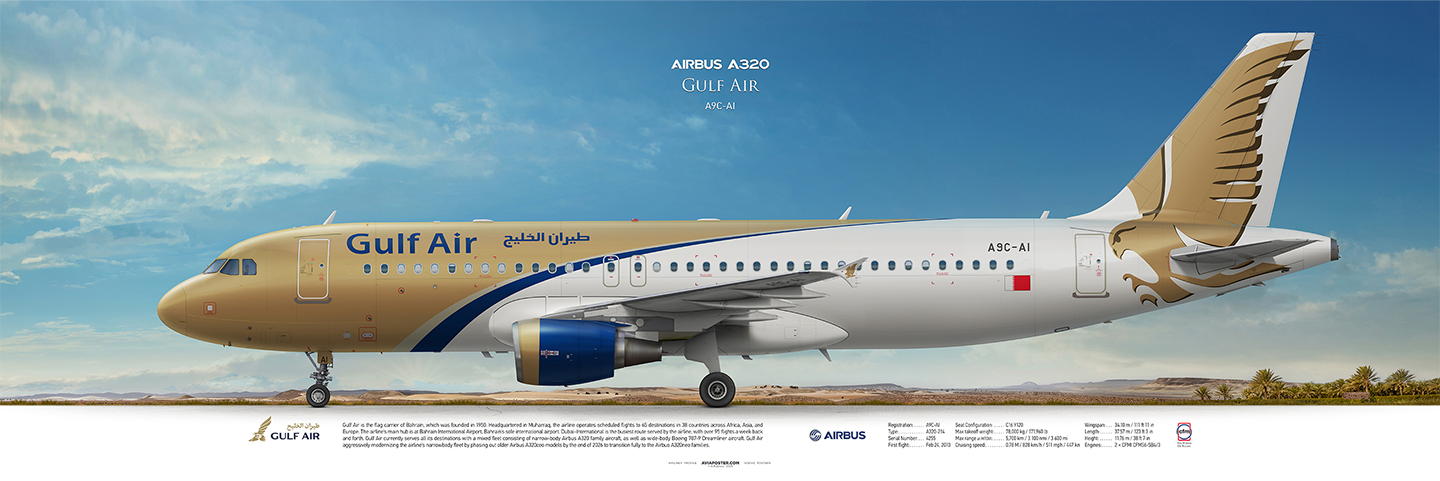
In the blogosphere I've come across the claim that this airline's old livery is "gold" and the new one is "white." But if you study the old and new Gulf Air aircraft closely, at some point you realize that this popular name for the new livery isn't quite accurate. Unlike the old livery, it has no white at all. It only looks white.
Let me explain it all in order.
How it all began
The story of this paint scheme begins in 2003. That year Landor Associates took on Gulf Air's corporate identity (I've written a lot before about this agency, which left a bright mark on world aviation). This time its designers didn't invent the airline's symbol from scratch. The golden falcon had lived on the company's tails since the seventies, since the days of the Lockheed TriStar. Falconry is a deep national tradition in Bahrain, and the falcon is an unofficial symbol of the whole Middle East, embodying nobility, strength and speed. That is exactly why the airline's brand has historically been inseparable from this image. Landor didn't break with tradition and kept the falcon in place, but redrew it thoroughly. From a neat little emblem the bird turned into the central element of the livery.
I've seen the result in real life many times. Half of the aircraft, from the nose to the wing, is painted gold. Behind that the fuselage is pure white. And on the tail is a huge golden falcon that starts down on the fuselage under the fin and rises up with its wings spread. Gold is the dominant color here, and white strengthens the accents.
A blue stripe draws the border between the two main colors, and this is where you can feel the designers' mastery. It is a rich, deep dark blue that looks perfect next to the gold. The colors don't argue with each other, they work in harmony.
For the company, 2003 was a year of big changes, and the livery became its calling card. The aircraft flew in this form for more than fifteen years.
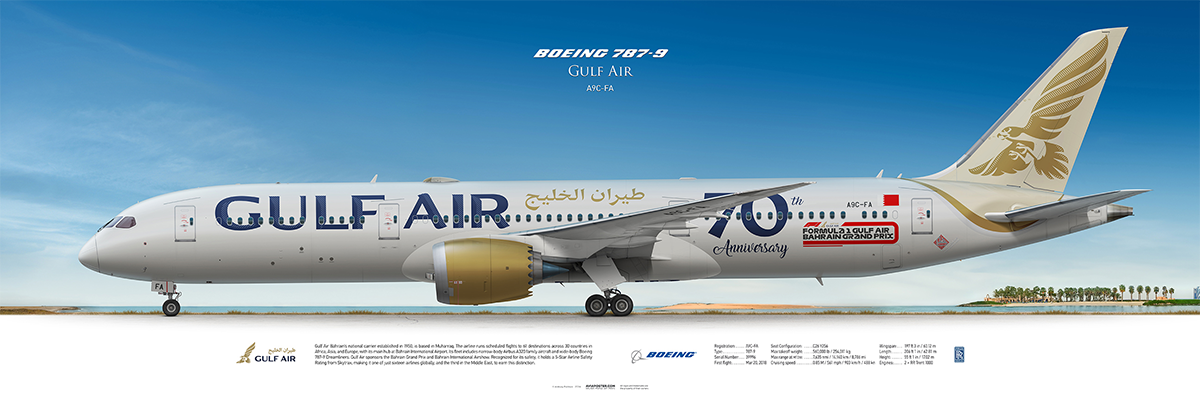
Then in 2018 Gulf Air unveiled a new corporate identity. The first aircraft to get it was a Boeing 787-9, and later it came to the neo family aircraft as well. Descriptions usually call the new livery white, with a small golden falcon on the tail and dark blue lettering. From a distance, that is how it looks. However, if you look closer...
White, but not quite
It is commonly believed that the old livery is bright and golden, while the new one is white. But if you compare them in person, it turns out almost the opposite. The old livery is actually whiter. The new one only looks white.
The main confusion comes from the tail. It is painted a light beige, noticeably different from the fuselage, and the golden stripe under the tail serves as the border between them. With such an accent, the main color of the livery really does look white.
But let's go through the details that will dot the i's and cross the t's on this question.
The first one, in my view, is the Bahrain national flag on the rear part of the fuselage. It has two colors, red and white. On the new livery, the white part of the flag clearly differs from the supposedly white main color, which emphasizes the difference. On the 2003 livery, this part of the flag is separated by a black outline to divide the two white zones.
Next, going down and to the right, under the door, there is the Bahrain International Circuit logo with its inscription "white on white," which clearly underlines the "non-whiteness" of the white fuselage.
And that's not all. In one photograph it becomes completely obvious. During repairs, an aircraft had its nose radome replaced, and the new part was installed in white. It differs sharply from the rest of the fuselage. The difference is visible immediately.
So those who call the new livery "white" are mistaken. But I couldn't help noticing it, because while drawing the livery I studied it up close and reproduced its smallest details.
By the way, the blue isn't so simple either. On the new livery it changed shade, becoming even closer to turquoise. And since it now has much less saturation, in cloudy weather or in low light it is perceived as dark gray with a slight blue tint. Compared to Landor's rich blue, it looks more modest.
Where the gold went
If you compare the two aircraft, the shade of gold is about the same. It's all about the area. Before, gold covered the entire front part of the fuselage, plus the tail and a significant part of the body beneath it, where the huge falcon was located. Now the gold remains only on the falcon, which has become smaller and fits entirely on the tail, plus one small stripe beneath it. The one exception is the engine cowlings, which are painted entirely in gold and gleam like ingots.
This is one more reason the new livery is perceived as white: there is simply much less gold in it.
The border between eras
Today this difference has become a marker. All of Gulf Air's old aircraft wear the Landor livery, and all the new ones wear the current one. The generation of an aircraft is visible at a glance. And the time of the old generation is coming to an end. The fleet still has eight A320ceo, which for now keep flying reliably. They are being replaced by A320neo: nine are already in service, with two more expected. There are already sixteen A321neo, and one more is on the way.
The old A321s are less fortunate. On paper there are four of them, but in reality only one is in operation, and even that one is currently in maintenance. The other three stand off to the side and, according to my information, haven't flown for anywhere between six months and a year.
There were rumors that the fleet replacement was planned to be completed by the end of 2026. The timing may slip, but one way or another, there isn't long left.
A repaint at no cost
There is one detail in this story that I especially like. Only newly arriving aircraft were painted in the new livery. Nobody repainted the old ones: the Landor scheme is leaving naturally, together with the aircraft that wear it.
It turns out that the fleet changed its entire look without spending anything on repainting. The aircraft that arrived new received the new livery. Those due for replacement flew out their time in the old one. And the line between them became, by itself, the line between eras. All that remains is to wait until the last aircraft with a golden nose makes its final flight.
What remains
When the last aircraft with a golden nose flies off into retirement, it won't be just a livery that disappears. A certain view of how a Gulf Air aircraft should look will disappear too: generous, bright and a little theatrical. The golden falcon, of course, will remain, and it will outlive more than one livery. But such a vivid embodiment of it may well never return. Time will tell.
So if you've long been meaning to photograph these aircraft, don't put it off. There is very little time left.