First Encounter with the Giant
In the spring of 1970, Air France already had its flagship — the Boeing 707. A reliable, and for its time thoroughly comfortable, machine capable of carrying 180 passengers over nine thousand-odd kilometers. The airline had only just acquired a taste for the jet age: since 1959, Caravelles and those same 707s had been flying its routes, and it seemed the road ahead lay simply in refining a formula already mastered. But across the ocean, Boeing was preparing something that would not merely improve the formula — it would rewrite it entirely.
On March 20, 1970, Air France took delivery of its first Boeing 747-100. The aircraft was so unfamiliar in scale — that hump behind the cockpit, a fuselage that comfortably seated up to five hundred — that its arrival in Paris was followed by cameras from every French television channel, as though it were a matter of national significance. In a sense, it was: France was receiving not merely a new aircraft, but the first genuinely mass-market instrument of long-haul aviation.
On June 3, 1970, the "seven-four-seven" flew its first commercial service — on the airline's most prestigious route, Paris–New York. It is fitting that a few years later this same route would also carry Concorde: two poles of a single era, supersonic luxury for the few and mass accessibility for everyone else, would become neighbors on the very same crossing of the Atlantic. And while businessmen paid handsomely for three and a half hours faster than sound, others could, for the first time in their lives, afford a transatlantic flight at all — simply because a seat aboard the wide-body giant cost a fraction of one in the cramped cabin of the 707.
A two- or even threefold difference in capacity, at the same range, amounted to more than mere evolution — it was a genuine rupture in the economics of long-haul travel. The cost per seat-kilometer collapsed, and with it collapsed the barriers that had made air travel the privilege of the few. An era was beginning that would later be described as "mass tourism by air": the first charter operators and package tours emerged, and destinations that had once sounded like exotica from travel magazines — the Seychelles, Mauritius, the Caribbean — suddenly became affordable to the average French office worker.
Airports had to scramble to adapt: handling several Jumbos at once demanded terminals of an entirely different throughput, different baggage logistics, and ground handling on a different scale altogether. Crews, for their part, adapted to the new machine remarkably quickly — pilots would later recall it as surprisingly docile and easy to fly for its size, while flight attendants were delighted by how much room this cabin-cathedral gave them to work in. It was aboard the 747 that the position of chief purser first appeared at Air France — a dedicated role whose sole task was coordinating cabin service on an aircraft that could carry up to five hundred passengers at once. The sheer scale forced Air France to rebuild its entire onboard hierarchy.
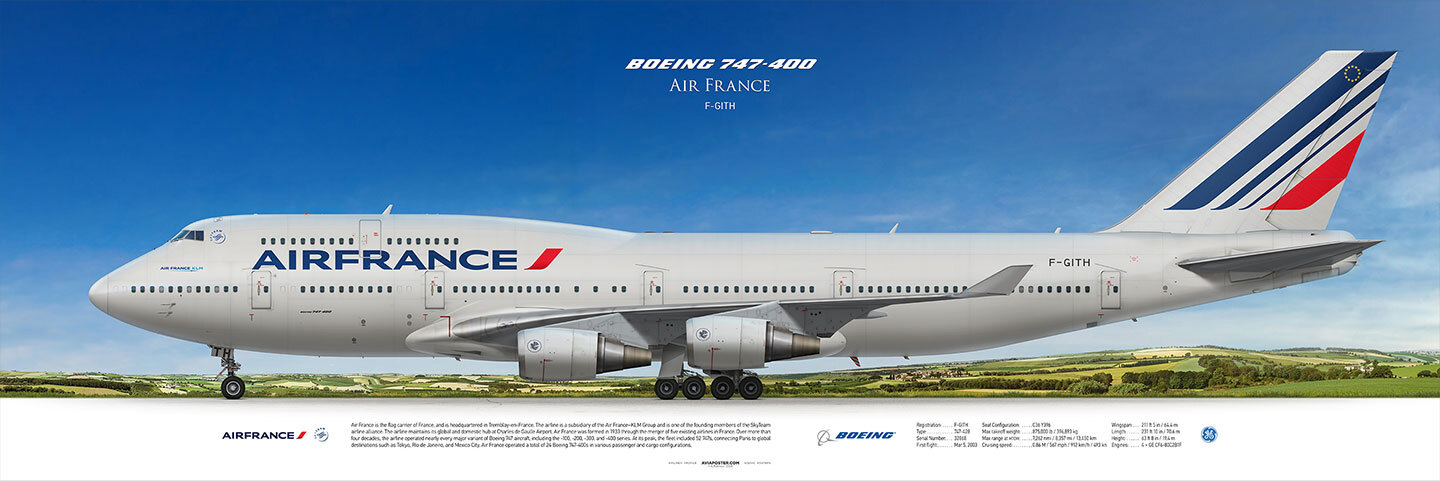
It's worth noting in passing that later variants soon followed the first "hundreds" into the fleet — the 747-200, then the 747-300 with its extended upper deck, and eventually the 747-400, which would become Air France's final and most numerous variant. There were also combined passenger-freight "Combi" versions, which will come up again in connection with the African and Caribbean routes. But at the outset, in 1970, all of that still lay ahead. For now, the French public was simply getting used to the idea that an airplane could be the size of an apartment block.
Long-Haul Routes: An Empire Without Territory
If the Atlantic was the program's showcase — the route that made television and newspapers — the real work of the Jumbo unfolded across a far more sprawling network, one that in many ways traced the contours of the French colonial and postcolonial world.
One clarification is essential here, without which the entire geography of the 747 at Air France makes little sense. In 1963, the French government issued a directive dividing long-haul routes between Air France and the private carrier UTA (Union de Transports Aériens). Air France was forced to cede to UTA almost all of West Africa (except Senegal), Central Africa (except Burundi and Rwanda), Southern Africa, Libya, Bahrain and Oman, Ceylon, Indonesia, Malaysia, Singapore, Australia, New Zealand, New Caledonia, and Tahiti. In other words, for nearly three decades, a large share of the postcolonial world was simply off-limits to Air France's Jumbos — those routes belonged to UTA's aircraft. Air France would not fully reclaim this geography until 1992, when it merged with UTA: along with the routes came UTA's wide-body fleet, including 747 variants that UTA had been flying to Far Eastern and African destinations.
Until then, Air France and its Jumbo had to make do with less.
Routes to North America — New York as the flagship destination, later joined by Montreal and other cities on the continent. Flights to France's overseas territories in the Caribbean — Guadeloupe, Martinique, and later Saint-Martin, where the 747 regularly carried vacationers and cargo alike. The islands of the Indian Ocean — Réunion, along with Mauritius and the Seychelles, which, after a long stint as unattainable luxury, shifted into the category of affordable destinations precisely thanks to the Jumbo's great capacity. And finally Senegal — the sole West African country to remain within Air France's sphere after the 1963 division.
The Asian route deserves particular mention, one Air France developed only after the UTA merger and especially actively in the 1990s and 2000s. For this purpose, a subsidiary called Air France Asie was created in the 1990s, flying under its own livery: the same paint scheme as the parent airline, but on the tail — blue-and-white stripes instead of the familiar blue-white-red tricolor. Air France Asie's fleet included, among other aircraft, two Boeing 747-428Ms (a "Combi" version, combining a passenger cabin and cargo hold within a single fuselage) — a brief, nearly forgotten chapter in the type's history today. A parallel cargo entity, Air France Cargo Asie, also existed, operating both "pure" freighter 747-200Fs and Combis. Air France Asie ceased operating as a passenger brand in 2004, and its cargo division followed in 2007 — but the very fact that the Asian route required a separate sub-brand with its own livery speaks volumes about how complicated and politically fraught the route eastward was for French aviation.
It was precisely on the long-haul routes that the Combi version came fully into its own — an aircraft in which the rear portion of the main deck was given over to a cargo hold with a side cargo door, while the front remained passenger space. On routes like those to the Caribbean or Africa, where passenger traffic did not always fill a "pure" passenger aircraft to capacity, but where the cargo component — mail, commercial freight, supplies for the overseas territories — remained consistently significant, this hybrid configuration proved far more economically sound than operating a separate freighter.
By the early 1980s, the scale of the operation was substantial. For its fiftieth anniversary in 1983, Air France had a fleet of roughly one hundred jet aircraft, of which 33 were Boeing 747s. The company's workforce numbered more than 34,000, and its network — spanning 634,400 kilometers — connected 150 destinations in 73 countries. This made Air France the world's fourth-largest passenger airline and the second-largest by cargo volume. The Jumbo was the backbone of this network — a machine without which such a scale of operations simply could not have been achieved.
Sunset: Why One Era Ended Before the Other
The first clouds over Air France's 747 program did not arrive as a storm, but as a slow displacement — by newer, more efficient types. In the 1990s, the Boeing 777 began entering the fleet, offering economics comparable to the Jumbo's on long-haul routes while burning noticeably less fuel per seat-kilometer. Efficiency, rather than capacity, had become the defining criterion of the new era of air travel. Then, in the 2000s, the Airbus A380 entered the picture — a super-capacity successor that Air France regarded as the natural replacement for the departing Jumbo.
Here Air France made a choice that would determine the type's fate within the airline: unlike Germany's Lufthansa, the French carrier declined to order the stretched, modernized 747-8i, which Boeing offered as the line's logical continuation. For Air France, the Jumbo remained a machine of the -100/-200/-300/-400 generations, never advancing to the type's final, most modern iteration. This decision deserves particular emphasis: it meant that the 747's departure from the Air France fleet was not simply one aircraft being swapped for another, but a deliberate closing of a chapter. For Lufthansa, by contrast, the type's story continued into a new chapter of its own.
The cargo program went first: the last 747F left the Air France Cargo fleet back in 2014, giving way to the more modern Boeing 777F. By 2015, only five 747-400s remained in the passenger fleet. Against the backdrop of the company's financial crisis — compounded that same autumn by a pilots' strike — management decided to accelerate retirement: maintaining rapidly aging four-engine giants had simply become uneconomical compared with twin-engine wide-bodies.
Air France's final commercial Boeing 747 flight took place on January 11, 2016, on the Paris–Mexico City route — the very route that had connected Europe with Latin America for decades. A few days later, on January 14, 2016, the airline staged a farewell flight over France: a special service over the country's landmark landscapes, escorted by the Patrouille de France aerobatic display team. Upon returning to Roissy, passengers were given a tour of the maintenance hangars and offered a symbolic toast at the foot of the aircraft. The gesture was theatrical in the French manner, and touching in the French manner too: the country that had greeted its first Jumbo with television cameras half a century earlier now saw off its last one with an honor guard in the sky.
Air France, however, was neither one of the first nor one of the last European operators to retire the passenger Boeing 747. The peak period for the type's retirement in Europe fell between 2015 and 2020. Several airlines, though — Lufthansa among them, alongside Asian carriers like Air China and Korean Air — made a different choice, opting for the final 747-8i model and continuing to fly passenger Jumbos to this day, remaining the world's last major operators of the type in long-haul passenger configuration. A handful of other airlines still fly individual passenger 747s on rare, charter, or seasonal routes as well — carriers such as Max Air (Nigeria), Atlas Air (USA), Mahan Air (Iran), and Rossiya Airlines.
And in its cargo incarnation, the story of the 747 is far from over: dozens of freighter versions of the type continue flying worldwide in the fleets of specialized cargo carriers, for whom the nose cargo door and cavernous fuselage volume remain simply irreplaceable. Air France's departure from the type in 2016 marked the end of its own particular chapter — a rich one, nearly half a century long — but by no means the end of the type's story as a whole.
If one looks for a pattern in this chronology, it is this: Air France was among the very first operators of the 747 in 1970 — and, by the standards of the type's overall history, one of the comparatively late ones to part with it. The span between those two points — nearly forty-six years — encompassed the birth of mass long-haul tourism, the political geography of the route-sharing arrangement with UTA, a niche Asian sub-brand with a livery all its own, and finally, a quiet moment, barely noticed against the broader backdrop of world aviation, when one of Europe's oldest airlines lifted into the air, for the last time, an aircraft that had once seemed to it — and to the entire world — unimaginably vast.
In the spring of 1970, Air France already had its flagship — the Boeing 707. A reliable, and for its time thoroughly comfortable, machine capable of carrying 180 passengers over nine thousand-odd kilometers. The airline had only just acquired a taste for the jet age: since 1959, Caravelles and those same 707s had been flying its routes, and it seemed the road ahead lay simply in refining a formula already mastered. But across the ocean, Boeing was preparing something that would not merely improve the formula — it would rewrite it entirely.
On March 20, 1970, Air France took delivery of its first Boeing 747-100. The aircraft was so unfamiliar in scale — that hump behind the cockpit, a fuselage that comfortably seated up to five hundred — that its arrival in Paris was followed by cameras from every French television channel, as though it were a matter of national significance. In a sense, it was: France was receiving not merely a new aircraft, but the first genuinely mass-market instrument of long-haul aviation.
On June 3, 1970, the "seven-four-seven" flew its first commercial service — on the airline's most prestigious route, Paris–New York. It is fitting that a few years later this same route would also carry Concorde: two poles of a single era, supersonic luxury for the few and mass accessibility for everyone else, would become neighbors on the very same crossing of the Atlantic. And while businessmen paid handsomely for three and a half hours faster than sound, others could, for the first time in their lives, afford a transatlantic flight at all — simply because a seat aboard the wide-body giant cost a fraction of one in the cramped cabin of the 707.
A two- or even threefold difference in capacity, at the same range, amounted to more than mere evolution — it was a genuine rupture in the economics of long-haul travel. The cost per seat-kilometer collapsed, and with it collapsed the barriers that had made air travel the privilege of the few. An era was beginning that would later be described as "mass tourism by air": the first charter operators and package tours emerged, and destinations that had once sounded like exotica from travel magazines — the Seychelles, Mauritius, the Caribbean — suddenly became affordable to the average French office worker.
Airports had to scramble to adapt: handling several Jumbos at once demanded terminals of an entirely different throughput, different baggage logistics, and ground handling on a different scale altogether. Crews, for their part, adapted to the new machine remarkably quickly — pilots would later recall it as surprisingly docile and easy to fly for its size, while flight attendants were delighted by how much room this cabin-cathedral gave them to work in. It was aboard the 747 that the position of chief purser first appeared at Air France — a dedicated role whose sole task was coordinating cabin service on an aircraft that could carry up to five hundred passengers at once. The sheer scale forced Air France to rebuild its entire onboard hierarchy.
It's worth noting in passing that later variants soon followed the first "hundreds" into the fleet — the 747-200, then the 747-300 with its extended upper deck, and eventually the 747-400, which would become Air France's final and most numerous variant. There were also combined passenger-freight "Combi" versions, which will come up again in connection with the African and Caribbean routes. But at the outset, in 1970, all of that still lay ahead. For now, the French public was simply getting used to the idea that an airplane could be the size of an apartment block.
Long-Haul Routes: An Empire Without Territory
If the Atlantic was the program's showcase — the route that made television and newspapers — the real work of the Jumbo unfolded across a far more sprawling network, one that in many ways traced the contours of the French colonial and postcolonial world.
One clarification is essential here, without which the entire geography of the 747 at Air France makes little sense. In 1963, the French government issued a directive dividing long-haul routes between Air France and the private carrier UTA (Union de Transports Aériens). Air France was forced to cede to UTA almost all of West Africa (except Senegal), Central Africa (except Burundi and Rwanda), Southern Africa, Libya, Bahrain and Oman, Ceylon, Indonesia, Malaysia, Singapore, Australia, New Zealand, New Caledonia, and Tahiti. In other words, for nearly three decades, a large share of the postcolonial world was simply off-limits to Air France's Jumbos — those routes belonged to UTA's aircraft. Air France would not fully reclaim this geography until 1992, when it merged with UTA: along with the routes came UTA's wide-body fleet, including 747 variants that UTA had been flying to Far Eastern and African destinations.
Until then, Air France and its Jumbo had to make do with less.
Routes to North America — New York as the flagship destination, later joined by Montreal and other cities on the continent. Flights to France's overseas territories in the Caribbean — Guadeloupe, Martinique, and later Saint-Martin, where the 747 regularly carried vacationers and cargo alike. The islands of the Indian Ocean — Réunion, along with Mauritius and the Seychelles, which, after a long stint as unattainable luxury, shifted into the category of affordable destinations precisely thanks to the Jumbo's great capacity. And finally Senegal — the sole West African country to remain within Air France's sphere after the 1963 division.
The Asian route deserves particular mention, one Air France developed only after the UTA merger and especially actively in the 1990s and 2000s. For this purpose, a subsidiary called Air France Asie was created in the 1990s, flying under its own livery: the same paint scheme as the parent airline, but on the tail — blue-and-white stripes instead of the familiar blue-white-red tricolor. Air France Asie's fleet included, among other aircraft, two Boeing 747-428Ms (a "Combi" version, combining a passenger cabin and cargo hold within a single fuselage) — a brief, nearly forgotten chapter in the type's history today. A parallel cargo entity, Air France Cargo Asie, also existed, operating both "pure" freighter 747-200Fs and Combis. Air France Asie ceased operating as a passenger brand in 2004, and its cargo division followed in 2007 — but the very fact that the Asian route required a separate sub-brand with its own livery speaks volumes about how complicated and politically fraught the route eastward was for French aviation.
It was precisely on the long-haul routes that the Combi version came fully into its own — an aircraft in which the rear portion of the main deck was given over to a cargo hold with a side cargo door, while the front remained passenger space. On routes like those to the Caribbean or Africa, where passenger traffic did not always fill a "pure" passenger aircraft to capacity, but where the cargo component — mail, commercial freight, supplies for the overseas territories — remained consistently significant, this hybrid configuration proved far more economically sound than operating a separate freighter.
By the early 1980s, the scale of the operation was substantial. For its fiftieth anniversary in 1983, Air France had a fleet of roughly one hundred jet aircraft, of which 33 were Boeing 747s. The company's workforce numbered more than 34,000, and its network — spanning 634,400 kilometers — connected 150 destinations in 73 countries. This made Air France the world's fourth-largest passenger airline and the second-largest by cargo volume. The Jumbo was the backbone of this network — a machine without which such a scale of operations simply could not have been achieved.
Sunset: Why One Era Ended Before the Other
The first clouds over Air France's 747 program did not arrive as a storm, but as a slow displacement — by newer, more efficient types. In the 1990s, the Boeing 777 began entering the fleet, offering economics comparable to the Jumbo's on long-haul routes while burning noticeably less fuel per seat-kilometer. Efficiency, rather than capacity, had become the defining criterion of the new era of air travel. Then, in the 2000s, the Airbus A380 entered the picture — a super-capacity successor that Air France regarded as the natural replacement for the departing Jumbo.
Here Air France made a choice that would determine the type's fate within the airline: unlike Germany's Lufthansa, the French carrier declined to order the stretched, modernized 747-8i, which Boeing offered as the line's logical continuation. For Air France, the Jumbo remained a machine of the -100/-200/-300/-400 generations, never advancing to the type's final, most modern iteration. This decision deserves particular emphasis: it meant that the 747's departure from the Air France fleet was not simply one aircraft being swapped for another, but a deliberate closing of a chapter. For Lufthansa, by contrast, the type's story continued into a new chapter of its own.
The cargo program went first: the last 747F left the Air France Cargo fleet back in 2014, giving way to the more modern Boeing 777F. By 2015, only five 747-400s remained in the passenger fleet. Against the backdrop of the company's financial crisis — compounded that same autumn by a pilots' strike — management decided to accelerate retirement: maintaining rapidly aging four-engine giants had simply become uneconomical compared with twin-engine wide-bodies.
Air France's final commercial Boeing 747 flight took place on January 11, 2016, on the Paris–Mexico City route — the very route that had connected Europe with Latin America for decades. A few days later, on January 14, 2016, the airline staged a farewell flight over France: a special service over the country's landmark landscapes, escorted by the Patrouille de France aerobatic display team. Upon returning to Roissy, passengers were given a tour of the maintenance hangars and offered a symbolic toast at the foot of the aircraft. The gesture was theatrical in the French manner, and touching in the French manner too: the country that had greeted its first Jumbo with television cameras half a century earlier now saw off its last one with an honor guard in the sky.
Air France, however, was neither one of the first nor one of the last European operators to retire the passenger Boeing 747. The peak period for the type's retirement in Europe fell between 2015 and 2020. Several airlines, though — Lufthansa among them, alongside Asian carriers like Air China and Korean Air — made a different choice, opting for the final 747-8i model and continuing to fly passenger Jumbos to this day, remaining the world's last major operators of the type in long-haul passenger configuration. A handful of other airlines still fly individual passenger 747s on rare, charter, or seasonal routes as well — carriers such as Max Air (Nigeria), Atlas Air (USA), Mahan Air (Iran), and Rossiya Airlines.
And in its cargo incarnation, the story of the 747 is far from over: dozens of freighter versions of the type continue flying worldwide in the fleets of specialized cargo carriers, for whom the nose cargo door and cavernous fuselage volume remain simply irreplaceable. Air France's departure from the type in 2016 marked the end of its own particular chapter — a rich one, nearly half a century long — but by no means the end of the type's story as a whole.
If one looks for a pattern in this chronology, it is this: Air France was among the very first operators of the 747 in 1970 — and, by the standards of the type's overall history, one of the comparatively late ones to part with it. The span between those two points — nearly forty-six years — encompassed the birth of mass long-haul tourism, the political geography of the route-sharing arrangement with UTA, a niche Asian sub-brand with a livery all its own, and finally, a quiet moment, barely noticed against the broader backdrop of world aviation, when one of Europe's oldest airlines lifted into the air, for the last time, an aircraft that had once seemed to it — and to the entire world — unimaginably vast.