In 2008, as the world was gripped by financial crisis, the Dubai government made a bold decision – to create its own budget airline. This is how flydubai was born, becoming the answer to the growing need for affordable air travel from the rapidly developing UAE aviation hub.
From the very beginning, the concept was clear: to connect Dubai with underserved markets where major carriers didn't fly, while offering affordable prices and reliable service. Interestingly, flydubai is often called Emirates' "sister" – both companies are owned by the Dubai government and are even headed by the same person, Sheikh Ahmed bin Saeed Al Maktoum. However, the companies' management is completely independent, and their strategies differ significantly.
While Emirates positions itself as a premium carrier with a focus on long-haul flights using wide-body aircraft, flydubai has focused on short and medium-haul routes with a narrow-body fleet. At the same time, the airline avoids the term "low-cost carrier," preferring to call itself a "hybrid carrier" – after all, it offers both business class with lie-flat seats and an in-flight entertainment system in economy class.
Development History: From First Flight to Global Network
Flydubai's history began in July 2008 with the signing of a contract for the delivery of 50 Boeing 737-800s worth $3.74 billion at the Farnborough Airshow. The choice of a single aircraft type was strategic – it significantly reduced maintenance costs, crew training expenses, and spare parts logistics.
The first aircraft arrived on May 17, 2009, and on June 1, the company operated its first commercial flights to Beirut and Amman. The growth rate was impressive – while in its first year the airline served only a few destinations, by the end of the first decade the network had grown to more than a hundred destinations.
An important milestone came in 2013 when flydubai announced the launch of business class. This decision was a response to corporate client demand and confirmed that the airline was not going to limit itself to an ultra-budget model. The business class cabin received 12 leather seats with increased pitch, 12-inch entertainment system screens, and three-course meals – not a bad package for a low-cost carrier.
Route Network 2024-2025: Connecting Underserved Markets
By the end of 2024, flydubai served 131 destinations in 55 countries – the most extensive network in the company's 15-year history. Notably, 97 of these destinations previously had no direct air service to Dubai. This is precisely where the airline's unique niche lies – it goes where major carriers don't go.
Flydubai's flight geography demonstrates impressive coverage – from Tanzania to Kazakhstan, from Albania to Thailand. The company has managed to build an extensive route network, focusing on regions that often remain in the shadow of major international carriers.
In Eastern Europe, the Balkan countries have become an integral part of its operations, while in the Caucasus, flydubai has established strong positions on routes to Georgia, Armenia, and Azerbaijan. In Central Asia, the airline is actively developing destinations to Uzbekistan, Kazakhstan, and Kyrgyzstan – a region that, despite its great potential, has not yet received proper attention from global players. The African continent is also part of the carrier's strategic interests. Routes to Kenya, Tanzania, Sudan, and Somalia are viewed as promising in terms of future passenger traffic growth. Finally, in the Middle East, flydubai maintains a dense flight network covering Iran (even under sanctions), Iraq, Jordan, and Saudi Arabia. Thus, the company consistently expands its presence in key regions, combining well-established routes with promising new destinations.
In 2025, flydubai launched 11 new routes, among which Antalya, El Alamein (Egypt), Damascus (after a long break due to the war in Syria), and Peshawar (Pakistan) stand out. Special attention is being paid to expansion in the Baltic region – flights to Chisinau, Iasi, Vilnius, and Riga are planned.
The company's strategy is simple but effective: find cities with populations between 500 thousand and 2 million people where there is demand for travel to Dubai and onward transit, but no direct service. Such routes provide stable load factors and good margins while avoiding fierce competition with major carriers.
Russian Direction: The Largest Market Outside the Middle East
Since its founding, flydubai has paid special attention to the Russian market – and this strategy has proven truly successful. As early as 2010, the carrier opened its first flights to Samara and Yekaterinburg, and since then its presence in Russia has steadily expanded.
By 2025, flydubai's route network covers 11 Russian cities, making the airline one of the key players in this direction. Moscow (Vnukovo Airport) remains the main gateway: daily flights depart from here. St. Petersburg is no less important – a route in demand among both tourists and business travelers.
Today, flydubai serves the most significant destinations in Russia. Kazan has become a major hub in the Volga region, Ufa provides connections to Bashkortostan, and Novosibirsk opens the way to Siberia. Makhachkala connects passengers with Dagestan, Mineralnye Vody serves as a gateway to Caucasian resorts, and Sochi attracts lovers of Black Sea vacations. Volgograd completes the list – an important regional center in southern Russia.
Notably, flydubai was the first UAE airline to launch direct flights to many of these cities. Before its appearance, residents of Novosibirsk or Kazan had to fly to Dubai with a connection through Moscow. Now travel has become much more convenient and accessible.
Working in the Russian market has its specifics, and flydubai skillfully adapts to local features. Passenger traffic here is consistently high: among travelers are tourists wishing to enjoy Dubai shopping, beaches, and exotica, as well as business passengers.
Demand fluctuates noticeably depending on the season. The peak falls on winter months when Russians go on New Year holidays, and summer – beach vacation time. In the off-season, the airline adjusts flight frequency, optimizing load factors.
On the Moscow route, flydubai faces competition from Russian carriers – for example, Ural Airlines. However, the airline maintains its position by offering passengers not only direct flights but also convenient transit options. Thanks to the codeshare agreement with Emirates, many passengers use Dubai as a transit point for travel to Asia, Africa, or the Middle East.
Thus, over a decade and a half, flydubai has managed to build a strong network in Russia, combining geographic expansion with a flexible approach to passenger needs. This allows the airline to remain in demand among both tourists and those traveling on business or in transit.
The Importance of the Russian Market
For many Russians, flydubai has become a kind of "window to the world" – especially in recent years, when sanctions and restrictions have complicated air connections with Europe and North America. Through Dubai, access opens to dozens of Asian, African, and Middle Eastern destinations.
The visa-free regime between Russia and the UAE, introduced in 2017, additionally stimulated demand. Russian tourists gained the opportunity to visit Dubai without complex visa procedures, making the emirate an even more attractive destination.
Fleet: Betting on Boeing 737 and Large-Scale Modernization
Flydubai's philosophy has been built from the start on the principle of single fleet type – using one type of aircraft. By the end of 2025, the fleet numbered 96 Boeing 737 family aircraft.
The average fleet age is just 5.3 years – one of the youngest figures among budget carriers in the region. In 2025, four more Boeing 737 MAX 8 aircraft are planned for delivery, bringing the total fleet size to 100 units.
However, reality proved more complex. Due to numerous problems at Boeing with production and certification, flydubai constantly faces delivery delays. Initially, 14 new aircraft were planned for 2024, but only four actually arrived, and all of them were from overdue orders from previous years. CEO Ghaith Al Ghaith has repeatedly expressed disappointment and called on Boeing to "fulfill its obligations."
These delays seriously affect operations – the airline is forced to revise schedules, postpone the launch of new routes, and extend leases on old Boeing 737-800s that were originally planned to be retired from the fleet.
Cabin Modernization Program
Flydubai compensates for the lack of new deliveries with a large-scale modernization program for its existing fleet. Since January 2024, the company has launched a multimillion-dollar project to update Boeing 737-800 cabins, which will continue until the end of 2026.
Since the beginning of 2024, flydubai has embarked on a large-scale renewal of its fleet – without purchasing new aircraft, but with serious modernization of existing ones. The company launched a multimillion-dollar project to transform Boeing 737-800 cabins, which will run until the end of 2026. This initiative is designed not just to refresh the appearance of aircraft, but to bring their competitiveness to a new level.
Special attention is paid to business class: fully lie-flat seats are being installed on Boeing 737-800s – the same as on the newest Boeing 737 MAX. Thanks to this, the old "eight-hundreds" are essentially transformed into long-haul aircraft. They are now capable of confidently competing with traditional carriers on routes lasting 5-6 hours, where passenger comfort is especially important.
No less noticeable changes await economy class passengers. New RECARO seats equipped with an integrated entertainment system have appeared here. Each seat is now equipped with an 11.6-inch HD screen. Passengers can choose from an extensive library of movies, series, music, and games – content is available in English, Arabic, and Russian. This makes long flights noticeably more pleasant and allows everyone to find something to their liking.
Additionally, the company has taken care of comfort on regional routes. On some Boeing 737 MAX aircraft with recliner seats in business class, the seat pitch has been increased: from 45 to 53 inches (135 cm). This solution significantly improves passenger comfort during flights, making the space around each seat more spacious and comfortable.
Thus, flydubai demonstrates that even without acquiring new aircraft, it's possible to seriously upgrade service and increase passenger satisfaction levels. The modernization program is designed to strengthen the airline's market position, combining proven technologies with modern comfort standards.
Most Boeing 737-800 aircraft have undergone modernization, and by the end of 2026 the program will be fully completed. Work is performed both by flydubai's own technical service and by partner GMR Aerotech MRO.
Interestingly, several aircraft will remain in purely economy configuration without business class – they will be used on short, high-frequency routes where demand for premium services is minimal.
Flydubai Livery
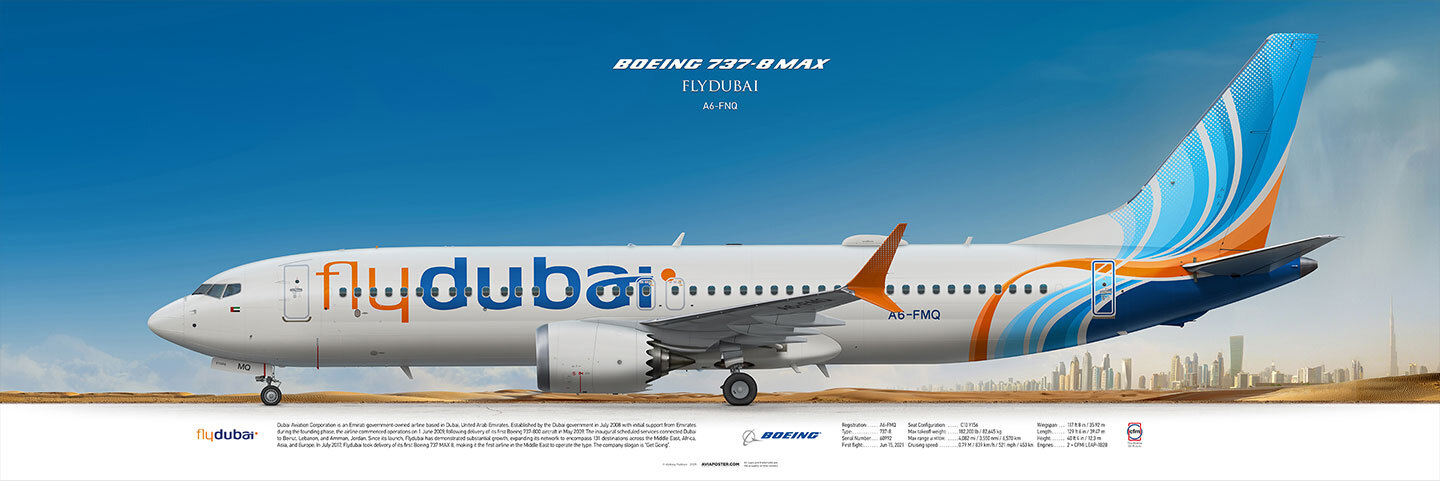
The flydubai livery design is not a simple set of graphic elements, but a carefully conceived visual narrative telling the story of Dubai. Each shade carries semantic weight, turning the aircraft fuselage into a kind of canvas on which the emirate's identity is captured. At its core is a combination of three key colors. Here is rich orange, the color of the sun and golden sands, and deep dark blue and refreshing light blue – the endless sky and azure waters of the Persian Gulf lapping Dubai's famous coastline. Together, these shades create a visual dialogue between earth and sky, desert and sea – two elements that determined Dubai's destiny.
The tail decoration attracts special attention, where the artist uses asymmetrical colored stripes. Their smooth, freely flowing lines are deliberately different on the left and right sides – this is not accidental, but a conceptual decision. Such asymmetry serves as a visual allegory of Dubai's constantly changing coastline. Just as the city itself transforms year after year, adding new skyscrapers and artificial islands, so the pattern on the tail embodies the idea of tireless dynamic development.
Thus, flydubai's livery goes beyond utilitarian design. It becomes a kind of "calling card" of the emirate, where every detail – from color choice to line configuration – tells the story of a place, its nature and people. This is not just aircraft painting, but a carefully calibrated visual code through which the airline broadcasts Dubai's values to the whole world.
From the very beginning, the concept was clear: to connect Dubai with underserved markets where major carriers didn't fly, while offering affordable prices and reliable service. Interestingly, flydubai is often called Emirates' "sister" – both companies are owned by the Dubai government and are even headed by the same person, Sheikh Ahmed bin Saeed Al Maktoum. However, the companies' management is completely independent, and their strategies differ significantly.
While Emirates positions itself as a premium carrier with a focus on long-haul flights using wide-body aircraft, flydubai has focused on short and medium-haul routes with a narrow-body fleet. At the same time, the airline avoids the term "low-cost carrier," preferring to call itself a "hybrid carrier" – after all, it offers both business class with lie-flat seats and an in-flight entertainment system in economy class.
Development History: From First Flight to Global Network
Flydubai's history began in July 2008 with the signing of a contract for the delivery of 50 Boeing 737-800s worth $3.74 billion at the Farnborough Airshow. The choice of a single aircraft type was strategic – it significantly reduced maintenance costs, crew training expenses, and spare parts logistics.
The first aircraft arrived on May 17, 2009, and on June 1, the company operated its first commercial flights to Beirut and Amman. The growth rate was impressive – while in its first year the airline served only a few destinations, by the end of the first decade the network had grown to more than a hundred destinations.
An important milestone came in 2013 when flydubai announced the launch of business class. This decision was a response to corporate client demand and confirmed that the airline was not going to limit itself to an ultra-budget model. The business class cabin received 12 leather seats with increased pitch, 12-inch entertainment system screens, and three-course meals – not a bad package for a low-cost carrier.
Route Network 2024-2025: Connecting Underserved Markets
By the end of 2024, flydubai served 131 destinations in 55 countries – the most extensive network in the company's 15-year history. Notably, 97 of these destinations previously had no direct air service to Dubai. This is precisely where the airline's unique niche lies – it goes where major carriers don't go.
Flydubai's flight geography demonstrates impressive coverage – from Tanzania to Kazakhstan, from Albania to Thailand. The company has managed to build an extensive route network, focusing on regions that often remain in the shadow of major international carriers.
In Eastern Europe, the Balkan countries have become an integral part of its operations, while in the Caucasus, flydubai has established strong positions on routes to Georgia, Armenia, and Azerbaijan. In Central Asia, the airline is actively developing destinations to Uzbekistan, Kazakhstan, and Kyrgyzstan – a region that, despite its great potential, has not yet received proper attention from global players. The African continent is also part of the carrier's strategic interests. Routes to Kenya, Tanzania, Sudan, and Somalia are viewed as promising in terms of future passenger traffic growth. Finally, in the Middle East, flydubai maintains a dense flight network covering Iran (even under sanctions), Iraq, Jordan, and Saudi Arabia. Thus, the company consistently expands its presence in key regions, combining well-established routes with promising new destinations.
In 2025, flydubai launched 11 new routes, among which Antalya, El Alamein (Egypt), Damascus (after a long break due to the war in Syria), and Peshawar (Pakistan) stand out. Special attention is being paid to expansion in the Baltic region – flights to Chisinau, Iasi, Vilnius, and Riga are planned.
The company's strategy is simple but effective: find cities with populations between 500 thousand and 2 million people where there is demand for travel to Dubai and onward transit, but no direct service. Such routes provide stable load factors and good margins while avoiding fierce competition with major carriers.
Russian Direction: The Largest Market Outside the Middle East
Since its founding, flydubai has paid special attention to the Russian market – and this strategy has proven truly successful. As early as 2010, the carrier opened its first flights to Samara and Yekaterinburg, and since then its presence in Russia has steadily expanded.
By 2025, flydubai's route network covers 11 Russian cities, making the airline one of the key players in this direction. Moscow (Vnukovo Airport) remains the main gateway: daily flights depart from here. St. Petersburg is no less important – a route in demand among both tourists and business travelers.
Today, flydubai serves the most significant destinations in Russia. Kazan has become a major hub in the Volga region, Ufa provides connections to Bashkortostan, and Novosibirsk opens the way to Siberia. Makhachkala connects passengers with Dagestan, Mineralnye Vody serves as a gateway to Caucasian resorts, and Sochi attracts lovers of Black Sea vacations. Volgograd completes the list – an important regional center in southern Russia.
Notably, flydubai was the first UAE airline to launch direct flights to many of these cities. Before its appearance, residents of Novosibirsk or Kazan had to fly to Dubai with a connection through Moscow. Now travel has become much more convenient and accessible.
Working in the Russian market has its specifics, and flydubai skillfully adapts to local features. Passenger traffic here is consistently high: among travelers are tourists wishing to enjoy Dubai shopping, beaches, and exotica, as well as business passengers.
Demand fluctuates noticeably depending on the season. The peak falls on winter months when Russians go on New Year holidays, and summer – beach vacation time. In the off-season, the airline adjusts flight frequency, optimizing load factors.
On the Moscow route, flydubai faces competition from Russian carriers – for example, Ural Airlines. However, the airline maintains its position by offering passengers not only direct flights but also convenient transit options. Thanks to the codeshare agreement with Emirates, many passengers use Dubai as a transit point for travel to Asia, Africa, or the Middle East.
Thus, over a decade and a half, flydubai has managed to build a strong network in Russia, combining geographic expansion with a flexible approach to passenger needs. This allows the airline to remain in demand among both tourists and those traveling on business or in transit.
The Importance of the Russian Market
For many Russians, flydubai has become a kind of "window to the world" – especially in recent years, when sanctions and restrictions have complicated air connections with Europe and North America. Through Dubai, access opens to dozens of Asian, African, and Middle Eastern destinations.
The visa-free regime between Russia and the UAE, introduced in 2017, additionally stimulated demand. Russian tourists gained the opportunity to visit Dubai without complex visa procedures, making the emirate an even more attractive destination.
Fleet: Betting on Boeing 737 and Large-Scale Modernization
Flydubai's philosophy has been built from the start on the principle of single fleet type – using one type of aircraft. By the end of 2025, the fleet numbered 96 Boeing 737 family aircraft.
The average fleet age is just 5.3 years – one of the youngest figures among budget carriers in the region. In 2025, four more Boeing 737 MAX 8 aircraft are planned for delivery, bringing the total fleet size to 100 units.
However, reality proved more complex. Due to numerous problems at Boeing with production and certification, flydubai constantly faces delivery delays. Initially, 14 new aircraft were planned for 2024, but only four actually arrived, and all of them were from overdue orders from previous years. CEO Ghaith Al Ghaith has repeatedly expressed disappointment and called on Boeing to "fulfill its obligations."
These delays seriously affect operations – the airline is forced to revise schedules, postpone the launch of new routes, and extend leases on old Boeing 737-800s that were originally planned to be retired from the fleet.
Cabin Modernization Program
Flydubai compensates for the lack of new deliveries with a large-scale modernization program for its existing fleet. Since January 2024, the company has launched a multimillion-dollar project to update Boeing 737-800 cabins, which will continue until the end of 2026.
Since the beginning of 2024, flydubai has embarked on a large-scale renewal of its fleet – without purchasing new aircraft, but with serious modernization of existing ones. The company launched a multimillion-dollar project to transform Boeing 737-800 cabins, which will run until the end of 2026. This initiative is designed not just to refresh the appearance of aircraft, but to bring their competitiveness to a new level.
Special attention is paid to business class: fully lie-flat seats are being installed on Boeing 737-800s – the same as on the newest Boeing 737 MAX. Thanks to this, the old "eight-hundreds" are essentially transformed into long-haul aircraft. They are now capable of confidently competing with traditional carriers on routes lasting 5-6 hours, where passenger comfort is especially important.
No less noticeable changes await economy class passengers. New RECARO seats equipped with an integrated entertainment system have appeared here. Each seat is now equipped with an 11.6-inch HD screen. Passengers can choose from an extensive library of movies, series, music, and games – content is available in English, Arabic, and Russian. This makes long flights noticeably more pleasant and allows everyone to find something to their liking.
Additionally, the company has taken care of comfort on regional routes. On some Boeing 737 MAX aircraft with recliner seats in business class, the seat pitch has been increased: from 45 to 53 inches (135 cm). This solution significantly improves passenger comfort during flights, making the space around each seat more spacious and comfortable.
Thus, flydubai demonstrates that even without acquiring new aircraft, it's possible to seriously upgrade service and increase passenger satisfaction levels. The modernization program is designed to strengthen the airline's market position, combining proven technologies with modern comfort standards.
Most Boeing 737-800 aircraft have undergone modernization, and by the end of 2026 the program will be fully completed. Work is performed both by flydubai's own technical service and by partner GMR Aerotech MRO.
Interestingly, several aircraft will remain in purely economy configuration without business class – they will be used on short, high-frequency routes where demand for premium services is minimal.
Flydubai Livery
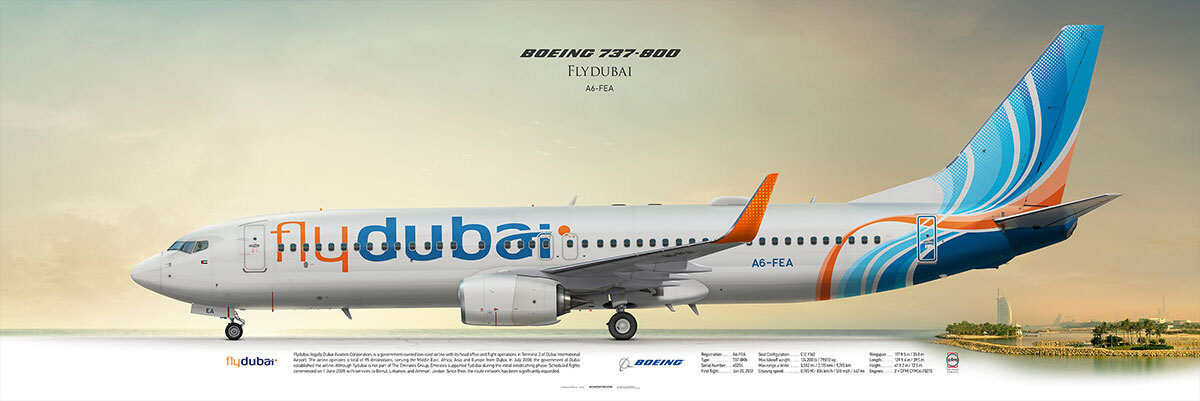
The flydubai livery design is not a simple set of graphic elements, but a carefully conceived visual narrative telling the story of Dubai. Each shade carries semantic weight, turning the aircraft fuselage into a kind of canvas on which the emirate's identity is captured. At its core is a combination of three key colors. Here is rich orange, the color of the sun and golden sands, and deep dark blue and refreshing light blue – the endless sky and azure waters of the Persian Gulf lapping Dubai's famous coastline. Together, these shades create a visual dialogue between earth and sky, desert and sea – two elements that determined Dubai's destiny.
The tail decoration attracts special attention, where the artist uses asymmetrical colored stripes. Their smooth, freely flowing lines are deliberately different on the left and right sides – this is not accidental, but a conceptual decision. Such asymmetry serves as a visual allegory of Dubai's constantly changing coastline. Just as the city itself transforms year after year, adding new skyscrapers and artificial islands, so the pattern on the tail embodies the idea of tireless dynamic development.
Thus, flydubai's livery goes beyond utilitarian design. It becomes a kind of "calling card" of the emirate, where every detail – from color choice to line configuration – tells the story of a place, its nature and people. This is not just aircraft painting, but a carefully calibrated visual code through which the airline broadcasts Dubai's values to the whole world.
Operational Base
Flydubai is based at Terminal 2 of Dubai International Airport (DXB) – an older and more compact terminal compared to the giant Terminal 3, which Emirates occupies. This is a logical division: Terminal 2 is well-suited for narrow-body aircraft on short and medium-haul routes, while Terminal 3 is designed for wide-body long-haul aircraft.
In terms of passenger volume, flydubai is the second-largest operator at DXB after Emirates. Interestingly, flydubai and Emirates are physically separated but operationally connected through one of the most successful codeshare programs in the region.
Codesharing with Emirates: A Key Advantage
Since 2017, an extensive codeshare agreement has been in effect between flydubai and Emirates, allowing passengers of both airlines to easily transfer from one flight to another using a single ticket and through baggage check-in.
Nowadays this is common practice. For example, a passenger from Yekaterinburg buys an Emirates ticket to Sydney via Dubai. The first segment (Yekaterinburg-Dubai) they actually fly on flydubai, and the second (Dubai-Sydney) on Emirates. The entire route is issued as a single Emirates ticket with baggage checked through to the final destination.
For travelers, the collaboration between the two airlines opens up wide opportunities. First, they gain access to an extensive route network – collectively, the airlines serve more than 225 destinations in over 100 countries. Second, passengers can book a single ticket that provides protection in case of a missed connection – this significantly reduces stress from transfers. Third, through baggage check-in operates: travelers don't need to collect and re-check their luggage at the transit airport. Fourth, loyalty program members can accumulate miles – in the Emirates Skywards or flydubai OPEN systems. And finally, an important advantage is convenient connections in Dubai, making transfers as comfortable as possible.
The airlines also derive substantial benefits from the partnership. Flydubai effectively feeds passengers to Emirates' long-haul flights, attracting travelers from regional points. In turn, Emirates gains access to new markets where it's impractical to send wide-body aircraft. Additionally, the airlines share resources – for example, ground and technical services, which helps reduce costs. Finally, the partnership helps optimize the route network: the airlines arrange schedules so as not to compete with each other, but to complement flights, increasing overall transportation efficiency.
By the end of 2024, the codeshare agreement covered more than 100 flydubai destinations and more than 80 Emirates destinations. This is one of the reasons why many passengers choose flydubai over competitors – the convenience of transit through Dubai with onward flights on Emirates.
Additional Services and Revenue Sources
Although flydubai is not a classic ultra-low-cost carrier, the airline successfully applies an ancillary revenue model, generating additional income sources and offering passengers flexible service options.
One of the key sources of additional revenue is seat selection. During online check-in, passengers can occupy a standard seat for free, however, special options – at the exit, in the first rows, or with increased legroom – require an additional payment. The cost varies from $10 to $50 depending on the route.
Baggage service makes a substantial contribution to revenues. The basic fare includes only hand luggage weighing up to 7 kg, while checked baggage (up to 20 kg) is paid separately. The price depends on the destination and ranges from $20 to $80.
In economy class, meals are not included in the ticket price and are offered for an additional fee – from $5 to $15. In business class, on the contrary, meals are already included in the ticket price, which emphasizes the difference in service level between classes.
The OPEN loyalty program plays an important role. Members can accumulate miles, which are then exchanged for airline tickets, class upgrades, and payment for additional services. The program's integration with Emirates Skywards gives it particular value, expanding opportunities for passengers of both airlines.
Finally, flydubai offers additional ancillary services when purchasing tickets. Passengers have access to trip cancellation insurance, car rental, and hotel booking.
This approach allows the airline not only to increase revenue but also to create a comprehensive "turnkey" travel experience for passengers, where all necessary services can be arranged in one place.
Challenges and Difficulties: How flydubai Overcomes Obstacles
Flydubai's journey has not been easy, and the company regularly faces serious challenges.
The problem of delivery delays from Boeing has become the most acute issue. In 2023, flydubai was supposed to receive 14 new Boeing 737 MAX aircraft, but in fact received only four. In 2024, the situation repeated itself.
CEO Ghaith Al Ghaith publicly expressed disappointment: "Boeing must fulfill its obligations. We understand the difficulties, but we need aircraft for growth." The delays force the airline to postpone the launch of new routes, extend leases on old Boeing 737-800s, and revise strategic plans.
Unlike some airlines that have diversified orders between Boeing and Airbus, flydubai remains committed to the single fleet type principle. This makes sense from an operational efficiency standpoint but creates dependence on a single supplier.
After the crashes in Ethiopia (March 2019) and Indonesia (October 2018), regulators worldwide banned Boeing 737 MAX flights. For flydubai, this was a serious blow – at that time, the company had 11 such aircraft, and they constituted a significant portion of the active fleet.
The grounding lasted almost two years, which forced flydubai to revise schedules, reduce flight frequency, and seek alternative solutions. To the company's credit, it did not cancel the 737 MAX order, as some carriers did, but waited for permission to resume flights and gradually introduced these aircraft into operation. Today, the Boeing 737 MAX comprises the majority of flydubai's fleet (70 of 96 aircraft), and the company highly values their characteristics.
The COVID-19 pandemic became one of the most difficult pages in the airline's history. Border closures, flight bans, and falling demand – all this led to a loss of $194 million, the first significant financial setback in the company's entire history.
But flydubai was able not only to survive but also to recover quickly. The airline retained most of its staff thanks to government support, quickly adapted schedules to changing restrictions, and actively worked with cargo transportation on passenger aircraft. Already in 2022, the company returned to profitability.
Also, one cannot forget about flydubai's many destinations, which are challenging markets with difficult conditions. Consider the infrastructural problems, corruption, and political instability in Africa. It's constantly necessary to account for limited infrastructure and harsh winter weather conditions in Central Asia. And finally, it's essential to constantly monitor the situation in the Middle East with its geopolitical risks and endless military conflicts.
The crash in Rostov-on-Don in 2016 reminded of the risks of operating on routes with poor weather conditions and imperfect infrastructure. After this incident, flydubai strengthened crew training and implemented stricter procedures for making landing decisions in difficult conditions.
Fleet Expansion
By the end of 2025, the fleet should reach 100 aircraft, and by 2030 – grow to 120-130 units. The Boeing 737 MAX will remain the backbone of the fleet for the coming years. These aircraft are more fuel-efficient than the previous generation.
In November 2023, at the Dubai Airshow, flydubai made a historic announcement – an order for 30 wide-body Boeing 787-9 Dreamliners. This is the first time the airline is moving beyond the narrow-body segment.
Dreamliner deliveries are scheduled to begin in 2026. These aircraft will allow flydubai to enter long-haul routes – to Southeast Asia, Africa, and possibly even Australia. This is a serious bid for a new role in regional aviation and potential competition with Emirates itself on some routes.
Conclusion: From Startup to Key Player
Over 15 years, flydubai's story has become a vivid example of how an ambitious startup, launched in difficult times, can grow into a major regional aviation market player. The company was born in the midst of the global financial crisis – a moment when many doubted the feasibility of new aviation projects. However, today flydubai manages a fleet of nearly 100 aircraft and connects passengers with 55 countries worldwide. What is the secret of such an impressive rise? The answer lies in a well-thought-out combination of strategic decisions and favorable conditions.
First and foremost, the company bet on underserved markets. Instead of entering into direct competition with aviation giants, flydubai purposefully sought niches – destinations where demand for flights existed but supply was limited. This allowed it to quickly win a loyal audience and build a sustainable business model.
No less important was the choice of a hybrid operating model. The airline found a golden mean between the rigid principles of low-cost carriers and the service of traditional carriers. Passengers gained access to affordable fares but could also count on a certain level of comfort and additional services – this balance appealed to a wide audience.
The synergy with Emirates played a special role. The codeshare agreement between the two carriers transformed them into a unified transportation system covering more than 225 destinations. Passengers benefited from an expanded route network and convenient connections in Dubai, while the airlines benefited from resource optimization and mutual passenger flow supplementation.
Government support became an important foundation for success. Financial stability provided by the Dubai government allowed the company not only to survive economic crises but also to systematically invest in development – renewing the fleet, expanding the network, and improving service quality.
Finally, operational discipline played a key role. The single fleet type principle (using a homogeneous aircraft fleet) simplified technical maintenance and personnel training. Effective cost management kept prices competitive, while unwavering adherence to high safety standards strengthened passenger trust.
Thus, a combination of forward-thinking strategy, partnerships, government support, and strict operational discipline transformed flydubai from a modest startup into one of the leaders in regional air connectivity.
Ahead for flydubai is a new chapter in its history with entry into long-haul routes thanks to the Boeing 787 Dreamliner. This is an ambitious step that could change the very essence of the airline. Will flydubai be able to maintain its efficiency when transitioning to a wide-body fleet? How will it compete with Emirates on long-haul routes? These questions will become key in the coming years.
One thing can be said for certain: flydubai has proven its viability, having survived financial crises, a pandemic, delivery delays, and geopolitical upheavals. And if the first 15 years were a story of formation, the next 15 promise to be a story of expansion and reaching a new level.
For passengers – especially from Russia, Central Asia, Eastern Europe, and other regions where flydubai has become an important link to the world – the company remains a reliable and affordable way to reach Dubai and beyond around the world. And this is perhaps the best assessment of any airline's success.
Flydubai is based at Terminal 2 of Dubai International Airport (DXB) – an older and more compact terminal compared to the giant Terminal 3, which Emirates occupies. This is a logical division: Terminal 2 is well-suited for narrow-body aircraft on short and medium-haul routes, while Terminal 3 is designed for wide-body long-haul aircraft.
In terms of passenger volume, flydubai is the second-largest operator at DXB after Emirates. Interestingly, flydubai and Emirates are physically separated but operationally connected through one of the most successful codeshare programs in the region.
Codesharing with Emirates: A Key Advantage
Since 2017, an extensive codeshare agreement has been in effect between flydubai and Emirates, allowing passengers of both airlines to easily transfer from one flight to another using a single ticket and through baggage check-in.
Nowadays this is common practice. For example, a passenger from Yekaterinburg buys an Emirates ticket to Sydney via Dubai. The first segment (Yekaterinburg-Dubai) they actually fly on flydubai, and the second (Dubai-Sydney) on Emirates. The entire route is issued as a single Emirates ticket with baggage checked through to the final destination.
For travelers, the collaboration between the two airlines opens up wide opportunities. First, they gain access to an extensive route network – collectively, the airlines serve more than 225 destinations in over 100 countries. Second, passengers can book a single ticket that provides protection in case of a missed connection – this significantly reduces stress from transfers. Third, through baggage check-in operates: travelers don't need to collect and re-check their luggage at the transit airport. Fourth, loyalty program members can accumulate miles – in the Emirates Skywards or flydubai OPEN systems. And finally, an important advantage is convenient connections in Dubai, making transfers as comfortable as possible.
The airlines also derive substantial benefits from the partnership. Flydubai effectively feeds passengers to Emirates' long-haul flights, attracting travelers from regional points. In turn, Emirates gains access to new markets where it's impractical to send wide-body aircraft. Additionally, the airlines share resources – for example, ground and technical services, which helps reduce costs. Finally, the partnership helps optimize the route network: the airlines arrange schedules so as not to compete with each other, but to complement flights, increasing overall transportation efficiency.
By the end of 2024, the codeshare agreement covered more than 100 flydubai destinations and more than 80 Emirates destinations. This is one of the reasons why many passengers choose flydubai over competitors – the convenience of transit through Dubai with onward flights on Emirates.
Additional Services and Revenue Sources
Although flydubai is not a classic ultra-low-cost carrier, the airline successfully applies an ancillary revenue model, generating additional income sources and offering passengers flexible service options.
One of the key sources of additional revenue is seat selection. During online check-in, passengers can occupy a standard seat for free, however, special options – at the exit, in the first rows, or with increased legroom – require an additional payment. The cost varies from $10 to $50 depending on the route.
Baggage service makes a substantial contribution to revenues. The basic fare includes only hand luggage weighing up to 7 kg, while checked baggage (up to 20 kg) is paid separately. The price depends on the destination and ranges from $20 to $80.
In economy class, meals are not included in the ticket price and are offered for an additional fee – from $5 to $15. In business class, on the contrary, meals are already included in the ticket price, which emphasizes the difference in service level between classes.
The OPEN loyalty program plays an important role. Members can accumulate miles, which are then exchanged for airline tickets, class upgrades, and payment for additional services. The program's integration with Emirates Skywards gives it particular value, expanding opportunities for passengers of both airlines.
Finally, flydubai offers additional ancillary services when purchasing tickets. Passengers have access to trip cancellation insurance, car rental, and hotel booking.
This approach allows the airline not only to increase revenue but also to create a comprehensive "turnkey" travel experience for passengers, where all necessary services can be arranged in one place.
Challenges and Difficulties: How flydubai Overcomes Obstacles
Flydubai's journey has not been easy, and the company regularly faces serious challenges.
The problem of delivery delays from Boeing has become the most acute issue. In 2023, flydubai was supposed to receive 14 new Boeing 737 MAX aircraft, but in fact received only four. In 2024, the situation repeated itself.
CEO Ghaith Al Ghaith publicly expressed disappointment: "Boeing must fulfill its obligations. We understand the difficulties, but we need aircraft for growth." The delays force the airline to postpone the launch of new routes, extend leases on old Boeing 737-800s, and revise strategic plans.
Unlike some airlines that have diversified orders between Boeing and Airbus, flydubai remains committed to the single fleet type principle. This makes sense from an operational efficiency standpoint but creates dependence on a single supplier.
After the crashes in Ethiopia (March 2019) and Indonesia (October 2018), regulators worldwide banned Boeing 737 MAX flights. For flydubai, this was a serious blow – at that time, the company had 11 such aircraft, and they constituted a significant portion of the active fleet.
The grounding lasted almost two years, which forced flydubai to revise schedules, reduce flight frequency, and seek alternative solutions. To the company's credit, it did not cancel the 737 MAX order, as some carriers did, but waited for permission to resume flights and gradually introduced these aircraft into operation. Today, the Boeing 737 MAX comprises the majority of flydubai's fleet (70 of 96 aircraft), and the company highly values their characteristics.
The COVID-19 pandemic became one of the most difficult pages in the airline's history. Border closures, flight bans, and falling demand – all this led to a loss of $194 million, the first significant financial setback in the company's entire history.
But flydubai was able not only to survive but also to recover quickly. The airline retained most of its staff thanks to government support, quickly adapted schedules to changing restrictions, and actively worked with cargo transportation on passenger aircraft. Already in 2022, the company returned to profitability.
Also, one cannot forget about flydubai's many destinations, which are challenging markets with difficult conditions. Consider the infrastructural problems, corruption, and political instability in Africa. It's constantly necessary to account for limited infrastructure and harsh winter weather conditions in Central Asia. And finally, it's essential to constantly monitor the situation in the Middle East with its geopolitical risks and endless military conflicts.
The crash in Rostov-on-Don in 2016 reminded of the risks of operating on routes with poor weather conditions and imperfect infrastructure. After this incident, flydubai strengthened crew training and implemented stricter procedures for making landing decisions in difficult conditions.
Fleet Expansion
By the end of 2025, the fleet should reach 100 aircraft, and by 2030 – grow to 120-130 units. The Boeing 737 MAX will remain the backbone of the fleet for the coming years. These aircraft are more fuel-efficient than the previous generation.
In November 2023, at the Dubai Airshow, flydubai made a historic announcement – an order for 30 wide-body Boeing 787-9 Dreamliners. This is the first time the airline is moving beyond the narrow-body segment.
Dreamliner deliveries are scheduled to begin in 2026. These aircraft will allow flydubai to enter long-haul routes – to Southeast Asia, Africa, and possibly even Australia. This is a serious bid for a new role in regional aviation and potential competition with Emirates itself on some routes.
Conclusion: From Startup to Key Player
Over 15 years, flydubai's story has become a vivid example of how an ambitious startup, launched in difficult times, can grow into a major regional aviation market player. The company was born in the midst of the global financial crisis – a moment when many doubted the feasibility of new aviation projects. However, today flydubai manages a fleet of nearly 100 aircraft and connects passengers with 55 countries worldwide. What is the secret of such an impressive rise? The answer lies in a well-thought-out combination of strategic decisions and favorable conditions.
First and foremost, the company bet on underserved markets. Instead of entering into direct competition with aviation giants, flydubai purposefully sought niches – destinations where demand for flights existed but supply was limited. This allowed it to quickly win a loyal audience and build a sustainable business model.
No less important was the choice of a hybrid operating model. The airline found a golden mean between the rigid principles of low-cost carriers and the service of traditional carriers. Passengers gained access to affordable fares but could also count on a certain level of comfort and additional services – this balance appealed to a wide audience.
The synergy with Emirates played a special role. The codeshare agreement between the two carriers transformed them into a unified transportation system covering more than 225 destinations. Passengers benefited from an expanded route network and convenient connections in Dubai, while the airlines benefited from resource optimization and mutual passenger flow supplementation.
Government support became an important foundation for success. Financial stability provided by the Dubai government allowed the company not only to survive economic crises but also to systematically invest in development – renewing the fleet, expanding the network, and improving service quality.
Finally, operational discipline played a key role. The single fleet type principle (using a homogeneous aircraft fleet) simplified technical maintenance and personnel training. Effective cost management kept prices competitive, while unwavering adherence to high safety standards strengthened passenger trust.
Thus, a combination of forward-thinking strategy, partnerships, government support, and strict operational discipline transformed flydubai from a modest startup into one of the leaders in regional air connectivity.
Ahead for flydubai is a new chapter in its history with entry into long-haul routes thanks to the Boeing 787 Dreamliner. This is an ambitious step that could change the very essence of the airline. Will flydubai be able to maintain its efficiency when transitioning to a wide-body fleet? How will it compete with Emirates on long-haul routes? These questions will become key in the coming years.
One thing can be said for certain: flydubai has proven its viability, having survived financial crises, a pandemic, delivery delays, and geopolitical upheavals. And if the first 15 years were a story of formation, the next 15 promise to be a story of expansion and reaching a new level.
For passengers – especially from Russia, Central Asia, Eastern Europe, and other regions where flydubai has become an important link to the world – the company remains a reliable and affordable way to reach Dubai and beyond around the world. And this is perhaps the best assessment of any airline's success.