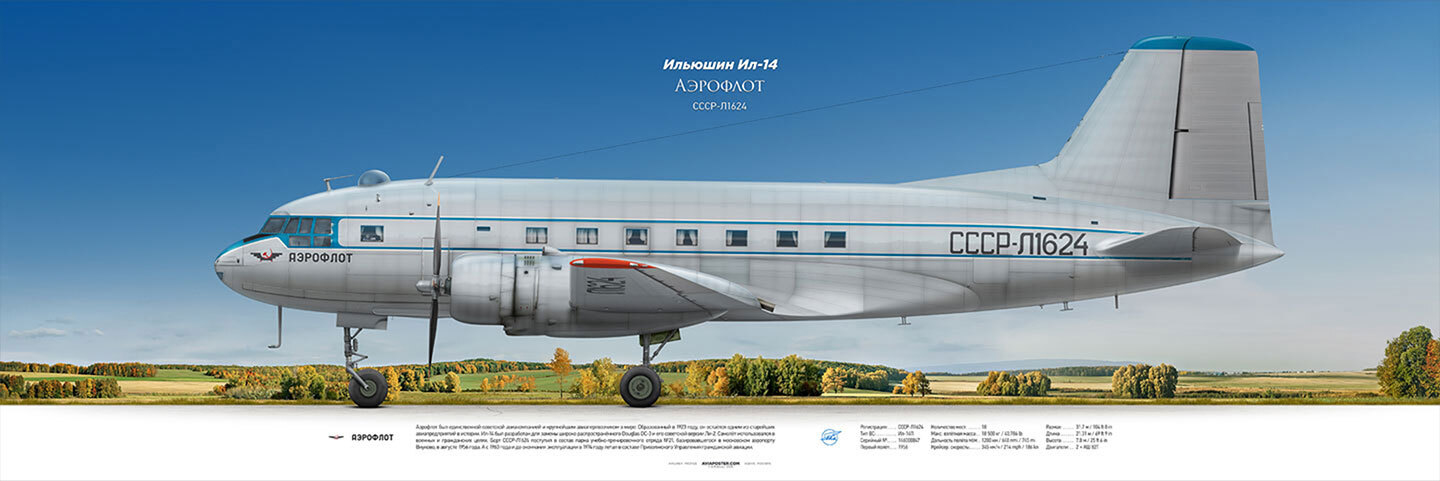
Background: From the Li-2 to the Il-12 and Beyond
By the mid-1940s, Soviet civil aviation rested almost entirely on a single aircraft — the Li-2, a licence-built copy of the American Douglas DC-3. The type was reliable and undemanding, but by the end of the war it had become hopelessly obsolete: a cramped cabin, modest cruising speed and limited range. The demand for an entirely new Soviet passenger aircraft was plain to see.
The answer from Sergei Ilyushin's design bureau was the Il-12, which made its maiden flight in 1945. Compared with the Li-2 it was markedly more modern: an all-metal structure, two powerful ASh-82FN engines and a tricycle undercarriage with a nose wheel — a significant innovation for its day. Aeroflot began scheduled operations with the Il-12 in 1947, and at first the type seemed to be exactly what Soviet civil aviation had been waiting for. In service, however, a serious flaw emerged: if one engine failed on take-off, the Il-12 struggled to maintain height and could often not complete the take-off run safely. This was not a design defect as such, but a consequence of the original calculations: the aircraft had been designed with enough thrust surplus to maintain level flight on one engine, but not to continue a take-off after an engine loss.
A series of accidents made it clear that the problem had to be solved decisively. As early as the end of 1946, barely having finished state trials of the Il-12, the Ilyushin OKB set to work on a fundamentally different aircraft — one that could be guaranteed to survive an engine failure right on the take-off run.
Birth of the Aircraft
The initial concept was straightforward: take the Il-12 and fit it with considerably more powerful ASh-73 engines, designed by Arkady Shvetsov. The additional thrust, it was assumed, would solve the single-engine take-off problem on its own. A prototype with this layout was built — and it disappointed: the gain in thrust was cancelled out by increased drag and greater weight. A continued take-off on one engine remained as problematic as before.
The designers then took a fundamentally different approach. Rather than chasing more power, they decided to redesign the aircraft from the ground up. A completely new wing was developed, with a different aerofoil section and far more effective high-lift devices. The wing's aerodynamic efficiency across the take-off speed range became noticeably higher than that of the Il-12. At the same time, the time required to retract the undercarriage after lift-off and to feather the propeller was reduced — precious seconds during which the aircraft is most vulnerable.
The engine, meanwhile, remained essentially unchanged — the ASh-82FN already proven on the Il-12, merely uprated to the ASh-82T variant. The increase in power amounted to just about 50 horsepower — a negligible figure. But it was precisely the combination of improved aerodynamics with a reliable, well-understood engine that delivered the desired result.
Beyond the wing, the designers reconsidered the aircraft's centre-of-gravity envelope. The new Il-14 received a more forward operational trim — 12–19% of the mean aerodynamic chord, compared with 19–22% on its predecessor. This improved ground stability and made it possible to dispense with the tail bumper, which had become a relic.
The first prototype Il-14 flew on 13 July 1950. Testing continued for several years, accompanied by numerous refinements. In 1953 a decree of the USSR Council of Ministers launched series production at two factories: in Tashkent and in Moscow (Plant No. 30). Manufacturing licences were granted to Czechoslovakia and East Germany — an exceptional arrangement in the history of Soviet civil aircraft production. In total, 1,348 aircraft were built: 1,065 in the USSR, 203 in Czechoslovakia and 80 in East Germany.
On Aeroflot's Routes: The Dependable Workhorse of the Fifties
On 30 November 1954, the first scheduled passenger service operated by an Il-14P (registered USSR-L5054) opened a new chapter in the history of Soviet civil aviation. The suffix "P" stood for passazhirsky — "passenger" — distinguishing this variant from the transport Il-14T. The initial cabin layout seated 18 passengers; later came the Il-14M ("modified"), with a stretched fuselage accommodating 24, while the Czechoslovak factories produced the AVIA-14 with room for 32 or even 42.
The new aircraft quickly earned a reputation for reliability and safety. In many respects it was the Il-14 that shaped the image of Soviet civil aviation as a serious and trustworthy mode of transport. Advanced radio-navigation equipment for its time — combined with an expanding network of ground-based radio aids — allowed Aeroflot crews to master regular scheduled flights in adverse weather and at night, including instrument approaches. This represented a genuine revolution for Soviet air transport.
The fleet grew rapidly: in 1954 Aeroflot operated 28 Il-14s, by 1955 the number had risen to 52, and by 1956 to 115. By the mid-1950s the Il-14P had become Aeroflot's principal mainline aircraft, and right through to the early 1960s it and the slightly more capacious Il-14M formed the backbone of Soviet domestic and international routes.
The aircraft confirmed its reputation at the highest level. In 1955, during a major diplomatic tour to India, Burma and Afghanistan, ten Il-14Ps flown by a Soviet government delegation covered a combined distance of some 22,500 kilometres without a single technical failure. It was the best possible advertisement: First Secretary Nikita Khrushchev and his colleagues were on board, and any malfunction would have been a disaster not only in technical terms but in political ones.
Aeroflot's Il-14 network spanned the entire Soviet Union — from the Baltic to the Far East, from Arkhangelsk to Tashkent. The relatively small aircraft was particularly valuable on medium and short-haul routes where larger airliners simply did not fit. The Il-14 linked Moscow with dozens of provincial cities and connected regional centres with one another. For many Soviet citizens, a flight on the Il-14 was their very first experience of air travel.
Gradually, the jet-powered Tu-104 (from 1956) and the turboprop Il-18 (from 1959) arrived on the main trunk routes. They were faster, roomier and more prestigious. Yet even after their appearance the Il-14 was far from redundant: it occupied a niche that the larger types could not fill — short routes, small aerodromes, services with insufficient traffic to justify a bigger aircraft.
"The Polar Fleet": To the Arctic and Antarctica
If on the mainline routes the Il-14 was simply a hardworking component of the fleet, in polar aviation it became a genuine legend — and it was here that its exceptional qualities were fully revealed.
By the mid-1950s, Soviet polar aviation had moved beyond mainly reconnaissance and occasional expedition flights to systematic, sustained operations: drifting "North Pole" stations, high-latitude Arctic expeditions, ice reconnaissance to guide vessels through the Northern Sea Route. All of this required an aircraft combining reliability, range, tolerance of primitive airstrips and the ability to operate in extreme cold. The Il-14 — and especially its transport variant, the Il-14T — met these requirements better than any other Soviet type of the period.
Arctic operations were conducted in temperatures down to minus 70 degrees Celsius, in conditions of severe icing, in the thin air of high altitudes. Ice-reconnaissance aircraft were fitted with airborne radar. Take-offs and landings were frequently made not from prepared aerodromes but directly onto the ice — onto surfaces chosen from the air, sometimes with very limited available run. The simplicity of maintenance, which the designers had initially regarded merely as a bonus, proved to be a life-or-death quality in polar conditions: the technical crew on an ice floe might be two or three people working in the frost with a limited set of tools, and the aircraft had to allow all necessary servicing to be carried out in such circumstances.
In 1962, a specialised Arctic variant of the Il-14P was tested, fitted with retractable ski undercarriage. The skis allowed the aircraft to land on soft snow and thin ice unsuitable for wheel-equipped machines. Some polar Il-14s were additionally equipped with JATO — solid-fuel rocket-assisted take-off units — to help the aircraft get airborne from the high-altitude glacial plateaux of Antarctica, where the thin air sharply reduced both engine thrust and wing lift.
The Antarctic chapter of the Il-14's story began later than the Arctic one. The first Soviet Antarctic expedition of 1955–57 operated aircraft of an older generation — the Il-12 and the Li-2. The Il-14 followed and quickly became indispensable on the continent. Additional fuel tanks were fitted to extend range, enabling non-stop flights between Soviet Antarctic stations separated by distances of up to 4,000 kilometres. Mirny, Vostok, Molodezhnaya, Bellingshausen — all of these stations were connected by air routes traced across the white silence aboard the Il-14.
On 9 February 1981, a Soviet Il-14 became the first aircraft of its type to land at the South Geographical Pole — an event that entered the history of polar aviation. Until 1990, the bulk of intra-continental air transport in Antarctica was carried out by aircraft of this type.
Alongside the Antarctic missions, Arctic work continued without pause. The polar division operated dedicated scheduled services from the mainland: routes 803 (Moscow–Pevek), 805 (Moscow–Khatanga) and 807 (Moscow–Tiksi) were flown on Il-14s, linking remote Arctic settlements with the rest of the country. The aircraft sustained the life of gold-mines, ore-extraction facilities, fur-trading posts and fishing cooperatives that would otherwise have been cut off from the wider world for months at a time.
The memoirs of polar pilots of that era form a genre of their own in Soviet aviation literature. In them the Il-14 appears not merely as a working tool but as something close to a living being — dependable, predictable, forgiving of mistakes. "An honest machine" was what the pilots called it, meaning that the aircraft always gave the crew a chance to recover a difficult situation and did not punish small errors with instant catastrophe.
Twilight: The An-24 Takes Over
By the early 1960s it was clear that the piston era in Soviet aviation was drawing to a close. The Il-14 had long since been displaced from the main trunk routes by faster types. Now the turn of the regional services had come.
The Antonov design bureau produced the An-24 — a turboprop aircraft designed specifically to replace the piston-engined Il-14s on short and medium routes. The An-24 made its first flight in October 1959; by September 1962 it had entered regular scheduled service with Aeroflot. The advantages of the new type were obvious: the AI-24 turboprop engines were more economical and reliable than the piston ASh-82T. Cruising speed rose from 320 to 450 km/h and capacity increased to 50 seats. Crucially, the An-24 could also operate from unpaved and poorly equipped aerodromes — occupying exactly the niche in which the Il-14 had previously reigned.
From the mid-1960s, the An-24 began methodically displacing the Il-14 from regional routes. The process was gradual: the Il-14 fleet was not written off at a stroke but shifted progressively to ever more marginal routes — Siberia, the Far North, Central Asia, the Far East. Where aerodromes were small and passenger numbers modest, the 18–24-seat Il-14 was actually preferable to the 50-seat An-24.
The 1980s brought the final act. On 19 December 1984, the Minister of Civil Aviation of the USSR signed Order No. 268, directing that mass retirement of Il-14s should begin in 1985–86 as the aircraft reached the end of their calendar service lives. The certificated life had been extended repeatedly — precisely because of the type's irreplaceability in polar conditions and the absence of a suitable successor for the most remote aerodromes. But it could not be extended indefinitely.
The Il-14 was officially withdrawn from Aeroflot's scheduled passenger services in 1989 — exactly 35 years after commercial operations had begun. It was a longevity record for a Soviet passenger airliner.
Notably, the aircraft's long career was explained not only by its outstanding qualities. The Il-14 found itself in a paradoxical position: it simply had no direct successor. The An-24 was larger and more expensive to operate on routes with minimal passenger numbers. The An-28 and the Let L-410 arrived late and in small quantities. For the smallest and most demanding aerodromes of the USSR, nothing was ever produced that fully replicated the Il-14's versatility — and that, perhaps, is the finest tribute one could pay the aircraft.
Legacy
The Il-14 was the last Soviet passenger aircraft with piston engines — the end of an entire technological era. After it, Soviet aviation moved into the world of turbines and jets and never looked back.
But the significance goes beyond the symbolic. The Il-14 accomplished something concrete and far from simple: it turned Soviet civil aviation into a genuinely mass form of transport. It was during the years of its dominance that aviation ceased to be the preserve of the few and became something familiar and accessible to millions of Soviet citizens. Radio navigation, night services, instrument approaches in difficult weather — all of this became routine precisely when the Il-14 took to the skies in large numbers.
In polar aviation its legacy is beyond calculation. It was the Il-14 that pioneered routes later served by the heavier Il-18. It was the Il-14 that sustained the Soviet Antarctic stations at a time when there was simply no alternative.
Today Russia has no indigenous aircraft of its own for servicing polar stations, and foreign — principally Canadian — types have had to fill the gap. To address this situation, a mock-up of the modernised Il-114-300 was presented in June 2015 at the Army-2015 forum, and the programme for developing Antarctica envisaged a ski-wheel variant that would serve as the direct successor to the polar Il-14. This specialised version would provide autonomous links between remote scientific stations on snow and ice airstrips, without requiring the construction of full-length paved runways.
Today a handful of airworthy Il-14s survive in Russia — preserved by aviation enthusiasts and carrying the names Pingvin ("Penguin") and Golubyaya Mechta ("Blue Dream"). They are kept flying by small teams of volunteers. Aircraft now more than six decades old still take to the air — a living reminder that a well-conceived design does not grow old.
By the mid-1940s, Soviet civil aviation rested almost entirely on a single aircraft — the Li-2, a licence-built copy of the American Douglas DC-3. The type was reliable and undemanding, but by the end of the war it had become hopelessly obsolete: a cramped cabin, modest cruising speed and limited range. The demand for an entirely new Soviet passenger aircraft was plain to see.
The answer from Sergei Ilyushin's design bureau was the Il-12, which made its maiden flight in 1945. Compared with the Li-2 it was markedly more modern: an all-metal structure, two powerful ASh-82FN engines and a tricycle undercarriage with a nose wheel — a significant innovation for its day. Aeroflot began scheduled operations with the Il-12 in 1947, and at first the type seemed to be exactly what Soviet civil aviation had been waiting for. In service, however, a serious flaw emerged: if one engine failed on take-off, the Il-12 struggled to maintain height and could often not complete the take-off run safely. This was not a design defect as such, but a consequence of the original calculations: the aircraft had been designed with enough thrust surplus to maintain level flight on one engine, but not to continue a take-off after an engine loss.
A series of accidents made it clear that the problem had to be solved decisively. As early as the end of 1946, barely having finished state trials of the Il-12, the Ilyushin OKB set to work on a fundamentally different aircraft — one that could be guaranteed to survive an engine failure right on the take-off run.
Birth of the Aircraft
The initial concept was straightforward: take the Il-12 and fit it with considerably more powerful ASh-73 engines, designed by Arkady Shvetsov. The additional thrust, it was assumed, would solve the single-engine take-off problem on its own. A prototype with this layout was built — and it disappointed: the gain in thrust was cancelled out by increased drag and greater weight. A continued take-off on one engine remained as problematic as before.
The designers then took a fundamentally different approach. Rather than chasing more power, they decided to redesign the aircraft from the ground up. A completely new wing was developed, with a different aerofoil section and far more effective high-lift devices. The wing's aerodynamic efficiency across the take-off speed range became noticeably higher than that of the Il-12. At the same time, the time required to retract the undercarriage after lift-off and to feather the propeller was reduced — precious seconds during which the aircraft is most vulnerable.
The engine, meanwhile, remained essentially unchanged — the ASh-82FN already proven on the Il-12, merely uprated to the ASh-82T variant. The increase in power amounted to just about 50 horsepower — a negligible figure. But it was precisely the combination of improved aerodynamics with a reliable, well-understood engine that delivered the desired result.
Beyond the wing, the designers reconsidered the aircraft's centre-of-gravity envelope. The new Il-14 received a more forward operational trim — 12–19% of the mean aerodynamic chord, compared with 19–22% on its predecessor. This improved ground stability and made it possible to dispense with the tail bumper, which had become a relic.
The first prototype Il-14 flew on 13 July 1950. Testing continued for several years, accompanied by numerous refinements. In 1953 a decree of the USSR Council of Ministers launched series production at two factories: in Tashkent and in Moscow (Plant No. 30). Manufacturing licences were granted to Czechoslovakia and East Germany — an exceptional arrangement in the history of Soviet civil aircraft production. In total, 1,348 aircraft were built: 1,065 in the USSR, 203 in Czechoslovakia and 80 in East Germany.
On Aeroflot's Routes: The Dependable Workhorse of the Fifties
On 30 November 1954, the first scheduled passenger service operated by an Il-14P (registered USSR-L5054) opened a new chapter in the history of Soviet civil aviation. The suffix "P" stood for passazhirsky — "passenger" — distinguishing this variant from the transport Il-14T. The initial cabin layout seated 18 passengers; later came the Il-14M ("modified"), with a stretched fuselage accommodating 24, while the Czechoslovak factories produced the AVIA-14 with room for 32 or even 42.
The new aircraft quickly earned a reputation for reliability and safety. In many respects it was the Il-14 that shaped the image of Soviet civil aviation as a serious and trustworthy mode of transport. Advanced radio-navigation equipment for its time — combined with an expanding network of ground-based radio aids — allowed Aeroflot crews to master regular scheduled flights in adverse weather and at night, including instrument approaches. This represented a genuine revolution for Soviet air transport.
The fleet grew rapidly: in 1954 Aeroflot operated 28 Il-14s, by 1955 the number had risen to 52, and by 1956 to 115. By the mid-1950s the Il-14P had become Aeroflot's principal mainline aircraft, and right through to the early 1960s it and the slightly more capacious Il-14M formed the backbone of Soviet domestic and international routes.
The aircraft confirmed its reputation at the highest level. In 1955, during a major diplomatic tour to India, Burma and Afghanistan, ten Il-14Ps flown by a Soviet government delegation covered a combined distance of some 22,500 kilometres without a single technical failure. It was the best possible advertisement: First Secretary Nikita Khrushchev and his colleagues were on board, and any malfunction would have been a disaster not only in technical terms but in political ones.
Aeroflot's Il-14 network spanned the entire Soviet Union — from the Baltic to the Far East, from Arkhangelsk to Tashkent. The relatively small aircraft was particularly valuable on medium and short-haul routes where larger airliners simply did not fit. The Il-14 linked Moscow with dozens of provincial cities and connected regional centres with one another. For many Soviet citizens, a flight on the Il-14 was their very first experience of air travel.
Gradually, the jet-powered Tu-104 (from 1956) and the turboprop Il-18 (from 1959) arrived on the main trunk routes. They were faster, roomier and more prestigious. Yet even after their appearance the Il-14 was far from redundant: it occupied a niche that the larger types could not fill — short routes, small aerodromes, services with insufficient traffic to justify a bigger aircraft.
"The Polar Fleet": To the Arctic and Antarctica
If on the mainline routes the Il-14 was simply a hardworking component of the fleet, in polar aviation it became a genuine legend — and it was here that its exceptional qualities were fully revealed.
By the mid-1950s, Soviet polar aviation had moved beyond mainly reconnaissance and occasional expedition flights to systematic, sustained operations: drifting "North Pole" stations, high-latitude Arctic expeditions, ice reconnaissance to guide vessels through the Northern Sea Route. All of this required an aircraft combining reliability, range, tolerance of primitive airstrips and the ability to operate in extreme cold. The Il-14 — and especially its transport variant, the Il-14T — met these requirements better than any other Soviet type of the period.
Arctic operations were conducted in temperatures down to minus 70 degrees Celsius, in conditions of severe icing, in the thin air of high altitudes. Ice-reconnaissance aircraft were fitted with airborne radar. Take-offs and landings were frequently made not from prepared aerodromes but directly onto the ice — onto surfaces chosen from the air, sometimes with very limited available run. The simplicity of maintenance, which the designers had initially regarded merely as a bonus, proved to be a life-or-death quality in polar conditions: the technical crew on an ice floe might be two or three people working in the frost with a limited set of tools, and the aircraft had to allow all necessary servicing to be carried out in such circumstances.
In 1962, a specialised Arctic variant of the Il-14P was tested, fitted with retractable ski undercarriage. The skis allowed the aircraft to land on soft snow and thin ice unsuitable for wheel-equipped machines. Some polar Il-14s were additionally equipped with JATO — solid-fuel rocket-assisted take-off units — to help the aircraft get airborne from the high-altitude glacial plateaux of Antarctica, where the thin air sharply reduced both engine thrust and wing lift.
The Antarctic chapter of the Il-14's story began later than the Arctic one. The first Soviet Antarctic expedition of 1955–57 operated aircraft of an older generation — the Il-12 and the Li-2. The Il-14 followed and quickly became indispensable on the continent. Additional fuel tanks were fitted to extend range, enabling non-stop flights between Soviet Antarctic stations separated by distances of up to 4,000 kilometres. Mirny, Vostok, Molodezhnaya, Bellingshausen — all of these stations were connected by air routes traced across the white silence aboard the Il-14.
On 9 February 1981, a Soviet Il-14 became the first aircraft of its type to land at the South Geographical Pole — an event that entered the history of polar aviation. Until 1990, the bulk of intra-continental air transport in Antarctica was carried out by aircraft of this type.
Alongside the Antarctic missions, Arctic work continued without pause. The polar division operated dedicated scheduled services from the mainland: routes 803 (Moscow–Pevek), 805 (Moscow–Khatanga) and 807 (Moscow–Tiksi) were flown on Il-14s, linking remote Arctic settlements with the rest of the country. The aircraft sustained the life of gold-mines, ore-extraction facilities, fur-trading posts and fishing cooperatives that would otherwise have been cut off from the wider world for months at a time.
The memoirs of polar pilots of that era form a genre of their own in Soviet aviation literature. In them the Il-14 appears not merely as a working tool but as something close to a living being — dependable, predictable, forgiving of mistakes. "An honest machine" was what the pilots called it, meaning that the aircraft always gave the crew a chance to recover a difficult situation and did not punish small errors with instant catastrophe.
Twilight: The An-24 Takes Over
By the early 1960s it was clear that the piston era in Soviet aviation was drawing to a close. The Il-14 had long since been displaced from the main trunk routes by faster types. Now the turn of the regional services had come.
The Antonov design bureau produced the An-24 — a turboprop aircraft designed specifically to replace the piston-engined Il-14s on short and medium routes. The An-24 made its first flight in October 1959; by September 1962 it had entered regular scheduled service with Aeroflot. The advantages of the new type were obvious: the AI-24 turboprop engines were more economical and reliable than the piston ASh-82T. Cruising speed rose from 320 to 450 km/h and capacity increased to 50 seats. Crucially, the An-24 could also operate from unpaved and poorly equipped aerodromes — occupying exactly the niche in which the Il-14 had previously reigned.
From the mid-1960s, the An-24 began methodically displacing the Il-14 from regional routes. The process was gradual: the Il-14 fleet was not written off at a stroke but shifted progressively to ever more marginal routes — Siberia, the Far North, Central Asia, the Far East. Where aerodromes were small and passenger numbers modest, the 18–24-seat Il-14 was actually preferable to the 50-seat An-24.
The 1980s brought the final act. On 19 December 1984, the Minister of Civil Aviation of the USSR signed Order No. 268, directing that mass retirement of Il-14s should begin in 1985–86 as the aircraft reached the end of their calendar service lives. The certificated life had been extended repeatedly — precisely because of the type's irreplaceability in polar conditions and the absence of a suitable successor for the most remote aerodromes. But it could not be extended indefinitely.
The Il-14 was officially withdrawn from Aeroflot's scheduled passenger services in 1989 — exactly 35 years after commercial operations had begun. It was a longevity record for a Soviet passenger airliner.
Notably, the aircraft's long career was explained not only by its outstanding qualities. The Il-14 found itself in a paradoxical position: it simply had no direct successor. The An-24 was larger and more expensive to operate on routes with minimal passenger numbers. The An-28 and the Let L-410 arrived late and in small quantities. For the smallest and most demanding aerodromes of the USSR, nothing was ever produced that fully replicated the Il-14's versatility — and that, perhaps, is the finest tribute one could pay the aircraft.
Legacy
The Il-14 was the last Soviet passenger aircraft with piston engines — the end of an entire technological era. After it, Soviet aviation moved into the world of turbines and jets and never looked back.
But the significance goes beyond the symbolic. The Il-14 accomplished something concrete and far from simple: it turned Soviet civil aviation into a genuinely mass form of transport. It was during the years of its dominance that aviation ceased to be the preserve of the few and became something familiar and accessible to millions of Soviet citizens. Radio navigation, night services, instrument approaches in difficult weather — all of this became routine precisely when the Il-14 took to the skies in large numbers.
In polar aviation its legacy is beyond calculation. It was the Il-14 that pioneered routes later served by the heavier Il-18. It was the Il-14 that sustained the Soviet Antarctic stations at a time when there was simply no alternative.
Today Russia has no indigenous aircraft of its own for servicing polar stations, and foreign — principally Canadian — types have had to fill the gap. To address this situation, a mock-up of the modernised Il-114-300 was presented in June 2015 at the Army-2015 forum, and the programme for developing Antarctica envisaged a ski-wheel variant that would serve as the direct successor to the polar Il-14. This specialised version would provide autonomous links between remote scientific stations on snow and ice airstrips, without requiring the construction of full-length paved runways.
Today a handful of airworthy Il-14s survive in Russia — preserved by aviation enthusiasts and carrying the names Pingvin ("Penguin") and Golubyaya Mechta ("Blue Dream"). They are kept flying by small teams of volunteers. Aircraft now more than six decades old still take to the air — a living reminder that a well-conceived design does not grow old.