Prologue: A Bird Too Big for the Atlantic
When Concorde carried its first passengers in January 1976, the world held its breath. An aircraft capable of crossing the Atlantic in just over three hours seemed the very embodiment of the twentieth century's most audacious technological ambitions. British Airways and Air France — the two carriers operating the Concordes — immediately began competing for the most prestigious routes on the planet.
Yet this triumph had a darker side. Supersonic flight generated a shockwave — that famous sonic boom that rattles windows and startles pets. Most countries closed their airspace to supersonic flight over populated territory, confining Concorde to a narrow corridor of overwater routes. One of the few remaining openings lay to the East — through the Persian Gulf and beyond, towards the tropical seas where the sun rises.
It was there that one of the most gripping and yet almost forgotten chapters in the history of civil aviation would unfold. The story of the London–Singapore route.
Background: The Persian Gulf as a Springboard
Even before Concorde had made its first commercial flight, British Airways was testing the ground for eastward routes. The "Kangaroo Route" — aviation slang for the journey from Britain to Australia — had always been one of the most commercially significant for British carriers. If the journey time could be cut from a gruelling 24 hours on conventional aircraft to 9 or 10 hours on a supersonic one, it would be nothing short of a revolution.
In 1976, British Airways launched regular London–Bahrain services. The route operated three times a week aboard G-BOAA, one of the first production Concordes. Over Europe the aircraft flew subsonically, but the moment it crossed the Mediterranean and headed out over the empty expanses of the Arabian Peninsula, the Rolls-Royce/Snecma Olympus 593 engines were pushed into reheat — and the white arrow broke the sound barrier. Bahrain was in the grip of an oil boom in those years, and wealthy sheikhs could easily afford a ticket priced well above first class on a conventional airliner.
But Bahrain was only the first step. British Airways was looking further — towards Singapore, Sydney and Tokyo. To reach those cities, it needed a partner.
Singapore Airlines Enters the Game
By the mid-1970s Singapore Airlines was a very young company, having been founded only in 1972 following the split from Malaysian Airlines System. Its ambitions, however, were enormous. The airline's management understood perfectly well: a joint Concorde service was not merely a transport operation — it was a prestige project of colossal proportions. Singapore was rapidly becoming a financial hub of Asia, and the launch of its own supersonic service would send an unmistakable signal to the world: this small island-state was playing in the premier league.
In November 1976, negotiations between British Airways and the Singapore government entered their final straight. The arrangement was elegantly simple — one aircraft, one route, two carriers — on a revenue-and-cost-sharing basis. Singapore Airlines would take 20 seats on each flight; British Airways the remaining 80. The formal agreement was signed in October 1977: services would operate three times a week on the London–Bahrain–Singapore route.
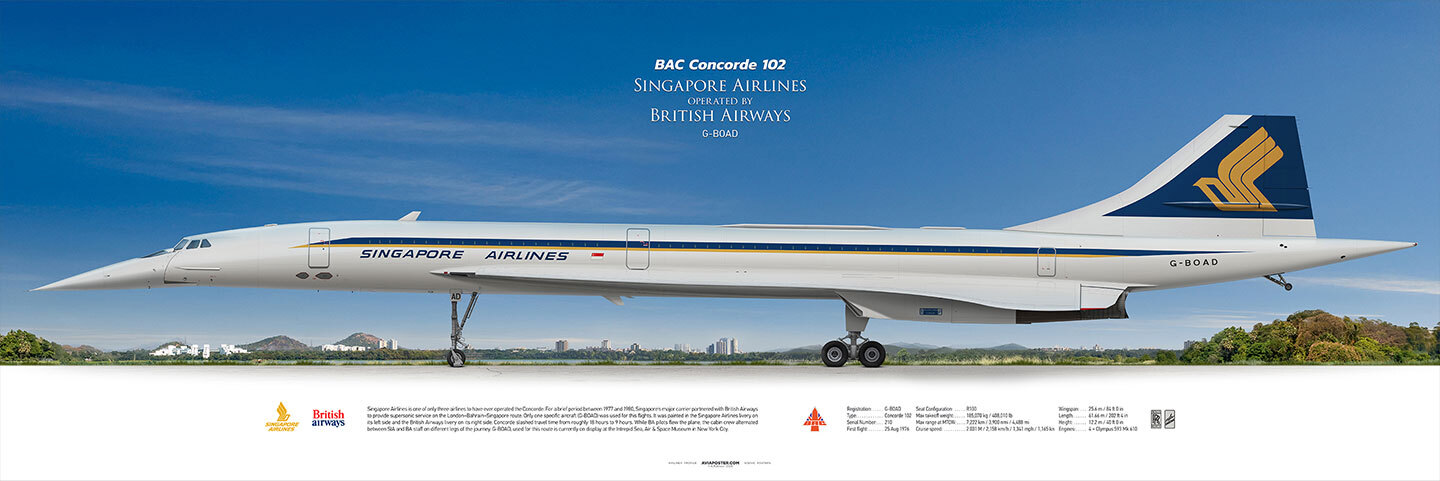
The aircraft chosen for the route — Concorde G-BOAD — became the embodiment of the partnership in the most literal sense. The engineers arrived at a truly Solomonic solution: the left-hand side of the fuselage was painted in the Singapore Airlines livery — yellow and blue stripes and a bird stylised after the Kris (a ritual dagger, a traditional cultural symbol of Singapore) — while the right-hand side retained the British Airways colours. Passengers in Heathrow saw one aircraft; passengers in Singapore saw an entirely different one. Or rather — half a different one.
9 December 1977: The Inaugural Flight
On a winter's morning on 9 December, a festive mood prevailed at London Heathrow. Among the honoured guests on board were the British Minister of Transport and senior representatives of both airlines. The crew comprised British Airways pilots and cabin staff drawn equally from both carriers. Passengers would later confess that the Singapore Airlines flight attendants were a particular highlight.
G-BOAD departed Heathrow and headed south-east. Over Europe — a routine subsonic cruise, unremarkable in every way. But the moment the aircraft reached open sky above the Mediterranean, the captain announced the commencement of acceleration. The machmeter needle crept rightward: Mach 1.0... Mach 1.5... Mach 2.02. Through the windows, the sky darkened from blue to deep indigo — the aircraft had climbed to some 18,000 metres, to the very threshold of the stratosphere. Below, through the haze, the curvature of the Earth's horizon was faintly visible.
A few hours later — a stop in Bahrain. About an hour for refuelling, then back into the sky. The Bahrain–Singapore leg was flown almost entirely at supersonic speeds: the cool, humid tropical air over the Indian Ocean and the Strait of Malacca gave the engines extra thrust, extending the aircraft's range by approximately 300 kilometres. Total journey time from London to Singapore was around 9 hours — compared with 13 to 14 hours on a conventional flight of that era.
The aircraft touched down at Paya Lebar Airport — Singapore's international airport at the time (the present-day Changi would not open until four years later). Singapore greeted it with tropical heat and enthusiastic journalists.
It all seemed to be going wonderfully. It lasted exactly three flights.
The First Crisis: The Malaysian Ban
On 13 December 1977, services were abruptly suspended. The culprit was Malaysia.
The Bahrain–Singapore route inevitably overflew or skirted Malaysian territory, including the Strait of Malacca. The government in Kuala Lumpur withdrew overflight permission, citing "environmental concerns" — the noise of the supersonic shockwave over residential areas. Behind this official pretext, however, lay a straightforwardly pragmatic diplomatic manoeuvre.
The fact was that around the same time, Britain had restricted Malaysian Airlines System's access to London routes — and Malaysia decided to use the Concorde situation as a bargaining chip in negotiations over "fifth freedom rights": the right for its carriers to operate commercial flights from London to third countries. British aviation sources of the day were blunt: "Nonsense, absolute nonsense. The problem is purely political."
Curiously, while the diplomatic row was blazing, G-BOAD — with the Singapore Airlines livery on its left side — was quietly flying to New York and Washington, inadvertently advertising Singapore Airlines to the entire North Atlantic world.
Negotiations reached an impasse, and the route remained closed for over a year.
The Second Crisis: India Closes Its Sky
While British Airways was resolving the Malaysian problem, another obstacle surfaced — the Indian one.
The most direct path from Bahrain to Singapore crossed the Indian subcontinent. India, for its part, refused Concorde the right to fly supersonically over its territory. According to some accounts, New Delhi used the situation to extract additional Heathrow slots for Air India.
A solution was found, but at a steep price: the route had to be rerouted around India — considerably further south, through Indonesian airspace. This added nearly 320 kilometres to the track and approximately 10 minutes of flying time. More significantly, it increased fuel consumption, which was already far from modest for Concorde.
The Resumption: January 1979
Diplomatic efforts eventually bore fruit. On 24 January 1979, services resumed along the new routing, bypassing both Malaysian and Indian airspace through an air corridor over Indonesia.
The route now ran as follows: London (Heathrow) — Bahrain (refuelling stop) — Singapore (Paya Lebar). Subsonic over Europe and part of the Middle East, supersonic over the Arabian Peninsula, then a refuelling stop in Bahrain followed by supersonic cruise once more over the Indian Ocean. Total journey time, including the one-hour ground stop in Bahrain, was around 9 hours.
For passengers, it was a remarkable experience. Kevin Tate, who was fortunate enough to be on one of the route's final flights, described it thus: "I was incredibly lucky — I was on the second-to-last flight from London and the last return. It was the end of the second attempt to make this route work." Passengers sat in narrow but luxuriously appointed four-seat rows (two on each side of the aisle), watching the sky outside deepen to the colour of indigo. Flight attendants from both airlines served champagne and exquisite food. When the aircraft settled into its Mach 2 cruise, the speed displayed on the machmeter above the cabin door became an irresistible photographic subject.
Life on Board: Luxury in Tight Quarters
One of the paradoxical features of Concorde was the striking contrast between its glamorous reputation and the modest dimensions of its cabin. The fuselage measured only about 2.6 metres in diameter — half the width of a Boeing 747. The seats were arranged two abreast on each side of the aisle. The seats themselves resembled modern business class more in price than in size.
The standard of service, however, was impeccable. On the London–Singapore route, both airlines sought to compensate for the snug surroundings with the quality of the food and drink. Krug champagne, lobster, fillet of beef — all served on bone china with silver cutlery. The cabin crew was drawn equally from British Airways and Singapore Airlines, and passengers' recollections consistently single out the Singapore Airlines flight attendants for special praise.
Some seasoned travellers accustomed to the spacious first-class suites of large wide-body jets were less than enthusiastic, however: why pay 15 per cent more than a conventional first-class ticket, they grumbled, for a seat no more comfortable than economy?
When Concorde carried its first passengers in January 1976, the world held its breath. An aircraft capable of crossing the Atlantic in just over three hours seemed the very embodiment of the twentieth century's most audacious technological ambitions. British Airways and Air France — the two carriers operating the Concordes — immediately began competing for the most prestigious routes on the planet.
Yet this triumph had a darker side. Supersonic flight generated a shockwave — that famous sonic boom that rattles windows and startles pets. Most countries closed their airspace to supersonic flight over populated territory, confining Concorde to a narrow corridor of overwater routes. One of the few remaining openings lay to the East — through the Persian Gulf and beyond, towards the tropical seas where the sun rises.
It was there that one of the most gripping and yet almost forgotten chapters in the history of civil aviation would unfold. The story of the London–Singapore route.
Background: The Persian Gulf as a Springboard
Even before Concorde had made its first commercial flight, British Airways was testing the ground for eastward routes. The "Kangaroo Route" — aviation slang for the journey from Britain to Australia — had always been one of the most commercially significant for British carriers. If the journey time could be cut from a gruelling 24 hours on conventional aircraft to 9 or 10 hours on a supersonic one, it would be nothing short of a revolution.
In 1976, British Airways launched regular London–Bahrain services. The route operated three times a week aboard G-BOAA, one of the first production Concordes. Over Europe the aircraft flew subsonically, but the moment it crossed the Mediterranean and headed out over the empty expanses of the Arabian Peninsula, the Rolls-Royce/Snecma Olympus 593 engines were pushed into reheat — and the white arrow broke the sound barrier. Bahrain was in the grip of an oil boom in those years, and wealthy sheikhs could easily afford a ticket priced well above first class on a conventional airliner.
But Bahrain was only the first step. British Airways was looking further — towards Singapore, Sydney and Tokyo. To reach those cities, it needed a partner.
Singapore Airlines Enters the Game
By the mid-1970s Singapore Airlines was a very young company, having been founded only in 1972 following the split from Malaysian Airlines System. Its ambitions, however, were enormous. The airline's management understood perfectly well: a joint Concorde service was not merely a transport operation — it was a prestige project of colossal proportions. Singapore was rapidly becoming a financial hub of Asia, and the launch of its own supersonic service would send an unmistakable signal to the world: this small island-state was playing in the premier league.
In November 1976, negotiations between British Airways and the Singapore government entered their final straight. The arrangement was elegantly simple — one aircraft, one route, two carriers — on a revenue-and-cost-sharing basis. Singapore Airlines would take 20 seats on each flight; British Airways the remaining 80. The formal agreement was signed in October 1977: services would operate three times a week on the London–Bahrain–Singapore route.
The aircraft chosen for the route — Concorde G-BOAD — became the embodiment of the partnership in the most literal sense. The engineers arrived at a truly Solomonic solution: the left-hand side of the fuselage was painted in the Singapore Airlines livery — yellow and blue stripes and a bird stylised after the Kris (a ritual dagger, a traditional cultural symbol of Singapore) — while the right-hand side retained the British Airways colours. Passengers in Heathrow saw one aircraft; passengers in Singapore saw an entirely different one. Or rather — half a different one.
9 December 1977: The Inaugural Flight
On a winter's morning on 9 December, a festive mood prevailed at London Heathrow. Among the honoured guests on board were the British Minister of Transport and senior representatives of both airlines. The crew comprised British Airways pilots and cabin staff drawn equally from both carriers. Passengers would later confess that the Singapore Airlines flight attendants were a particular highlight.
G-BOAD departed Heathrow and headed south-east. Over Europe — a routine subsonic cruise, unremarkable in every way. But the moment the aircraft reached open sky above the Mediterranean, the captain announced the commencement of acceleration. The machmeter needle crept rightward: Mach 1.0... Mach 1.5... Mach 2.02. Through the windows, the sky darkened from blue to deep indigo — the aircraft had climbed to some 18,000 metres, to the very threshold of the stratosphere. Below, through the haze, the curvature of the Earth's horizon was faintly visible.
A few hours later — a stop in Bahrain. About an hour for refuelling, then back into the sky. The Bahrain–Singapore leg was flown almost entirely at supersonic speeds: the cool, humid tropical air over the Indian Ocean and the Strait of Malacca gave the engines extra thrust, extending the aircraft's range by approximately 300 kilometres. Total journey time from London to Singapore was around 9 hours — compared with 13 to 14 hours on a conventional flight of that era.
The aircraft touched down at Paya Lebar Airport — Singapore's international airport at the time (the present-day Changi would not open until four years later). Singapore greeted it with tropical heat and enthusiastic journalists.
It all seemed to be going wonderfully. It lasted exactly three flights.
The First Crisis: The Malaysian Ban
On 13 December 1977, services were abruptly suspended. The culprit was Malaysia.
The Bahrain–Singapore route inevitably overflew or skirted Malaysian territory, including the Strait of Malacca. The government in Kuala Lumpur withdrew overflight permission, citing "environmental concerns" — the noise of the supersonic shockwave over residential areas. Behind this official pretext, however, lay a straightforwardly pragmatic diplomatic manoeuvre.
The fact was that around the same time, Britain had restricted Malaysian Airlines System's access to London routes — and Malaysia decided to use the Concorde situation as a bargaining chip in negotiations over "fifth freedom rights": the right for its carriers to operate commercial flights from London to third countries. British aviation sources of the day were blunt: "Nonsense, absolute nonsense. The problem is purely political."
Curiously, while the diplomatic row was blazing, G-BOAD — with the Singapore Airlines livery on its left side — was quietly flying to New York and Washington, inadvertently advertising Singapore Airlines to the entire North Atlantic world.
Negotiations reached an impasse, and the route remained closed for over a year.
The Second Crisis: India Closes Its Sky
While British Airways was resolving the Malaysian problem, another obstacle surfaced — the Indian one.
The most direct path from Bahrain to Singapore crossed the Indian subcontinent. India, for its part, refused Concorde the right to fly supersonically over its territory. According to some accounts, New Delhi used the situation to extract additional Heathrow slots for Air India.
A solution was found, but at a steep price: the route had to be rerouted around India — considerably further south, through Indonesian airspace. This added nearly 320 kilometres to the track and approximately 10 minutes of flying time. More significantly, it increased fuel consumption, which was already far from modest for Concorde.
The Resumption: January 1979
Diplomatic efforts eventually bore fruit. On 24 January 1979, services resumed along the new routing, bypassing both Malaysian and Indian airspace through an air corridor over Indonesia.
The route now ran as follows: London (Heathrow) — Bahrain (refuelling stop) — Singapore (Paya Lebar). Subsonic over Europe and part of the Middle East, supersonic over the Arabian Peninsula, then a refuelling stop in Bahrain followed by supersonic cruise once more over the Indian Ocean. Total journey time, including the one-hour ground stop in Bahrain, was around 9 hours.
For passengers, it was a remarkable experience. Kevin Tate, who was fortunate enough to be on one of the route's final flights, described it thus: "I was incredibly lucky — I was on the second-to-last flight from London and the last return. It was the end of the second attempt to make this route work." Passengers sat in narrow but luxuriously appointed four-seat rows (two on each side of the aisle), watching the sky outside deepen to the colour of indigo. Flight attendants from both airlines served champagne and exquisite food. When the aircraft settled into its Mach 2 cruise, the speed displayed on the machmeter above the cabin door became an irresistible photographic subject.
Life on Board: Luxury in Tight Quarters
One of the paradoxical features of Concorde was the striking contrast between its glamorous reputation and the modest dimensions of its cabin. The fuselage measured only about 2.6 metres in diameter — half the width of a Boeing 747. The seats were arranged two abreast on each side of the aisle. The seats themselves resembled modern business class more in price than in size.
The standard of service, however, was impeccable. On the London–Singapore route, both airlines sought to compensate for the snug surroundings with the quality of the food and drink. Krug champagne, lobster, fillet of beef — all served on bone china with silver cutlery. The cabin crew was drawn equally from British Airways and Singapore Airlines, and passengers' recollections consistently single out the Singapore Airlines flight attendants for special praise.
Some seasoned travellers accustomed to the spacious first-class suites of large wide-body jets were less than enthusiastic, however: why pay 15 per cent more than a conventional first-class ticket, they grumbled, for a seat no more comfortable than economy?
Facts and Figures
The London–Bahrain–Singapore route had a number of technical characteristics that made it unique even by Concorde's standards.
Distance and time. The total route distance was approximately 11,000 kilometres. Including the one-hour stop in Bahrain, journey time was around 9 hours — compared with 13 to 14 hours on a conventional Boeing 747 of that era. Block-to-block flying time was approximately 8 hours.
Cruise parameters. On the supersonic segments, the aircraft cruised at 17,000 to 18,000 metres at Mach 2.02, equivalent to approximately 2,160 km/h. By comparison, a conventional airliner cruises at 10,000 to 12,000 metres at around 900 km/h.
Route characteristics. The tropical air over the Indian Ocean gave Concorde's engines extra thrust. Engineers calculated that the cool, humid air between Bahrain and Singapore extended the aircraft's range by approximately 300 kilometres for the same fuel load.
Ticket price. A one-way ticket from London to Singapore cost £1,330 — an enormous sum by the standards of the late 1970s.
The aircraft. The route was served by a single airframe — G-BOAD — the very aircraft that entered aviation history thanks to its twin livery.
The Aircraft with Two Faces
Concorde G-BOAD deserves a chapter of its own.
The aircraft was delivered in 1976 and initially operated on transatlantic routes. For the Singapore project it was specially repainted: the left-hand (port) side received the Singapore Airlines livery — a blue stripe running the length of the fuselage and a golden bird on the tail — while the right-hand (starboard) side retained the "Negus" British Airways livery — blue, white and grey — designed by Negus & Negus.
This detail produced a delightful footnote: a Singaporean twenty-dollar banknote featured an illustration of the aircraft — but the artist had drawn the Singapore Airlines livery on the wrong side.
G-BOAD held another distinction: it was the first aircraft in history to carry 100 passengers at supersonic speed — during a test flight, prior to the launch of regular services.
The aircraft's subsequent fate was a happy one: after retiring from commercial service in 2003, it was donated to the Intrepid Sea, Air & Space Museum in New York, where it stands to this day. The Singapore Airlines livery, however, has since been painted over — both sides of the fuselage now carry British Airways colours.
1 November 1980: The End of the Route
The service, resumed in 1979, lasted a further 20 months. On 1 November 1980, it was permanently discontinued.
There were several reasons, each compounding the others. First and foremost — economics. The route was losing an estimated £2 million to £2.5 million a year. On average only around 50 of the 100 seats were filled. The picture was uneven: eastbound flights from London performed better, while westbound services from Singapore suffered from chronically low load factors.
Second, operational complexity. The rerouting through Indonesian airspace demanded extra fuel and complicated scheduling. During the hot months, temperatures in Bahrain frequently exceeded the permitted take-off parameters for a fully loaded aircraft, limiting the number of passengers and the amount of cargo that could be carried.
Third, competition from the North Atlantic. By 1979 and 1980, the London–New York and London–Washington routes had become enormously profitable for British Airways: wealthy American business travellers were happy to pay for the privilege of crossing the Atlantic in three and a half hours. The more aircraft were required on the Atlantic, the fewer remained available for the exotic eastern venture.
Finally, there were the plans that never came to pass. The original vision had been for Singapore to serve as a staging post: Concorde was then to continue to Melbourne and Sydney. Australia, however, refused overflight permission, shielding Qantas from competition. Without the Australian "tail" the route lost much of its appeal.
The final flight was operated by the same G-BOAD. A journalist present at the farewell departure from Singapore described an almost elegiac atmosphere: a few dozen passengers, a little champagne, a little sadness.
The Future That Never Was
Had the route proved profitable, an ambitious continuation awaited it. The plans included:
- Extension to Melbourne and Sydney (the true Kangaroo Route);
- Short-haul supersonic services: Singapore–Hong Kong (90 minutes instead of the usual 4 hours);
- Singapore–Tokyo (3 hours instead of 7);
- Singapore–Manila;
- Singapore–Seoul.
Imagine it: a supersonic aircraft shuttling between Asia's financial capitals like a high-speed commuter train between suburbs. The story of this unrealised future is one of the most compelling "what ifs" in aviation history.
Legacy: What Remains of the "Twin Livery"
The London–Singapore route operated for approximately 20 months of net flying time — three flights in December 1977, plus January 1979 through November 1980. By the standards of aviation history, a fleeting episode. And yet the mark it left is disproportionately large.
First: it was the first scheduled commercial supersonic service to South-East Asia in history. No second has followed to this day, and none seems likely in the near future.
Second: the route demonstrated that political barriers are a far higher obstacle for supersonic aviation than technical ones. Concorde flew — reliably, safely and fast. But India, Malaysia and Australia each in turn closed their skies to it, not because the aircraft was deficient, but because each country had its own diplomatic and economic grievances against Britain.
Third: G-BOAD's twin livery became perhaps the most extraordinary example of collaboration in the history of aviation design. The photographs of that aircraft — with a golden Singaporean bird on the left and British blue on the right — are among the most recognisable images in world aviation history. It is worth noting that the same solution — two liveries, one on each side — was repeated years later, in 1998, by the Northwest Airlines–KLM alliance. But G-BOAD was first.
For Singapore Airlines, the route carried enormous symbolic weight. A young carrier from a small nation barely five years old had taken its place alongside the giants of world aviation — British Airways and Air France. That experience, in the view of many analysts, laid the foundations for the reputation Singapore Airlines would go on to earn over the following decades as one of the finest airlines in the world.
Epilogue: Is Supersonic Coming Back?
Concorde retired for good in October 2003 — following the crash of Air France Flight 4590 in 2000, the sharp collapse in demand after the September 11 attacks, and the relentless rise in operating costs.
Today, several companies — Boom Supersonic, Aerion, Spike Aerospace — are working on a new generation of supersonic airliners. Some projects are aimed squarely at transpacific routes, including services to Asia. The technology has moved on: modern engines are far more fuel-efficient, and new aerodynamic approaches can reduce the intensity of the sonic boom to levels acceptable for flight over populated areas.
Perhaps one day a supersonic aircraft will once again take up the London–Singapore route. This time it may fly even faster — and without the political scandals.
But the story that played out in the skies above the Persian Gulf and the Indian Ocean in the late 1970s will remain unique forever: a bold experiment by two airlines, a white arrow with two faces, a bird on the left side, and nine hours of supersonic flight into a future that never arrived.
Concorde G-BOAD deserves a chapter of its own.
The aircraft was delivered in 1976 and initially operated on transatlantic routes. For the Singapore project it was specially repainted: the left-hand (port) side received the Singapore Airlines livery — a blue stripe running the length of the fuselage and a golden bird on the tail — while the right-hand (starboard) side retained the "Negus" British Airways livery — blue, white and grey — designed by Negus & Negus.
This detail produced a delightful footnote: a Singaporean twenty-dollar banknote featured an illustration of the aircraft — but the artist had drawn the Singapore Airlines livery on the wrong side.
G-BOAD held another distinction: it was the first aircraft in history to carry 100 passengers at supersonic speed — during a test flight, prior to the launch of regular services.
The aircraft's subsequent fate was a happy one: after retiring from commercial service in 2003, it was donated to the Intrepid Sea, Air & Space Museum in New York, where it stands to this day. The Singapore Airlines livery, however, has since been painted over — both sides of the fuselage now carry British Airways colours.
1 November 1980: The End of the Route
The service, resumed in 1979, lasted a further 20 months. On 1 November 1980, it was permanently discontinued.
There were several reasons, each compounding the others. First and foremost — economics. The route was losing an estimated £2 million to £2.5 million a year. On average only around 50 of the 100 seats were filled. The picture was uneven: eastbound flights from London performed better, while westbound services from Singapore suffered from chronically low load factors.
Second, operational complexity. The rerouting through Indonesian airspace demanded extra fuel and complicated scheduling. During the hot months, temperatures in Bahrain frequently exceeded the permitted take-off parameters for a fully loaded aircraft, limiting the number of passengers and the amount of cargo that could be carried.
Third, competition from the North Atlantic. By 1979 and 1980, the London–New York and London–Washington routes had become enormously profitable for British Airways: wealthy American business travellers were happy to pay for the privilege of crossing the Atlantic in three and a half hours. The more aircraft were required on the Atlantic, the fewer remained available for the exotic eastern venture.
Finally, there were the plans that never came to pass. The original vision had been for Singapore to serve as a staging post: Concorde was then to continue to Melbourne and Sydney. Australia, however, refused overflight permission, shielding Qantas from competition. Without the Australian "tail" the route lost much of its appeal.
The final flight was operated by the same G-BOAD. A journalist present at the farewell departure from Singapore described an almost elegiac atmosphere: a few dozen passengers, a little champagne, a little sadness.
The Future That Never Was
Had the route proved profitable, an ambitious continuation awaited it. The plans included:
- Extension to Melbourne and Sydney (the true Kangaroo Route);
- Short-haul supersonic services: Singapore–Hong Kong (90 minutes instead of the usual 4 hours);
- Singapore–Tokyo (3 hours instead of 7);
- Singapore–Manila;
- Singapore–Seoul.
Imagine it: a supersonic aircraft shuttling between Asia's financial capitals like a high-speed commuter train between suburbs. The story of this unrealised future is one of the most compelling "what ifs" in aviation history.
Legacy: What Remains of the "Twin Livery"
The London–Singapore route operated for approximately 20 months of net flying time — three flights in December 1977, plus January 1979 through November 1980. By the standards of aviation history, a fleeting episode. And yet the mark it left is disproportionately large.
First: it was the first scheduled commercial supersonic service to South-East Asia in history. No second has followed to this day, and none seems likely in the near future.
Second: the route demonstrated that political barriers are a far higher obstacle for supersonic aviation than technical ones. Concorde flew — reliably, safely and fast. But India, Malaysia and Australia each in turn closed their skies to it, not because the aircraft was deficient, but because each country had its own diplomatic and economic grievances against Britain.
Third: G-BOAD's twin livery became perhaps the most extraordinary example of collaboration in the history of aviation design. The photographs of that aircraft — with a golden Singaporean bird on the left and British blue on the right — are among the most recognisable images in world aviation history. It is worth noting that the same solution — two liveries, one on each side — was repeated years later, in 1998, by the Northwest Airlines–KLM alliance. But G-BOAD was first.
For Singapore Airlines, the route carried enormous symbolic weight. A young carrier from a small nation barely five years old had taken its place alongside the giants of world aviation — British Airways and Air France. That experience, in the view of many analysts, laid the foundations for the reputation Singapore Airlines would go on to earn over the following decades as one of the finest airlines in the world.
Epilogue: Is Supersonic Coming Back?
Concorde retired for good in October 2003 — following the crash of Air France Flight 4590 in 2000, the sharp collapse in demand after the September 11 attacks, and the relentless rise in operating costs.
Today, several companies — Boom Supersonic, Aerion, Spike Aerospace — are working on a new generation of supersonic airliners. Some projects are aimed squarely at transpacific routes, including services to Asia. The technology has moved on: modern engines are far more fuel-efficient, and new aerodynamic approaches can reduce the intensity of the sonic boom to levels acceptable for flight over populated areas.
Perhaps one day a supersonic aircraft will once again take up the London–Singapore route. This time it may fly even faster — and without the political scandals.
But the story that played out in the skies above the Persian Gulf and the Indian Ocean in the late 1970s will remain unique forever: a bold experiment by two airlines, a white arrow with two faces, a bird on the left side, and nine hours of supersonic flight into a future that never arrived.